Featured

My own first steps.

“Yes, 4am is a good time to get up”- Me, 2016, 2017, 2018, 2019….

I suppose, I should talk about my first intrepid steps into doing things like this. I started doing vaguely ambitious trips within the UK in around 2015. I remember my mum saying to me that once I was 16 I’d be allowed to get off on my own to different places, and I suppose I held her to her word in that respect.

London was always the place that seemed to be the big ‘no’. Because, as parents are, they irrationally worry about things and my mum was convinced I’d be blown up as soon as I stepped onto the platform at King’s Cross. However, me being me, I went a solid half dozen times before she realised that I’d been at all. I survived! I didn’t really know fear in that sense, I suppose. Sure, I got anxious sometimes and was cripplingly anxious about so many other things in life, but I don’t think booking a train, jumping on it, and going to the other end of the country has ever fazed me.

Sure enough, by 17, I had a two-week-long All Lines pass and was away for most of it basking in glorious Devon sunshine, wandering down the Avon canal and getting pissed on with rain the Welsh Valleys. I didn’t use hotels all that often, and for six nights I slept on the seats of the Night Riviera between London and Plymouth, having a full day out, leaving London at midnight, getting myself into Plymouth for 5:30 and being back in London for 9. Sleep at times was seemingly optional, and I have no idea how I did what I did, as even these days at the ripe age of 20, I need to have my head down on a bed at night if I can help it!
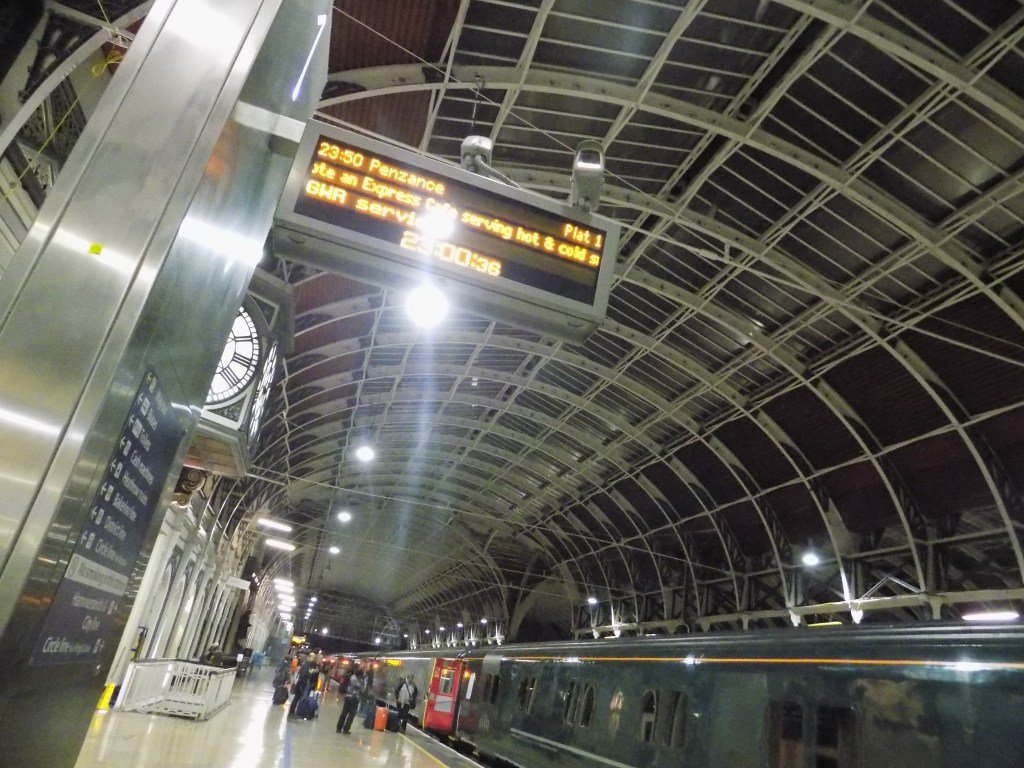
The following year (2017), I did much the same thing, except I realised that one night on the seats of the Riviera was one night too many. I was also a little more social, taking one of my now friends (at the time I’d been speaking to her for about a week on Twitter) on a guided tour of the attractions of London.

And, continuing the London-centric theme, I started off one morning in London, took an early train to Norwich, met a friend, took her back to London for a tour then deposited her back in Norwich where I also collapsed in a hotel bed. It went well, but it was here that I also that I also realised that I was in fact fallible as I woke up an hour late, and ended up diving out of bed, throwing my hotel key at reception (not literally) and sprinting across the Circle Line at rush hour to grab the first Norwich train I could. I thankfully managed to meet her without much drama and just about kept up my reputation as a wonderful tour guide (thanks Cat). At least all those times navigating the tube came in handy.

It was shortly after that I broke through to pastures new, and pastures that continue to fulfill me to this day. I headed off to the wider continent. It was a bit of a last minute decision and set me back £99, but it was certainly a defining moment when I booked the Eurostar to Brussels. The first and hopefully last time that I pay full price for said train. Even at 18, where I’m a legal adult, that still felt like the rebellious teenager in me protruding outwards as I slipped onto the 06:47 to Bruxelles-Midi, my parents blissfully unaware as they basked in some Mallorcan sunshine. My little trip to Belgium went off without any drama, but there was one small problem with it.
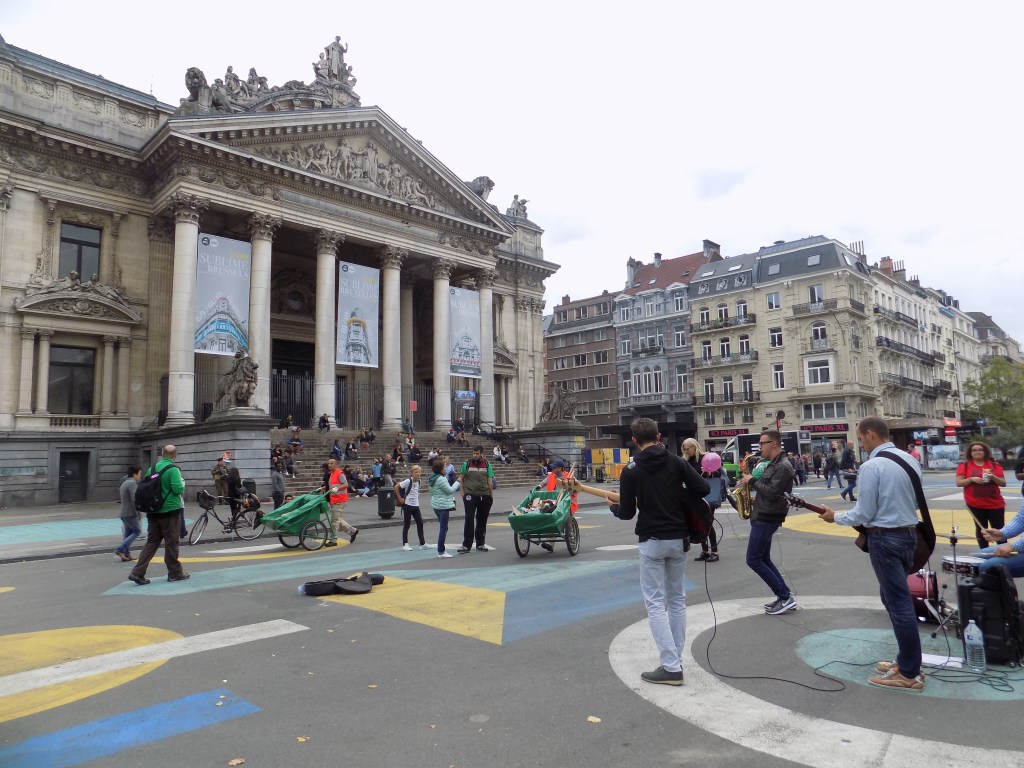
I was a bit hooked.

I’d only been in university for a couple of weeks before I suddenly decided that £56 return flights to Hamburg for the following week were incredibly tempting, so I booked away and went for an Ibis Budget off the Reeperbahn. It actually started off quite well, as I splashed out on the Airport lounge and sipped back some wine before sauntering onto what was a pretty empty plane, managing to lie across an entire row while doing some shorthand (blissful memories eh) and landing a little after 11pm in a very quiet Hamburg Airport. I then hit a slightly major problem: my phone coverage didn’t work. I ended up getting pretty irate at Virgin on Twitter via the Airport WiFi as it turns out I should have told in advance to activate the EU roaming. I ended up screenshotting directions to my hotel and jumping on the next S-Bahn into the city.
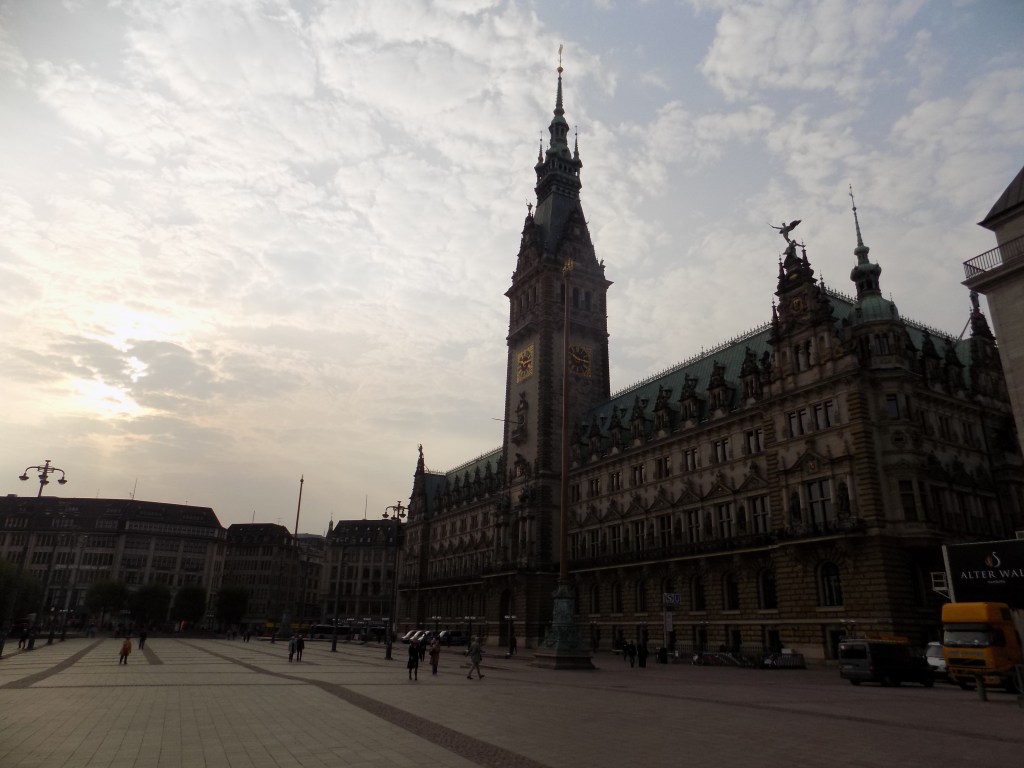
I can’t lie, I was somewhat shitting bricks and it was my first true taste of being alone in a foreign country for more than a day trip. Anxiety levels were a little through the roof as I managed to get my friend Chris to text my parents and let them know all was okay (maybe not quite that I was having a Wednesday night in Hamburg) before I managed to navigate my way past a few rather happy drunks and into my hotel room. I was tired, my ears were bust from flying while a bit ill, and I was wondering what the hell I’d got myself into.

Yet, I woke up at 6am the next day, wandered up to the ticket machine at St Pauli station, and set off on a trip around the sights of Hamburg, Google Maps downloaded in preparation, and had a bloody good day. I hopped on the plane back feeling dead proud of myself that evening, and recall landing back in Manchester around 10pm, and making a lass on Tinder quite irate that I wasn’t going to then go straight to Huddersfield to see her (And miss 8am shorthand? Never!)

Soon after, I was a little more hooked. I booked two trips abroad for January 2018 and was soon on my way to the Netherlands. That actually went quite well, aside from when I placed my Interrail pass in the wrong pocket and ended up at a police station in Den Haag claiming it had been stolen having told my sob story of how my ticket was ‘lost’ to two conductors, everyone in the ticket office and two police officers. Thankfully (?!) the police officer sent me away as she couldn’t help and as I was walking back to Den Haag Centraal, I checked the only pocket I hadn’t already. What a prat. Other than that, I can’t say that my foraying went off without any sort of hitch. I got myself exploring Amsterdam, Berlin and Brussels and was having the absolute time of my life.
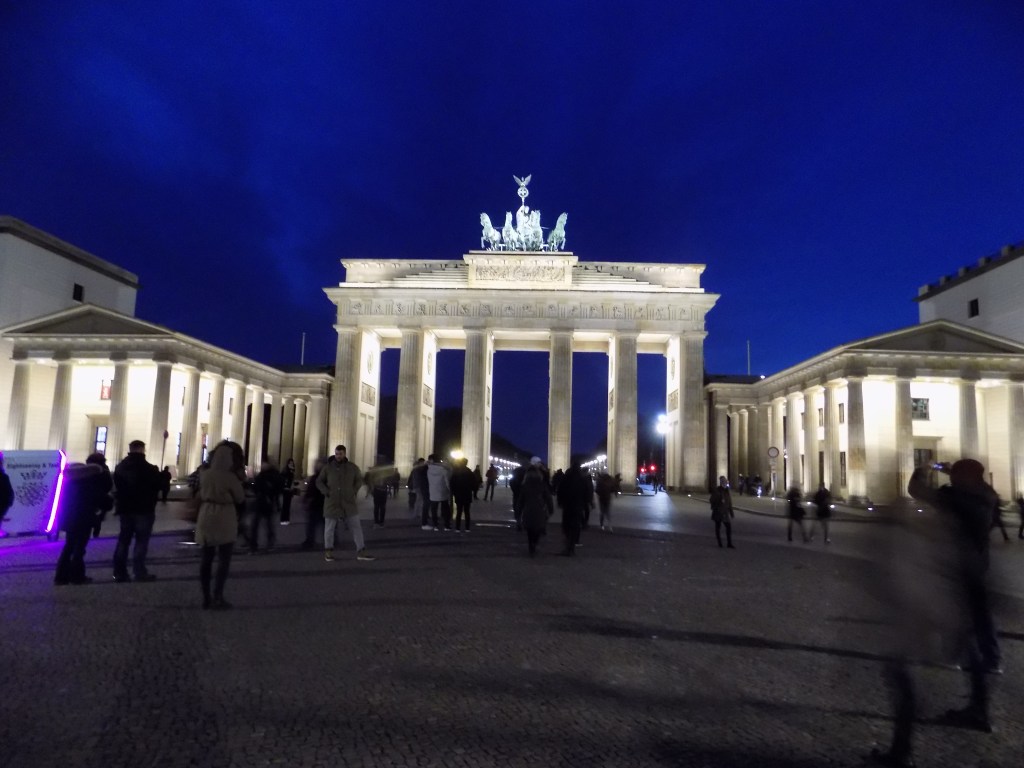
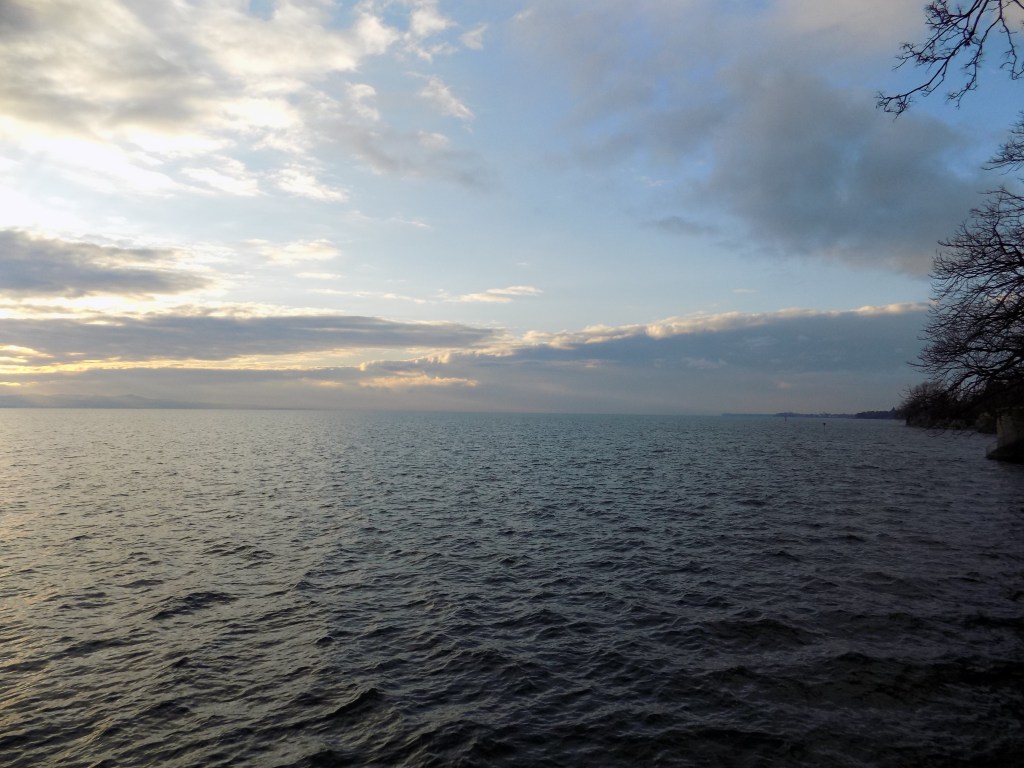
One of the nuttiest trips I did was shortly after. I’d just finished the exams in February and had booked a very cheap return flight to Frankfurt followed by a 44 euro ticket that would let me travel anywhere in Germany provided I didn’t want to use the ICE trains. I questioned my sanity a little as I joined the 04:53 to Aschaffenburg, considering maybe going to Nuremberg if I felt like it. Anyways, 13 hours and a visit to Nuremberg and Munich later, I was freezing my tits off in Lindau on the shores of the Bodensee, looking directly at Switzerland. I had ended up finding some rather deep snow and was having an absolute ball. I maintain that view from the island town of Lindau across the lake to be one of the best I’ve seen. I didn’t get back to Frankfurt until gone 1am, having had a rather unfortunate incident in Stuttgart Hbf where I slid on some piss while running for a train and nearly collided with a rather angry man.
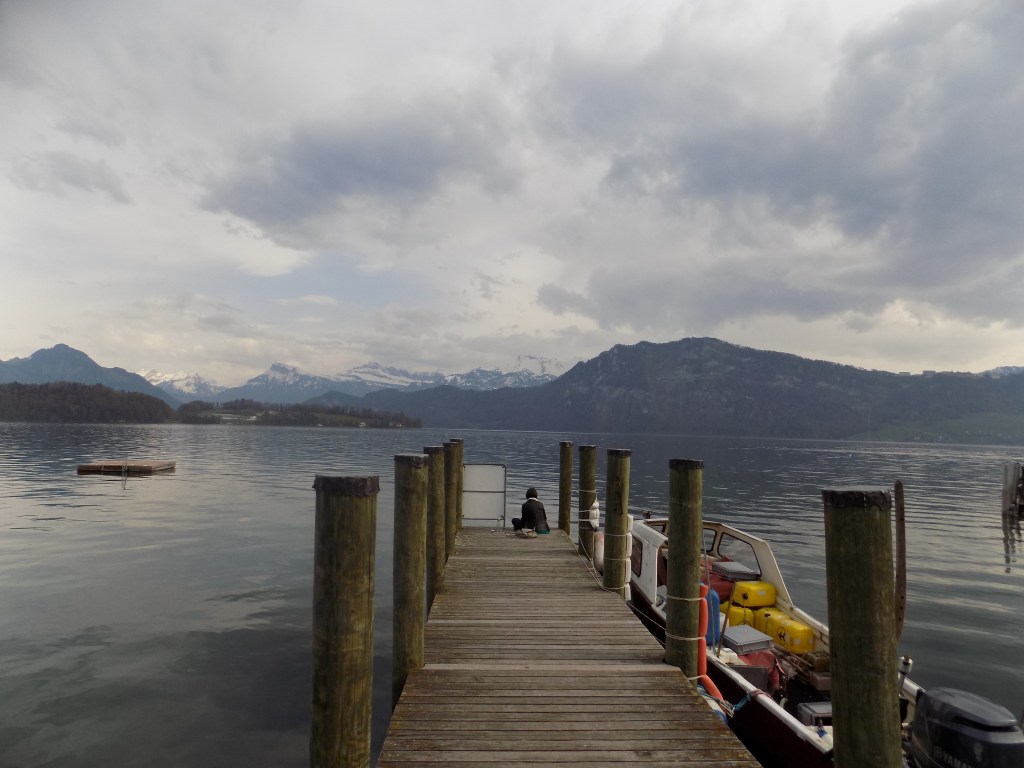
I then discovered the issue with booking very cheap flights and having to deal with everything else later. Stansted to Basel is £9.99 each way. Everything else is not. By the time I’d booked a Megabus to London for a tenner, Premier Inn for £45, hotels in Switzerland for £200, travel there for £100, and yeah you see where this going, don’t you? I also learned here that Stansted Airport is the absolute worst and is to be avoided at all damned costs. Everything however ended up going smoothly until I reached my hotel and realised that my adapter didn’t fit in the socket. The hotel ended up letting me borrow one and every time I attempted to return it the reception was closed! So there it sits on my shelf to this day.

I can’t lie, Switzerland is in a league of its own. Sure, it is genuinely expensive but the scenery and quality of life there are incredible. Everywhere I went was absolutely gorgeous. Even unassuming suburban railways would suddenly dive into the face of a mountain and emerge hugging a lake. A decent recommendation for Switzerland would be staying in Konstanz (far south of Germany) and commuting in each day. I did this the second time I went, paid £150 for five nights in the Ibis, and could have walked over the border in 20 minutes. That said, some of my days are tantamount to masochism, as I would frequently get the 5:09 to Zurich which meant waking up at about 4:30 and walking to the station in the bitter January cold with a biting wind off the lake. Probably not quite sipping champagne in St Moritz.
But then it was time for something big. I had planned a 22 day Interrail and was going to stray away from the easy countries like Germany. I fancied a challenge. Hungary, Slovakia, Slovenia, Czechia, all entered the list as I intricately listed off my planned journeys and where I wanted to go. Soon enough, I was on a flight to Stockholm Skavsta, on the bus to the centre and wondering once again what I’d got myself into. Slowly but surely, I found my feet and wandered around the city, taking in the sights and had myself two days before I was on the sleeper train down to Malmo.

Here, things got fast paced. I set off for Copenhagen before reaching the familiarity of Germany and heading towards Dresden. Then, I started to feel nervous again as we crossed to the Czech Republic and everything seemed a bit different. The trains were a bit more rickety, less people spoke English, and the whole feeling wasn’t quite so polished. On arriving at Prague’s main station, an angry man tried to headbutt me in the subway for no reason at all. I can’t say that was the introduction I was after.

Thankfully though, after a few days, I started to find the quirks of Central Europe part of the fun of travelling, and enjoyed taking the slow train, relying on smiles and hand signals with the token few words of Czech/Slovak to communicate, and of course how much cheaper everything was. Of course, never mention this to people in these countries as their wages are in fact accordingly lower so you’ll just seem like an ignorant prat. I still made a few errors though- I once jumped off at a station on the outskirts of Bratislava and on being unable to see which side the platform was on (they’re a bit lower this part of the world), I got off straight onto the tracks. Thankfully, in a world of common sense, I gave the driver a thumbs up and stepped back to let the thing leave so I wasn’t flattened.
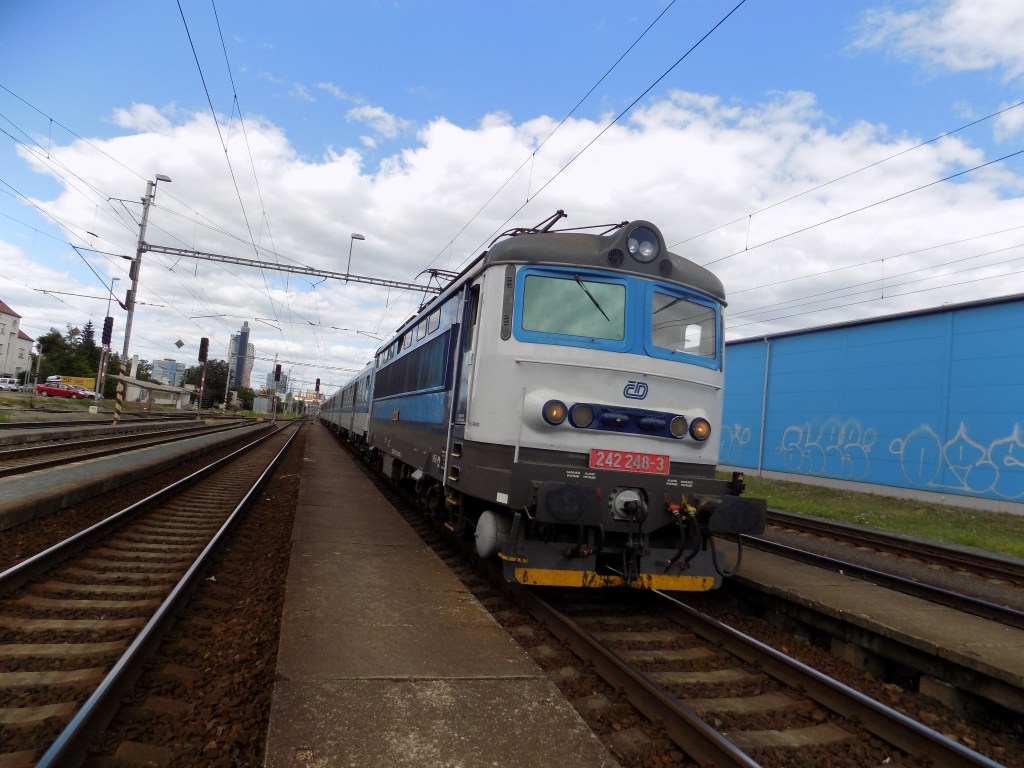
Nothing actually went that wrong until I got to the north of Spain and we had a bus replacement on this rather infrequent and adorably tiny railway line. Thing was, the bus was somewhat of an imaginary one! This was all of my travel anxieties rolled into one and I wanted to curl into a small ball. That was, until a group of French backpackers and their dog, Luna, got talking to me and we decided to keep strength in numbers. We managed to argue our way into a taxi which took us some of the way before a train picked us up. But the whole experience went from hell to heaven, as I had a can of beer chucked my way and one bloke got his kazoo out to play the French national anthem. We ended up sat in my hotel drinking cheap red wine until the small hours.

And there, I suppose I reached the pinnacle of travelling solo, and wasn’t much of a newbie anymore.

Of course, the story continues.
On Bucharest, Palaces and Metro Stations

Bucharest has a bit of a reputation. That is a reputation for being a grey, dull, Communist-era shithole with very little to give the average tourist. Yet, having developed a fascination with the Ceaușescu regime and its impact upon Romania and its people when studying the revolution of 1989, I was drawn to it for some reason. Naturally, in June 2022, I tacked a visit to the Romanian capital onto an Italian foray. Who wouldn’t when the flight was only 29 euros, right?

The flight to Bucharest Otopeni was pretty uneventful. Rome Ciampino was a hellhole of an Airport, being tiny and having next-to-nothing to offer anyone. Granted, there were works going on, but just one cafe, really? The most exciting part was when I ignored the automatic passport gates and woke up the half-asleep passport control officer so he would stamp me out of the Schengen area. I got ready to don my (very uncomfortable, in 35-degree temperatures) FFP2 mask but soon realised that nobody on the plane gave a toss. Even the cabin crew weren’t bothered. With that, I took my window seat and drifted in and out of sleep for the 90 minutes or so over to Bucharest.

I was expecting somewhat of a sterner welcome into Bucharest for some reason. Instead, the passport officer smiled at me and asked where I’d come from, before stamping the passport and sending me on my way. This was actually the same when I left the country by train, in that Romanian border guards are exceptionally friendly. I was left to dodge the rain instead and locate the railway station, which has recently opened in the past couple of years.

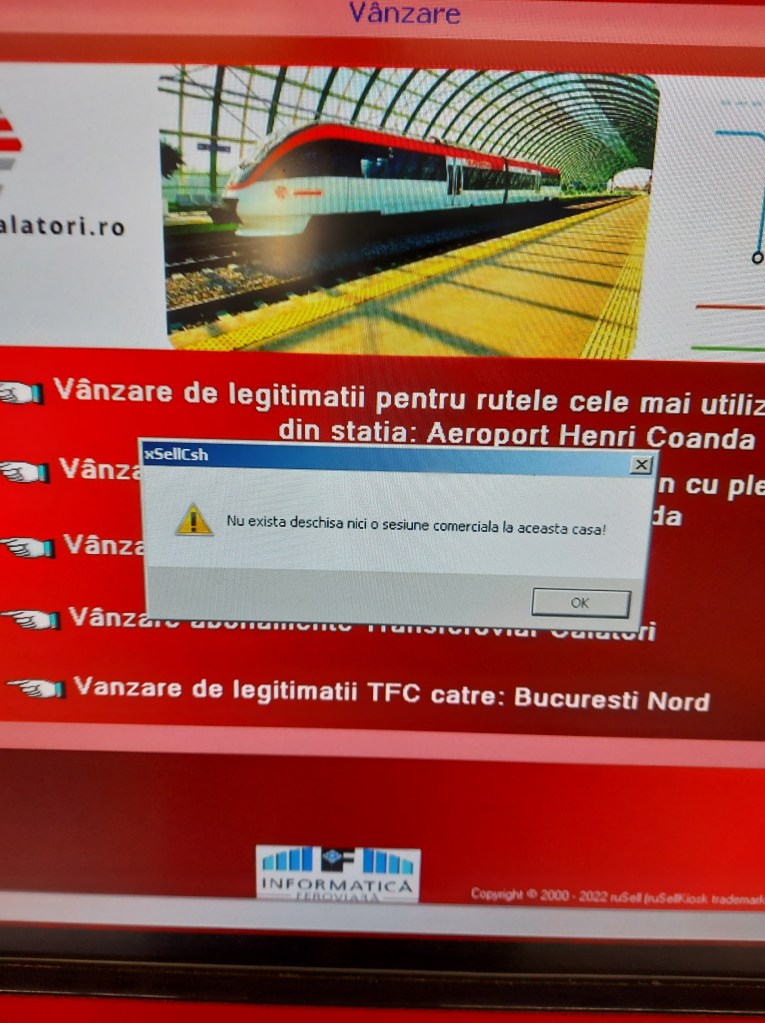
The service operates every 40 minutes but is a haphazard combination of the state operator, CFR Calatori, and private operator Transferoviar Calatori. You’ll find separate ticket machines for each, though the one for TFC appeared to work on some bodged version of Windows 95 and was incapable of doing anything other than screaming error messages. Thankfully, the displays at the station informed everyone that tickets were to be purchased on board the train.
TAKE MY MONEY PLEASE

The train itself was fairly modern, secondhand from the German operator Regiobahn. In fact, I’d travelled on this exact train in its previous life between Duesseldorf and Kaarster See when it was plying the S28 line. On boarding, there was some sort of weird validator that you’d tap a bank card or phone onto, and it would deduct the fare. I had a go, and sure enough, the light went green.

Naturally, the conductor had absolutely no way of checking whether anyone had done this, and he didn’t speak English either. For some daft reason, I decided to try and demonstrate what I’d done by slapping the back of my phone, which was likely interpreted as me wanting to slap his arse. Thankfully, Google Translate came to the rescue and he took my word that I’d paid the whole £0.71 for the journey to Bucharest Nord. The journey took around half an hour, with two stops along the way. Most amusingly, we stopped at one station which had no lighting and barely any platform surface, but a very flashy departure board that lit up the entire vicinity.

Bucharest’s North Station isn’t exactly going to win any design awards, being a row of rather dirty platforms attached to a windswept concourse and a motley collection of kiosks and outlets. I ended up slipping out of a side entrance and set Google Maps for my hotel around 15 minutes walk away.
It was all just a bit creepy, to be honest. Like, even at 10:30pm in a capital city, you’d expect some signs of life. Instead, I was ducking under trees over cracked paving stones to the flickers of neon lights above closed sex shops. Even the roads were completely empty. Like, surely at least somebody had a reason to be somewhere? Especially on a Friday night. I eventually found my hotel, and it was a similar story, with the receptionist being delighted that a live human being had stumbled through the doors.

I ended my day by flopping into bed and realising that some fucking mosquito had decided to leave me with a nice lump on my hand. So, correction, I ended my day by Googling the nearest Pharmacy.

I didn’t rise particularly early the next morning, peeling myself out of bed at around 9am. The weather outside was drab, with big lazy drops of rain running down the windows of the hotel restaurant. Eventually, I decided to brave it and set the directions for the nearest Metro station, which was pressing more towards the suburbs than the actual city centre.

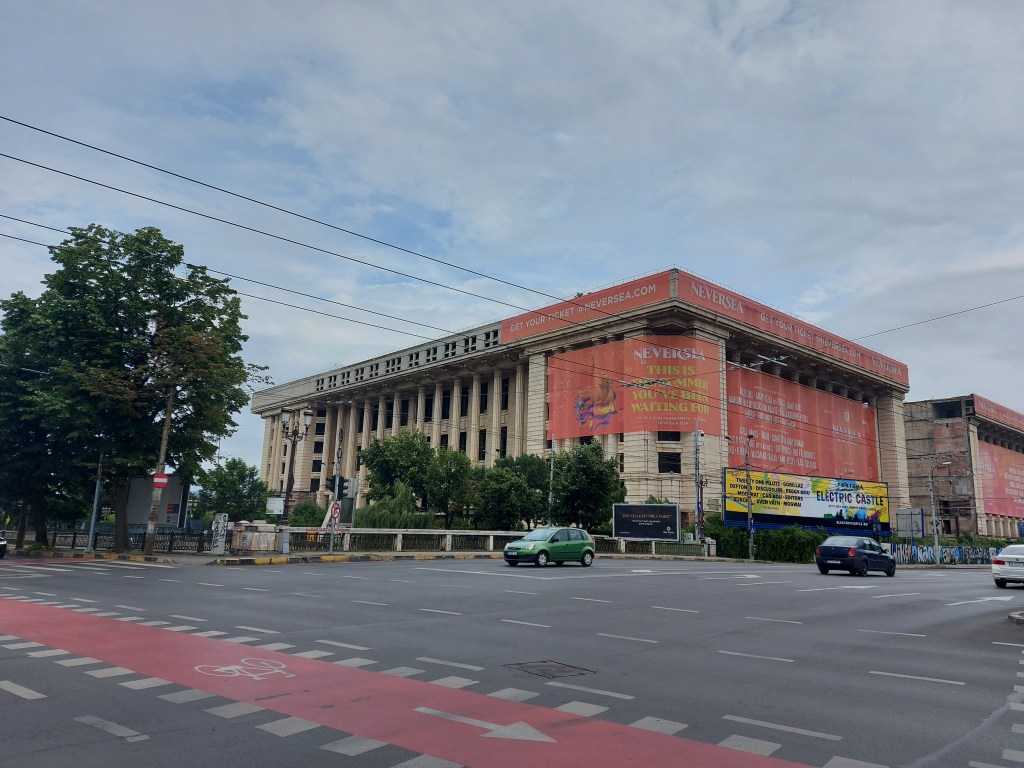
On the way, I came across Casa Radio, the first sign of this being a city with a dysfunctional past:

This behemoth (only a small part of it is actually pictured) should have been a 35000sq ft museum dedicated to the Communist Party of Romania. However, with the fall of the Ceausescu regime in 1989, it lay unfinished, being a symbol of a dictator so narcissistic he’d rather let his people starve as he bankrupted the country with vanity project after vanity project. Works had restarted in an attempt to make use of the building shells, but they were halted by the 2008 financial crisis, so the rather spooky yet majestic (yet infuriating) shells will be there for some time to come.

The Casa Radio sits across from Eroilor Metro Station, which is where I made an attempt to buy a day pass for the system…and failed, spectacularly. All the ticket machines would sell me were one trip and two trip tickets, with the gateline attendants, just standing around seemingly waiting for Godot. In the end, I gave up and thanked the lord that Bucharest had discovered contactless payment, so I was able to whack my phone on the gate and pass straight through. A single fare on the system will set you back the princely sum of around 50 pence, with there being no limit on the distance travelled, so long as you do it all in one go.

I rode the Metro up to the Piata Romana, having made a transfer between the imaginatively named ‘Piata Unirii’ and ‘Piata Unirii 1’. There was a pharmacy in my sights, so I whipped out Google Translate and joyfully thrust my bitten hand across the counter. To my surprise, she just squinted at the bite for a second before handing me a tube of antiseptic for SIX POUNDS. I know that wouldn’t be too far off in the UK, but considering that Romanians by and large earn a fair bit less and everything is accordingly cheaper, it seemed…high. Still, I was able to stand on the street corner dabbing my hand with a few spots of what by rights should have been pure gold.

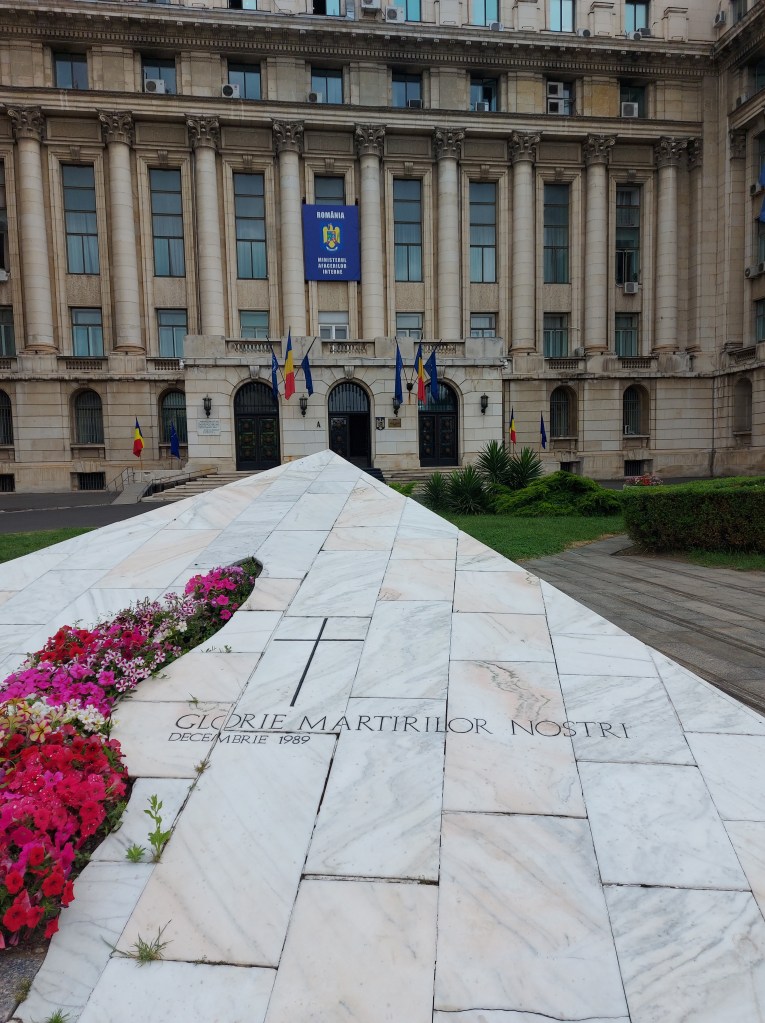
From there, the walking began, as I headed for the Piața Revoluției. It was awfully strange being stood in front of a building that had been party to the reshaping of Romanian history. Especially as now it’s a government building like any other, hosting the Ministry of Internal Affairs.

At the centre of that balcony is where Ceausescu made his final speech as dictator of the Romanian Socialist Republic. As he stood there, giving another mealy-mouthed speech, he watched his rule disintegrate in front of him, with the crowd becoming evermore restless. Restless behaviours turned to clashes on the streets. Four days later, he and his wife would be executed by firing squad after fleeing the capital.

I continued on through the old town, but to be honest, I wasn’t all that impressed with it. Bucharest is a city where you have to dive deeper and understand why it’s the complete mess that it is in order to truly appreciate it. This isn’t Paris. It isn’t Berlin. It isn’t every disco you can get in. It’s a communist-era capital bearing the scars of decades of tyranny and mismanagement.

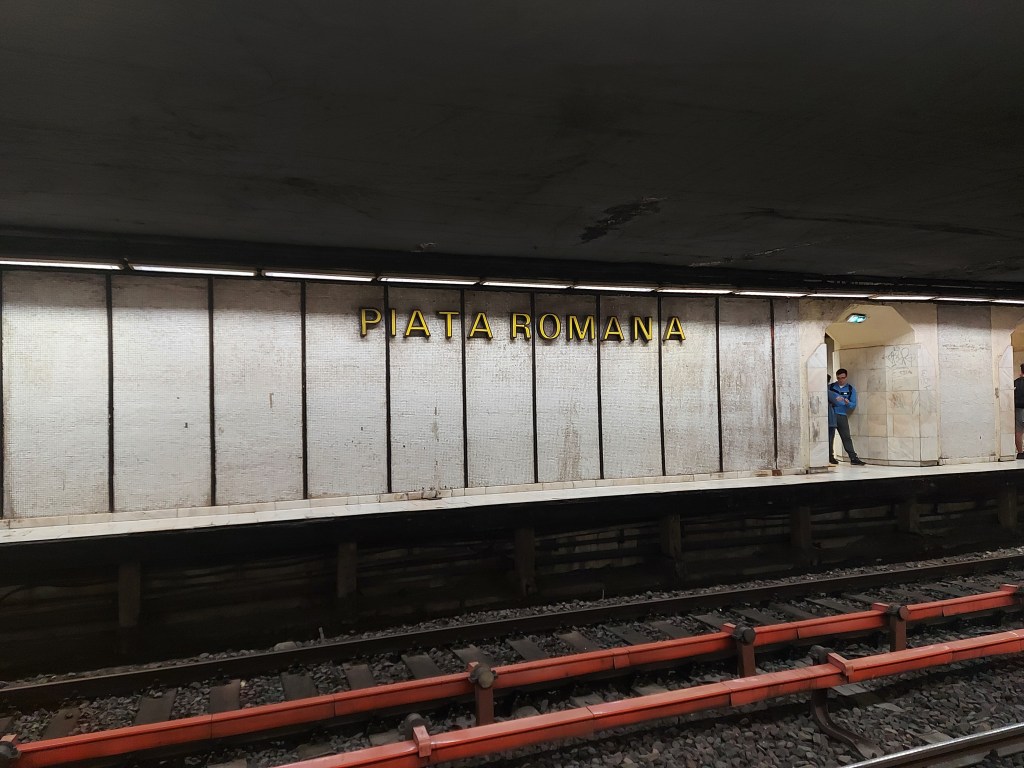
I rejoined the Metro so that I could head towards the decidedly Parisian Arc de Triumf. I was back at the Piata Romana station and had some time to reflect on just how…odd the whole thing was.

The vibe was undeniably very seventies/eighties. But, notice the unusually placed archway? The platforms were excessively narrow, with people waiting behind the incredibly thick walls until the trains had pulled in. But why, you ask? It sounds absurd to say that Ceausescu thought that workers were too fat and needed to walk further to a station, but that’s pretty much exactly the reason why. The damned thing was built in secret as the Ceausescus simply didn’t want it to be built. Hence, we’re left with narrow platforms of uneven length and the whole thing feeling like it was put together by two drunks on a Thursday afternoon in November.

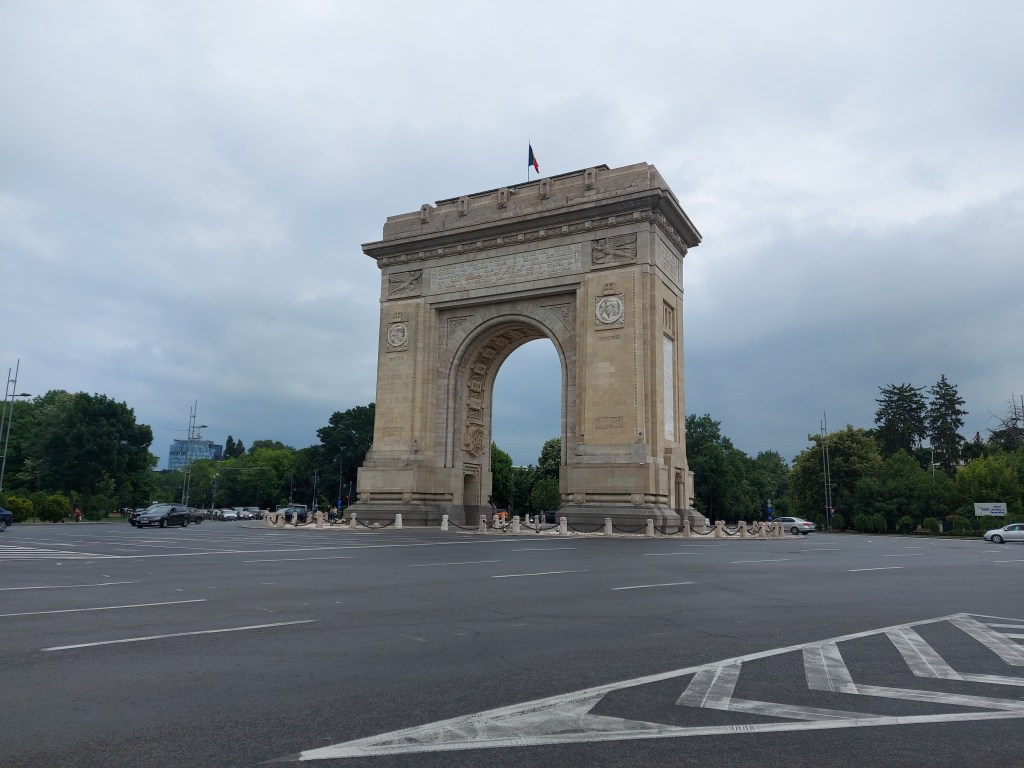
It was about a 10-minute walk through a fairly nondescript park to the Arc de Triumf. Certainly, it looked fairly similar to its Parisian cousin, even if the surroundings weren’t quite the same.

I was a bit sick of the Metro and was looking for another way to meander back into the centre for lunch. See, travelling by tram in Bucharest is a bit of a minefield if you want to use a bank card. Only one line actually offers contactless payment. Want to use contactless on the bus? Best make a note of which model the bus is, as only the Mercedes-Benz vehicles and the weird Turkish-built buses accept card. Good luck!

Alas, the tram line that did accept cards, line 41, was the nearest one to the Arc. It was just a shame that the first tram I used declined my card. I jumped off at the next stop, waiting tentatively to see if the next one would actually accept it. Thankfully, it did actually come to life and decided to spit out a ticket. I spent the next half hour or so on a pair of absolutely battered trams meandering my way around various rainy grey Commieblock suburbs, before picking up lunch and contemplating the highlight of the day.

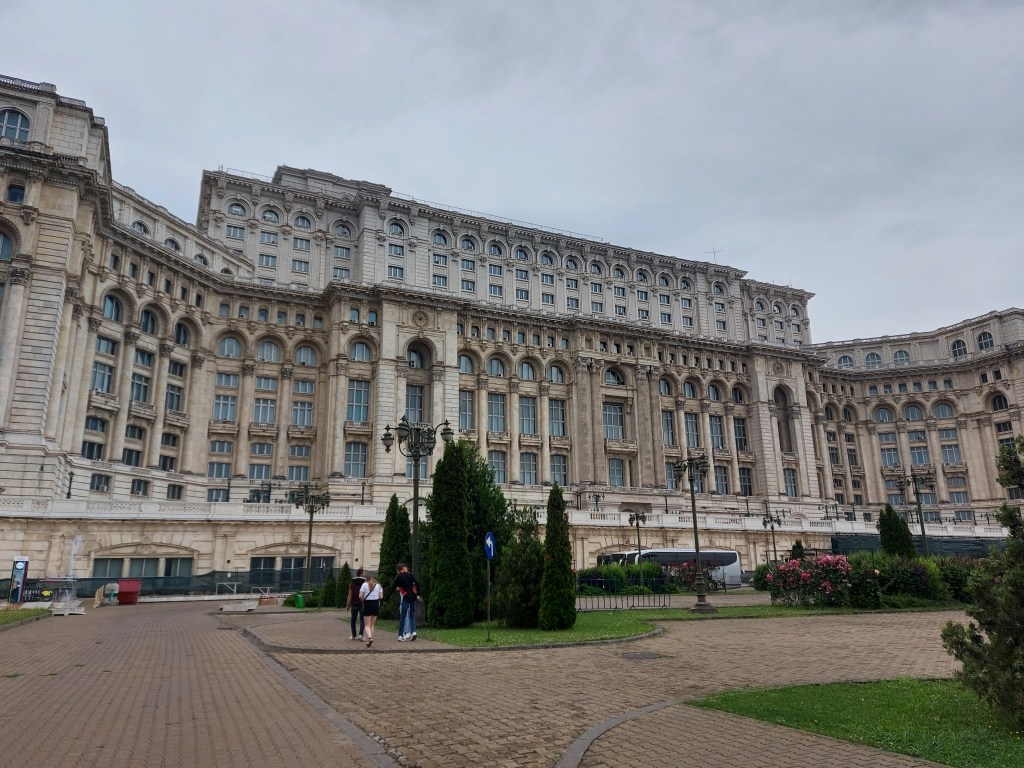
I am of course talking about the Palace of Parliament. The ultimate exercise in despotic self-indulgence. Keen to emulate the looks of Pyongyang, Ceausescu embarked upon Project Bucharest in 1978, starting with the demolition of seven square kilometres of the city and the relocation of 40,000.

It was quite a long trudge to the frankly mindboggling building, even though it seemed to be constantly within touching distance. It took around half an hour of walking down the seemingly North Korean boulevard to eventually reach the Piața Constituției, which lay directly in front of the palace. With that, my phone rang. It was my guide wondering if I was nearby! See, you can’t just wander into the palace. You need to book ahead, and I paid a couple of extra quid to do it online and have someone else work out the faff. Alternatively, you can ring the palace yourself the day before.

I met my guide and was joined by a Greek couple, too. He started out with various facts about the building, before descending into raging discontent about the state of Romanian politics. Certainly, the country has moved on from the days of dictatorship, but a culture of corruption remains. “We never even see our leader!” he exclaimed, pointing out that in the last election, the choice was between the leader they never saw or a “random woman who didn’t even speak Romanian”. Suddenly British politics seemed a little bit sane.

The Greek couple was particularly intrigued by me, with the lass wanting to know my opinions on royalty and our friend Boris Johnson. “We feel like the British hate us”, she said. “I used to work with all of these wonderful people from across Britain, then Brexit happened. You just shut us all out.” Sobering words, certainly. That is effectively what we did. Most of us didn’t want to, I didn’t want to. Then again, a Brit coming to Bucharest for fun isn’t likely to be much of a Eurosceptic.

Divulging the British public opinion aside, we headed inside the gates. The vibe inside was very much akin to an Airport and likely any other government building (I’ve not pushed my journalism career enough to go into many of those). After swapping guides and being asked by the Greeks what I thought of the Diamond Jubilee, we’d now come together with various other tour groups to begin the tour. I felt a little out of place, surrounded by couples and large families. I was the only single traveller, looking a bit disheveled, having been on three flights in as many days.

The guide was an older man with a fairly unassuming and mild manner, clearly unfazed by the scale of the building he was in, having done this tour so many times before. Yet, for the visitor, being told that you were looking at a million cubic metres of marble would be incredible if it wasn’t so obscene. All that marble is part of the reason why it’s the world’s heaviest building.

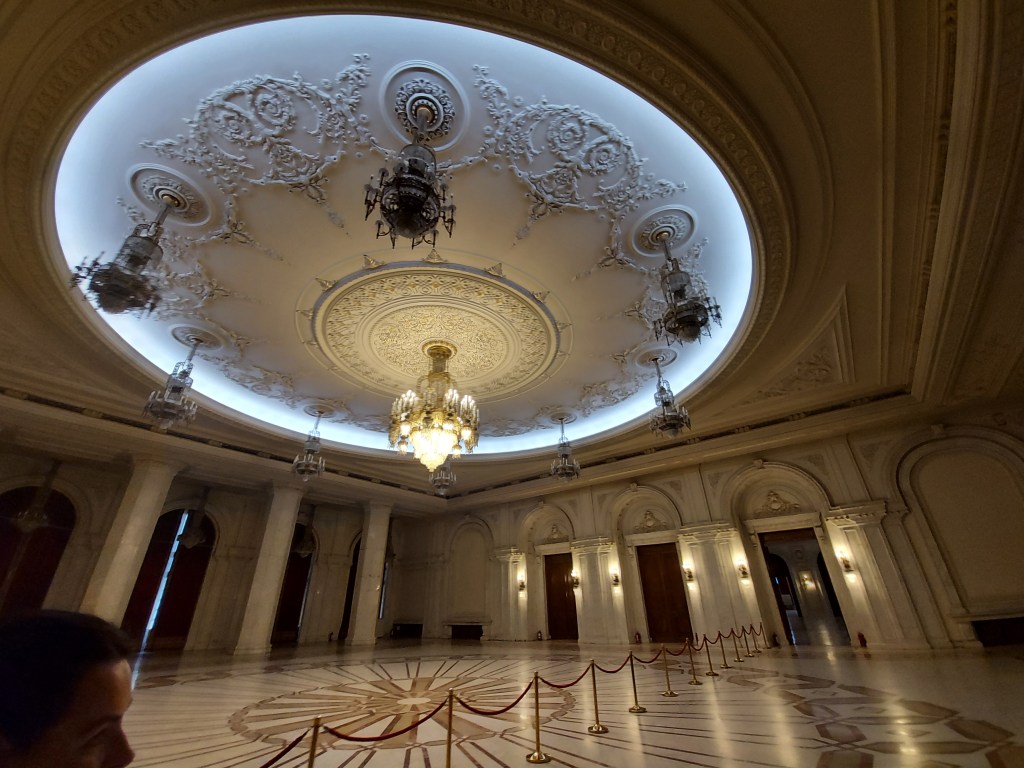
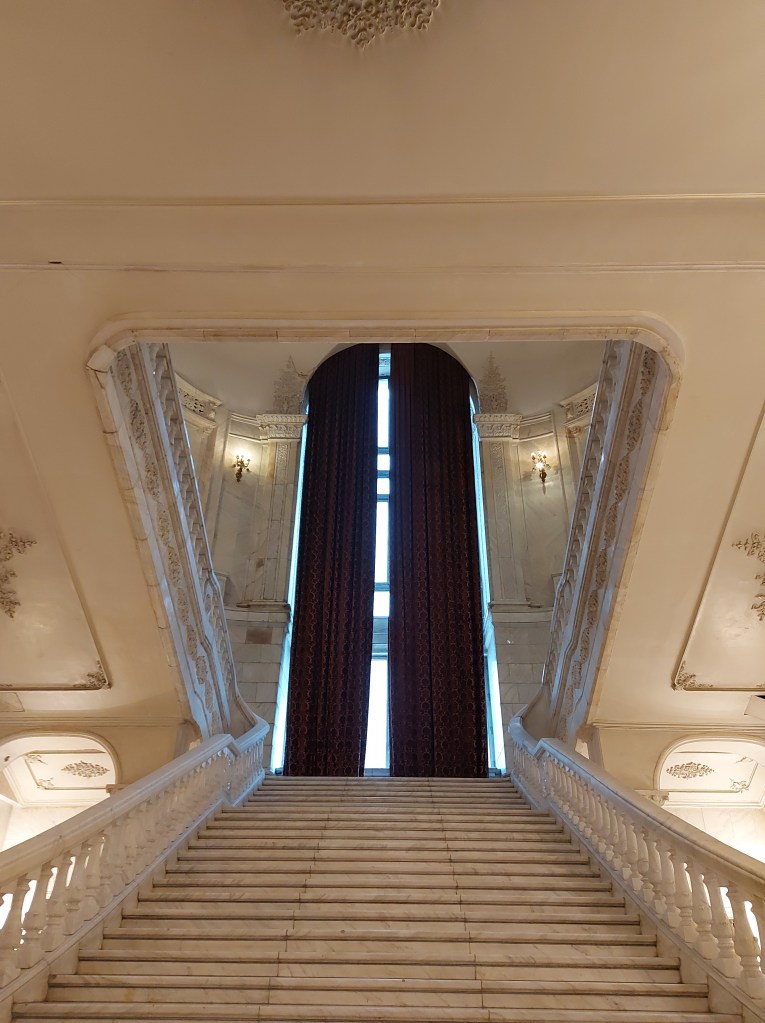
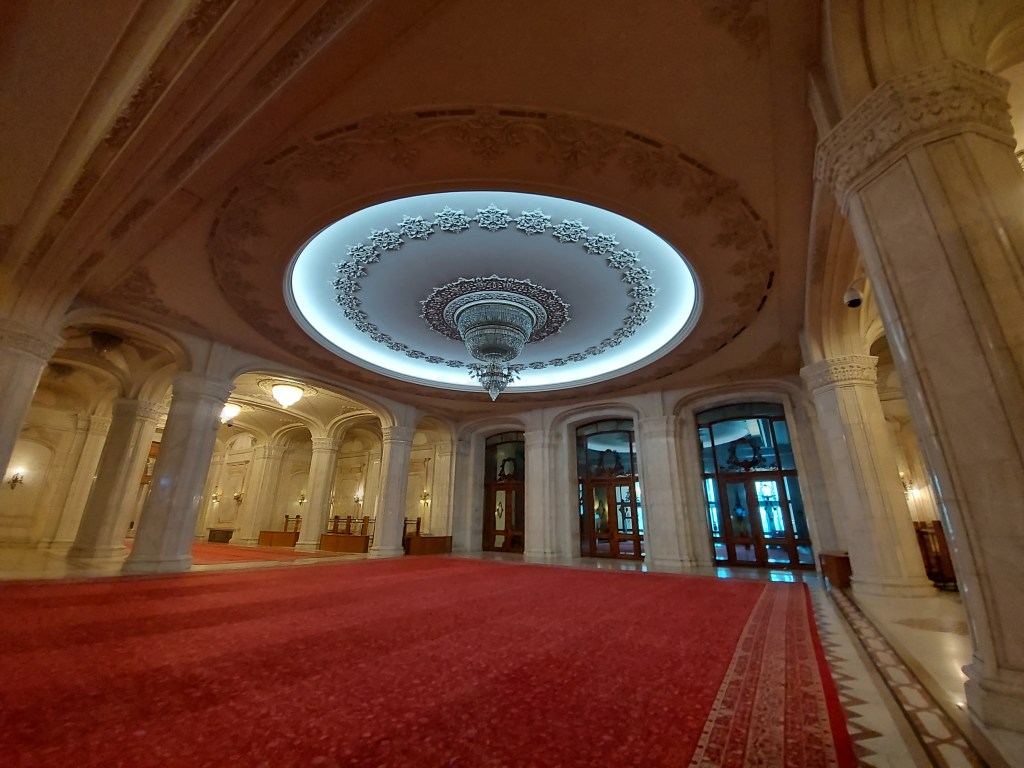
Nowadays, as well as being the seat of the Romanian Parliament, the building earns its keep with various international conferences and events. It’s still 70% unoccupied, though, despite the fact that it consumes as much power as the average medium-sized city. We were led from one room to another, witnessing marble staircase after marble staircase, the world’s largest set of curtains, and the world’s biggest display of a dictator trying to overcompensate for something else…

It all sort of just merged into one. Ballrooms, conference rooms, ornate staircases, press booths. You can just imagine how Ceausescu would have loved to have wandered around here and flaunted his wealth to the rest of the world. Instead, he took a bullet to the head before it was finished.

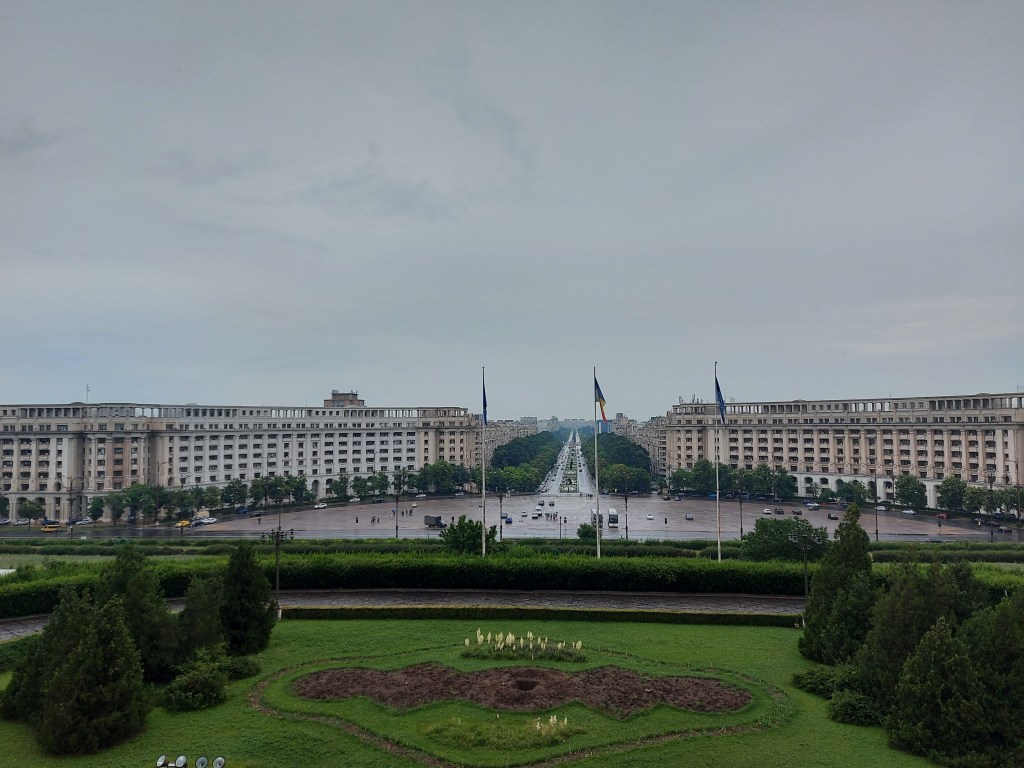
We walked out onto a balcony and I looked down at the Bulevardul Unirii. You could see how Ceausescu’s Pyongyang-esque dreams had pretty much come to fruition in this sector of the city. There was something grand yet depressing about it as the muggy June rain acted like a slightly-unsatisfying fine mist. I moved back inside to one of the empty and cavernous rooms to give others a chance to gawp and take their photos.

The tour guide was stood looking a little underwhelmed with life.

“It seems rather crass, doesn’t it. The city itself needs so much more love, yet here we are in a marble palace”, I said.

“Yeah, it’s…not great, it does seem strange.”

Bucharest just needs love. It’s never going to be the tourist hotspot that some might want it to be, but something is just really depressing about it. Romania isn’t all like this. It’s a gorgeous country. It isn’t rich by European standards, but Bucharest just encompasses all of the issues that former Eastern European dictatorships have had as they’ve transitioned to democracy.

They could have been opportunities for growth with ‘liberalisation’ and modernisation. Instead, it was just an opportunity to squander and hoard. A damp squib compared to what the revolution will have ultimately wanted.

I left the palace feeling like I’d come what I wanted to achieve. I wanted to see what the Ceausescu regime, the revolution, and the new democratic era had done to Bucharest. The answer is that there’s still much to be done.

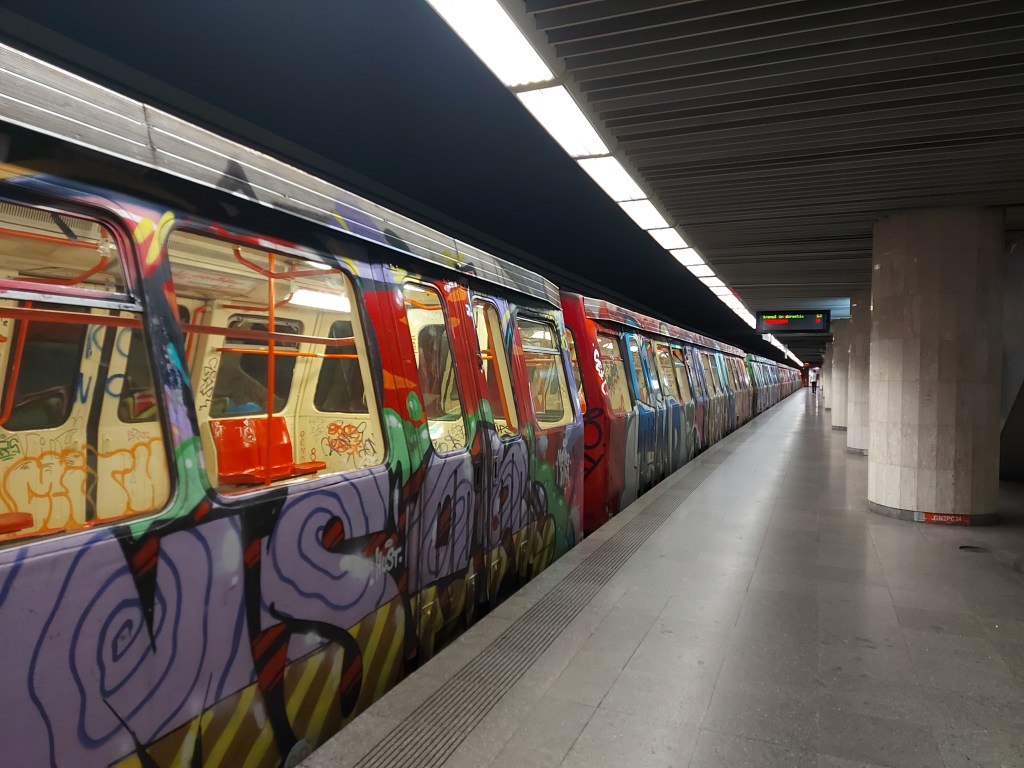
It was starting to get late as I walked towards a Metro station and took a look at Line 4. I’d heard that it was an effective dumping ground for old trains that nobody loved anymore.

At least on this train, they’d cleaned the windows. Apparently, they were getting replaced soon, so they weren’t minded to do much about it as it costs money. Meanwhile, there’s a million cubic metres of marble just hanging out 20 minutes away.

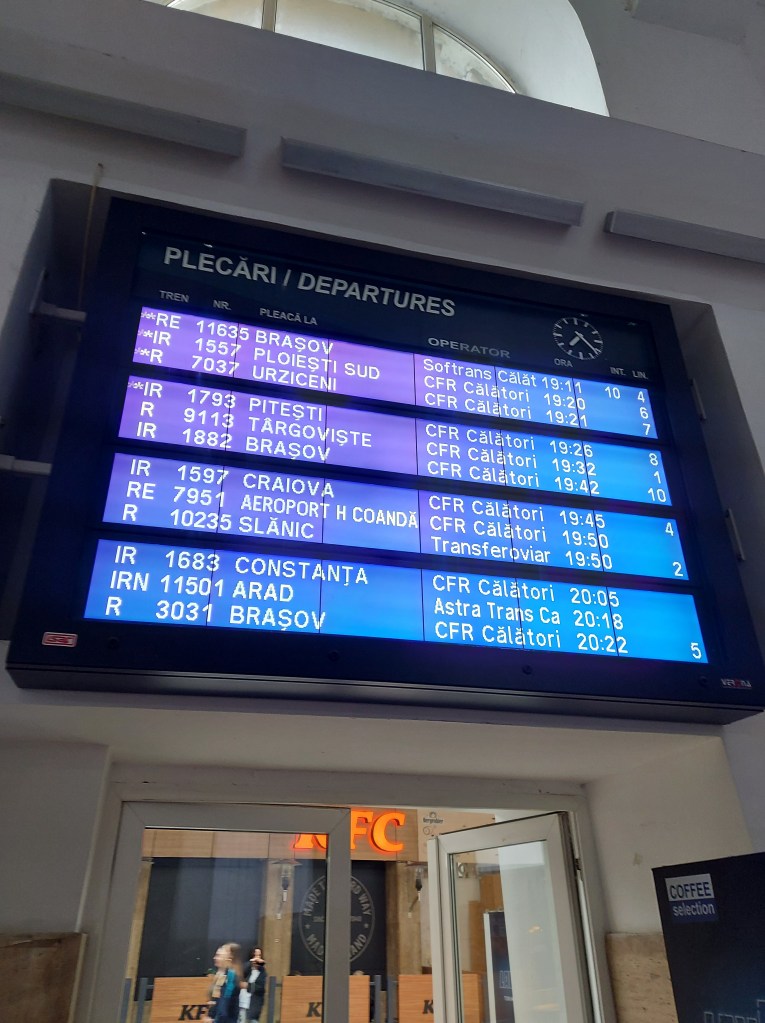
I visited a supermarket for some supplies and headed for the Gara de Nord. I was travelling on the 20:18 to Arad tonight, operated by Astra Transcarpatic. My destination was actually Budapest, but the direct train was absurdly expensive, likely a bit old and naff and took bordering on 16 hours. This shiny little number I was going for had only cost me £60 for an en-suite and meant I could have a wander around a much prettier lil city in the morning.

The departure board wasn’t looking too exotic when I sidled up to the station just after 7pm. Both trains to Hungary were gone and I don’t even know if the one to Moldova was running at the time.

Having spent forever pacing around on the concourse, I eventually saw my train trundling into the far platform in reverse. It was a brightly coloured green and yellow lil number, in contrast to some of the beaten-up-looking stuff going elsewhere.

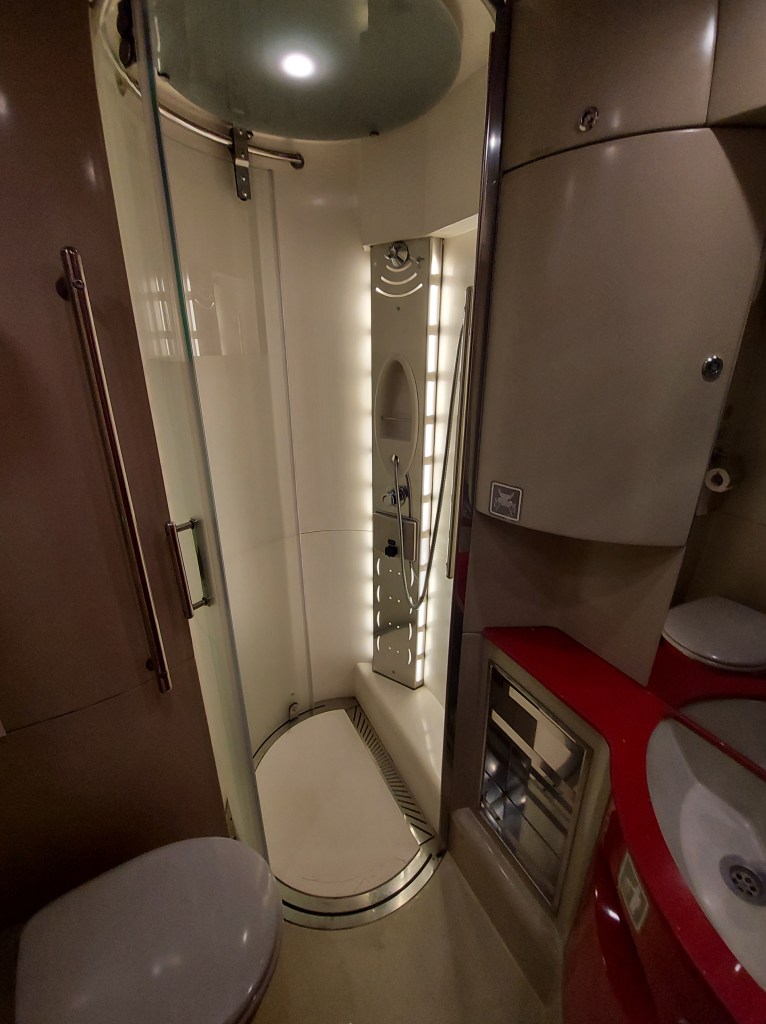
I found my private compartment and I’ll be honest, I was pretty impressed:

It was really nice. A proper little hotel on wheels for the price. The conductor came along and stared at my ticket before running back to throw a sandwich and a bottle of water and me.

Not that I was picking that option. I whiled away a couple of hours thinking about the city I’d just seen while I sipped on absurdly cheap beer.

Would I go back? To Bucharest, no. I’ve done what I wanted to do. To Romania? Absolutely.

RegioJet: A viable overnight option?

Who are RegioJet?

RegioJet is a name perhaps unknown to those of us in the UK or even some parts of Western Europe, yet they’re big business in the budget coaching world. They even run a (somewhat absurd) twice-weekly route from London Victoria to Plzeň and Prague for those of us who really want to get to/from the Czech Republic on an extreme budget.

Closer to Central Europe, they’re all over the map. They’ve also got quite a few fingers in the pie that is the Croatian coach network, especially in the absence of a viable rail service for many towns and cities, particularly in Dalmatia. While not quite at the levels of Flixbus, RegioJet at least operates all of its own services, rather than being a brand slapped on hundreds of smaller operators.

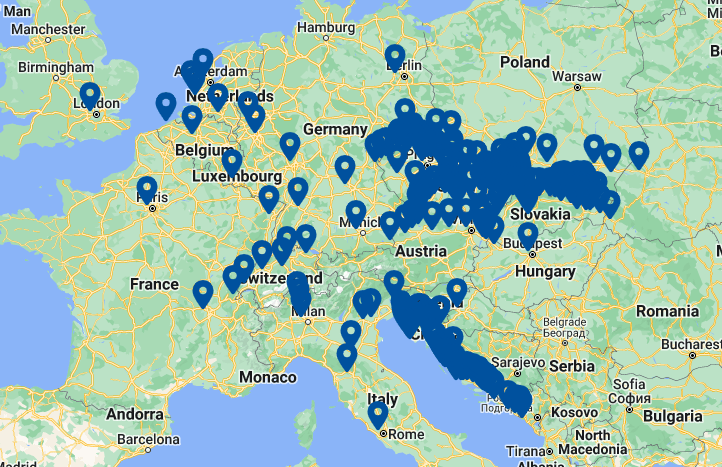
All stopping points (both buses and trains) on the RegioJet network (courtesy of the RegioJet website)

Their rail operation too has been steadily growing in recent years. They’ve gone from running a handful of trains on the main Prague – Pardubice – Olomouc – Ostrava – Havirov corridor to winning state contracts to operate both local and interregional services. In recent years, they’ve also introduced two sleeper train services: A Prague-Košice train and a summer-only Prague-Rijeka & Split one.

RegioJet & InterRail

I’d be lying if I said that I was a particular fan of RegioJet’s idea of ‘service’, considering my previous encounter with their staff in January 2020. The whole thing smacked of amateurs playing trains in gaudy pink t-shirts when they gleefully threw me in the lowest class possible with my first class InterRail pass (having initially denied that they even accepted the pass at all).

Alas, two years on, such an issue has now been ‘resolved’ as you need to book a reservation in advance for ‘RJ’ category trains (which is all of their ‘commercial’ ones). Thankfully, this can be done online with little fuss, rather than the previous need to visit a sales point.

Notably, InterRail passes are NOT valid on their ‘Os(Osobni Vlak/Local train) category services, not that a tourist would have any reason to use these, with there usually being an alternative ‘R(Rychlik/Fast) category service available to use. They’re also not accepted on the seasonal sleeper train down to Rijeka and Split, though there are various alternatives if you want to make this journey.

Most peculiarly, if you have a first-class pass, it’s NOT valid in first class on their R8 and R23 routes, which run between Brno-Ostrava-Bohumin and Usti nad Labem-Lysa-Kolin respectively. I’m not sure what the reasoning is for this, but I appreciate that the people that this will genuinely effect will be slim to none. These ‘R’ category routes are operated under contract to the government, rather than being operated commercially.

To their credit, RegioJet did address my complaint quite well (maybe a little too well, as I’ve never had a company so viciously slag off its staff and say they were obviously just too stupid to understand my ticket in customer communications) and it’s clear that the company is working on branding itself as more than just some budget coach operator. The question was, how would they fare this time around?

The Booking Process

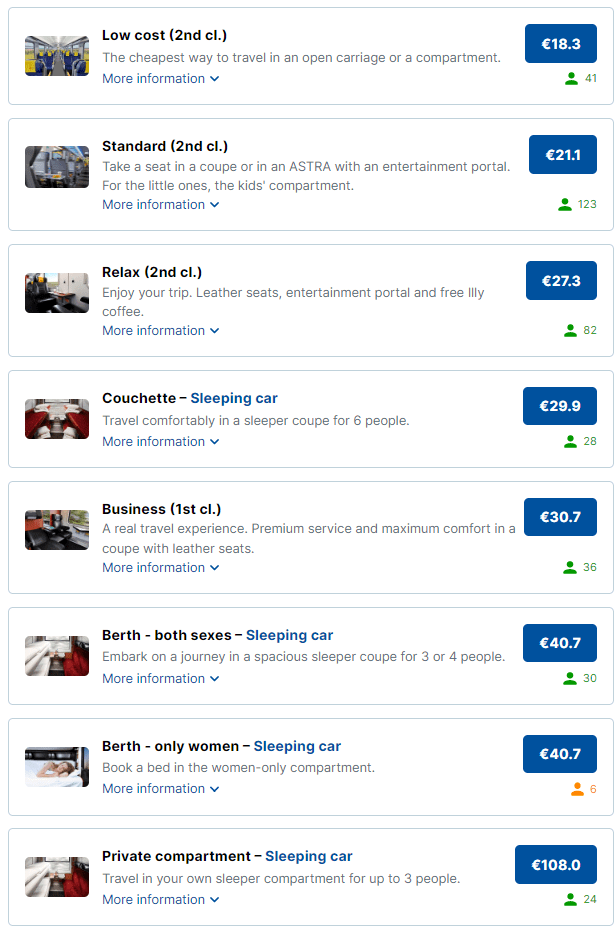
On the evening of May 10th, I’d be taking train RJ1021, which departs Praha hl.n at 21:37 and is scheduled to arrive in Košice, in the far east of Slovakia, at 06:07 the following morning. I’d paid for a private sleeper compartment for 67,80EUR (around £57) meaning that I would have the sole occupation of a compartment and wouldn’t need to share with anybody. If you’re happy with a seat or sharing, prices will be much lower. Here’s a sample of what’s available for a service in a fortnight’s time. As you can see, a private compartment is even more expensive on the date in question:

18EUR is undeniably fantastic value for such a long journey, especially as the ‘low cost’ carriages are now Deutsche Bahn first-class cast-offs which have retained their configuration, but whether you’d want to put yourself through that is another question. Business Class wouldn’t be an awful shout, but you could pay less and get a bed to lie flat on if sleep was what you were most intent on.

That said, the booking process was quick and easy, and I was given a PDF with a QR code and ticket number by email. Apparently, either would suffice to get me on board, with there being no need to even have the email to hand if I could make a note of the latter. Can’t argue with that!

The Journey

Having had a leisurely day exploring the western regions of the country, I took myself to the large Tesco in the Novy Smichov shopping centre for some supplies for both the evening and the following day. It’s some weird rite of passage for me every time I’m in Prague, with that Tesco providing a warm sense of homeliness while indulging me in (somewhat) cheaper prices compared to the UK. Certainly, you wouldn’t be getting a can of Pilsner Urquell for 60 pence!

By the time I’d done what I needed to do, my 90-minute ticket for Prague’s transport was running out of validity, so I ended up jumping on a tram to Smichov station to take whatever came first for the short hop over the river to Hlavni Nadraži. While fairly impressive at the platform level (particularly in the ‘historic’ area of the station), it’s an undeniable 80s-styled hellhole on the concourse. Having been approached by scammers multiple times on previous visits (and almost headbutted by someone on another occasion), I wasn’t exactly keen to spend too much time around here.

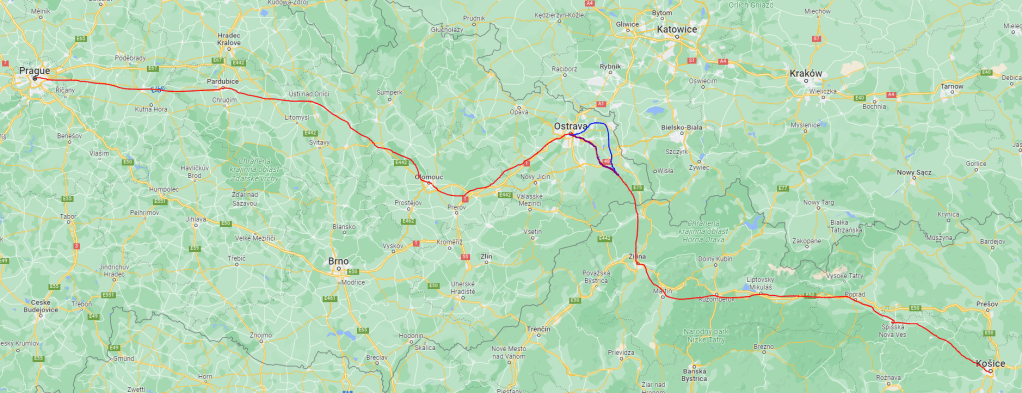
A crowd had formed on the concourse, with there being two sleeper trains to Košice in fairly quick succession. We were scheduled to leave first, followed by the ‘classic’ state-run affair, EuroNight 443 Slovakia, which would be going even further than Košice, to the town of Humenne. This train would also run via Bohumin and exchange various carriages with other services heading for the likes of Krakow and Warszawa. Meanwhile, our train would essentially ‘cut the corner off’, heading directly for the border via Havirov. See below for a map of the journey:

The blue line shows the slightly longer route that EN443 takes in order to reach Slovakia, while RJ1021 follows the more direct dark purple line.

I had also noticed the apparent chattering of various Ukrainians around me, as it seemed that quite a few would be availing of this service to return to their homeland, with the border not being far away from Košice. Whether for good or just to visit, the situation affecting Ukraine continues to be both a disgrace and a humanitarian tragedy.

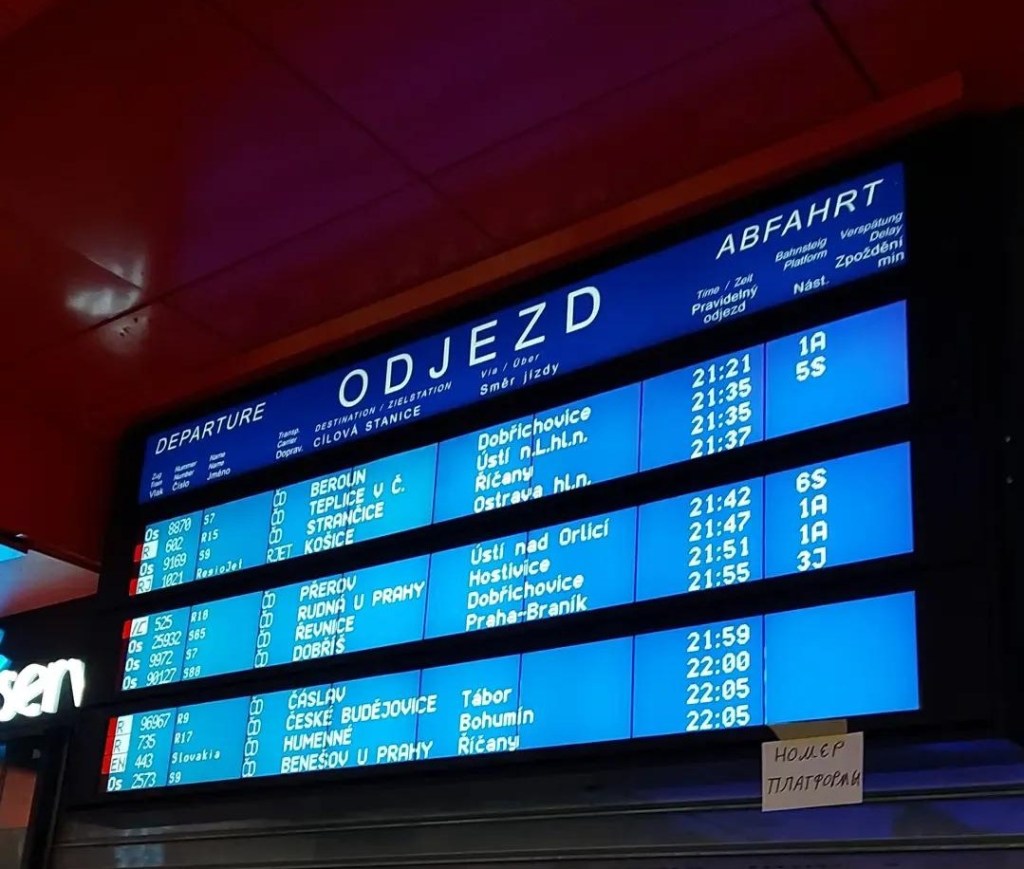
I started to get rather nervous as the crowds continued to form around the departure board yet no platform number appeared for RJ1021. It wasn’t like there was a delay of an inbound train either, as this train would come straight from the depot next to Smichov station. I let out a rather muted groan as ’10min’ appeared under the ‘delay’ section of the screen. While this was a fairly minor delay, I knew that it could just as easily be the start of something significantly more dramatic.

The fateful departure board. Note the hastily taped sign in Ukrainian, which I believe states ‘Track/Platform’?

10 minutes before the scheduled departure time, we all made our way to Platform 1. Lots of us, too. In fact, I was somewhat baffled as to how the hell so many people were going to make it on board. This wasn’t helped either by another train randomly occupying the platform as it waited to head to the depot.

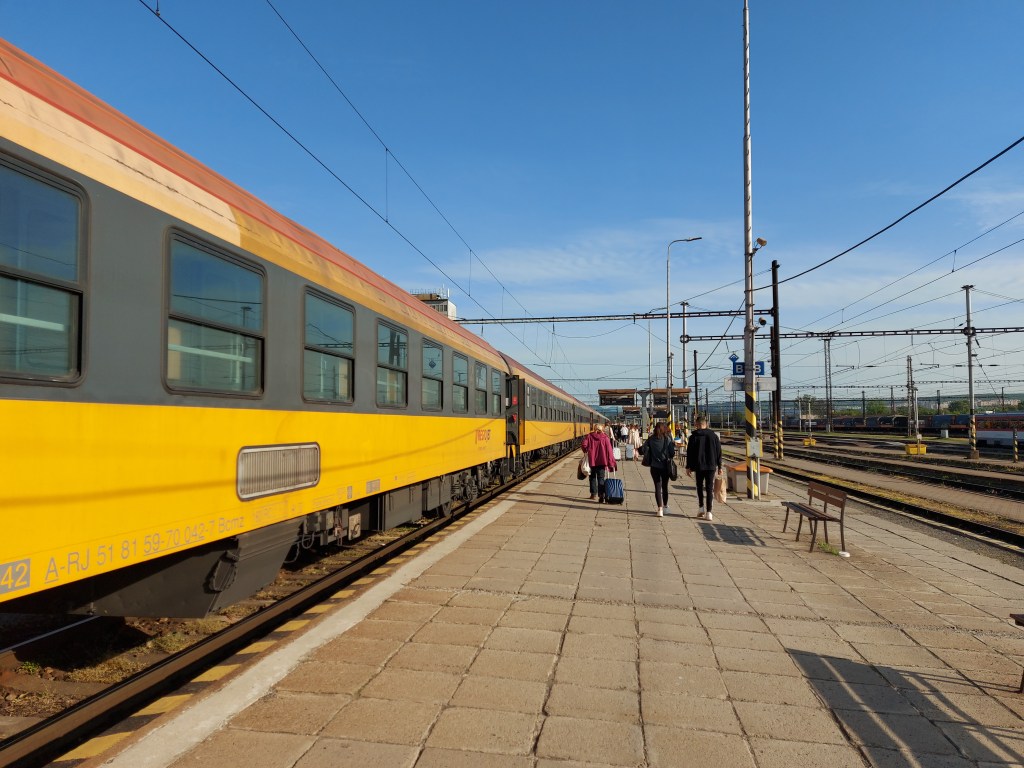
At the scheduled departure time, our train arrived from the depot, and the crowd dispersed up and down the platform. I locked eyes on my booked carriage and fought my way down to the front without too much trouble. This wasn’t exactly the NightJet experience, for sure. There was a host greeting us but he wasn’t doing much else, so no ticket checks or anything of the sort.

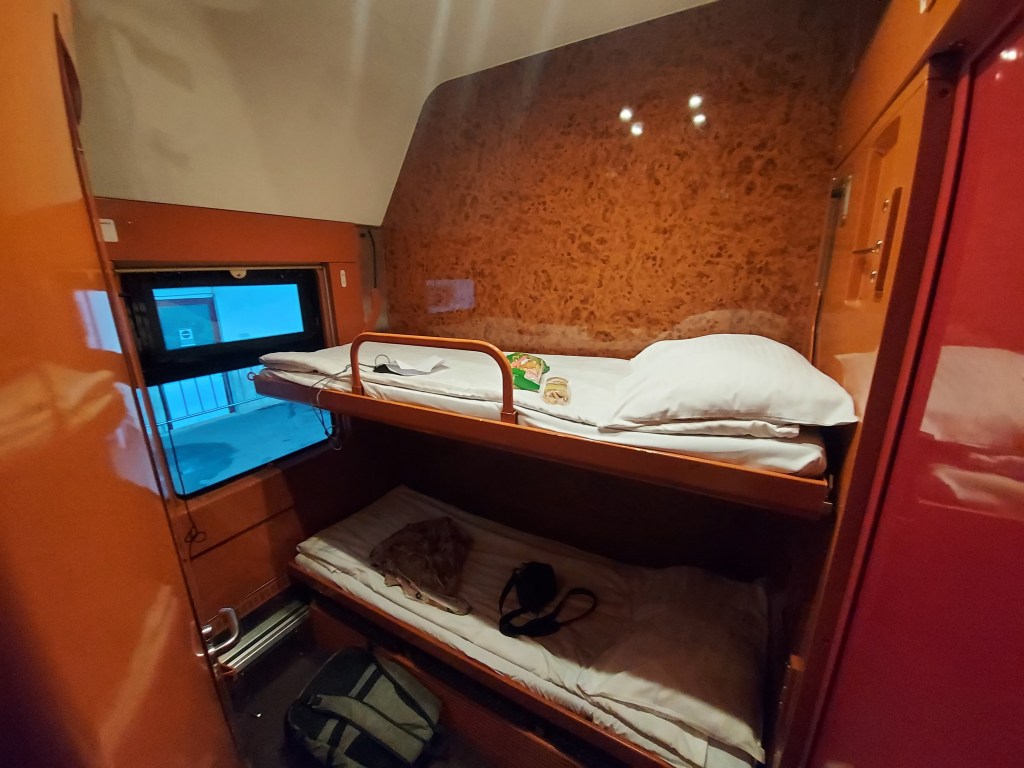
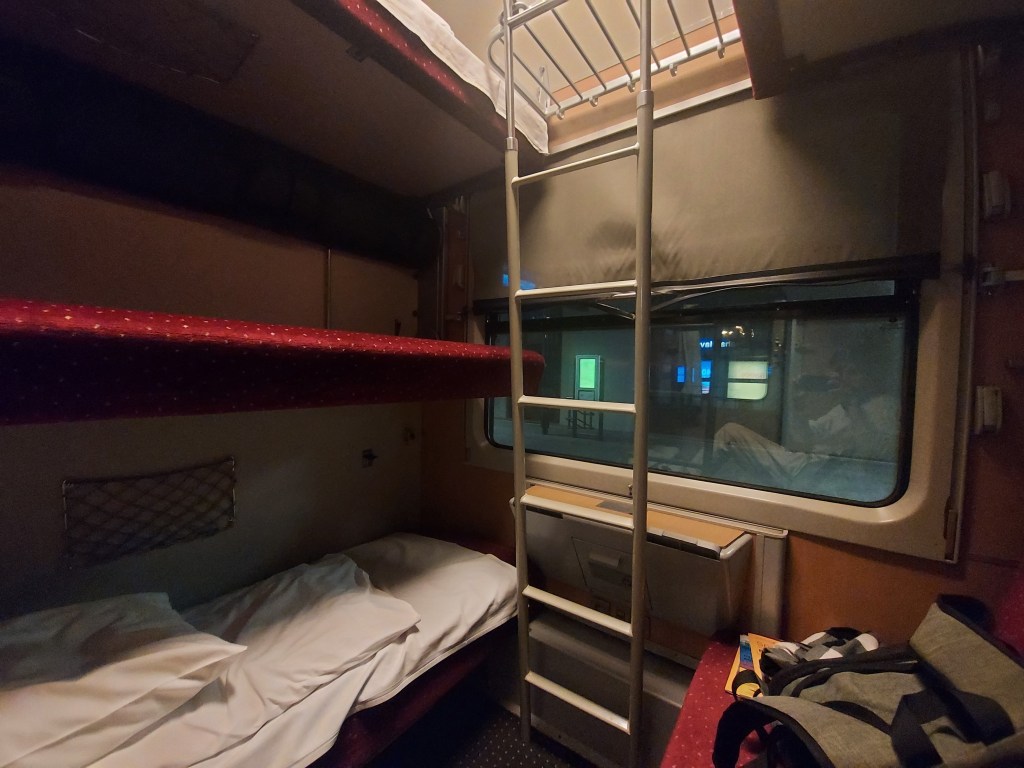
My cabin was…provincial, shall we say.

This wasn’t a sleeper cabin at all. It was a couchette with a couple of the beds put away! I couldn’t easily get either of the other beds away so ended up making up the seat I was sitting on in the picture instead, just so I wouldn’t wake up and smack my head on the bed above. The window blind was somewhat damaged (as you can see in the picture, someone’s almost ‘made’ a handle by bending and pulling away the metal on it) and the power sockets under the table didn’t work. First impressions were rather limp. It was also very obvious that the train had spent all day in the sunshine as it was painfully hot. My first thing to do was shove the AC on full blast.

I located a chain that could lock the door and decided I might as well settle myself in. I remade the beds by piling all of the sheets from the other beds on top of each other first, seeing as the bed itself was essentially a seat and was rock hard. With that done, I stretched out and we were away from Prague around 15 minutes behind schedule.

A friendly host came around shortly after departure just to check if I wanted anything to eat and if I wanted coffee in the morning. I took him up on the latter (it’s free!) but had ample beers and snacks for the evening. Bizarrely, no tickets or travel documents were ever checked. I don’t particularly care, but perhaps an educated guess is made on sleeper compartments, and so long as the right number of people are in one, then we’re good to go?

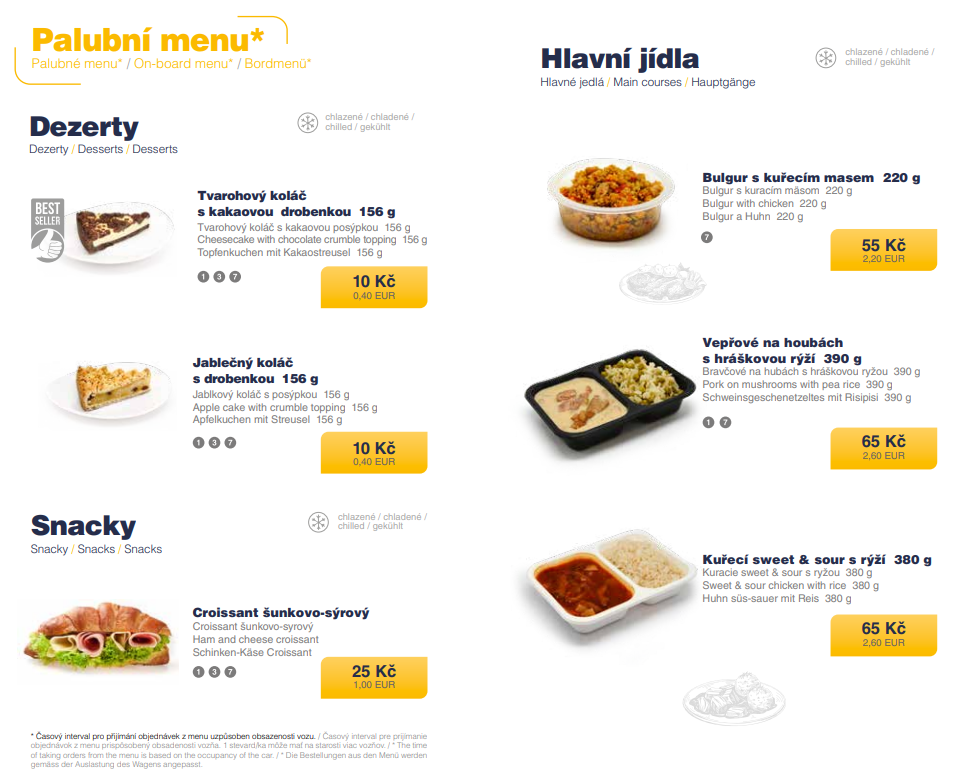
If you’re interested to see what you can purchase on-board if you want something to eat, click here. From the sample below, you can see that by western standards, it’s VERY good value. Beer is 0,80EUR for half a litre (!)

Courtesy of the RegioJet website…

With that, I flicked off the compartment light and locked the door, with the lights of suburbia lighting up the room with a kaleidoscope of streetlamps, headlights and various other delights. I was starting to notice the main issue with this carriage, though, which was the abysmal ride quality. We lurched and bounced our way down what is one of the main rail routes in the country, and I was feeling every little bump and jerk. Still, it was best not to think about it too much and just sip another can of beer. (Having studied the RegioJet website this is apparently not allowed, but the host certainly wasn’t arsed as I sat and talked to him while I had a drink. I suspect it’s more designed to stop the couchettes and seating cars turning into party carriages)

After we departed Kolin, I decided to turn in for the night. Each end of the carriage has a toilet and a washroom, so I utilised the former followed by the latter. Both were clean and well-appointed, so absolutely no complaints can be had on that front. All that was left to do was try and get comfortable in bed.

It was one hell of a task. The noise from other passengers and crew was minimal, but the train itself was loud. I eventually found myself on top of two of the sets of sheets and half spooning the other (it was slowly cooling down but not enough to bury myself under a duvet) and dozing off as we departed Pardubice.

My next memory is waking up to shouting from on-board, followed by the slamming of the carriage door, us moving off, and the shouting becoming ever more distant. I glanced at my phone to see that it was just past 2am and we were leaving Ostrava hl.n. Clearly someone undesirable had been ejected! I was then sound asleep again until around 5:20am, with my expectation being that we’d now be out of Poprad-Tatry and would have around an hour to go, considering our delay. I also knew that we were scheduled to have a 15-20 minute hold-up around Havirov, so that could be extended a little.

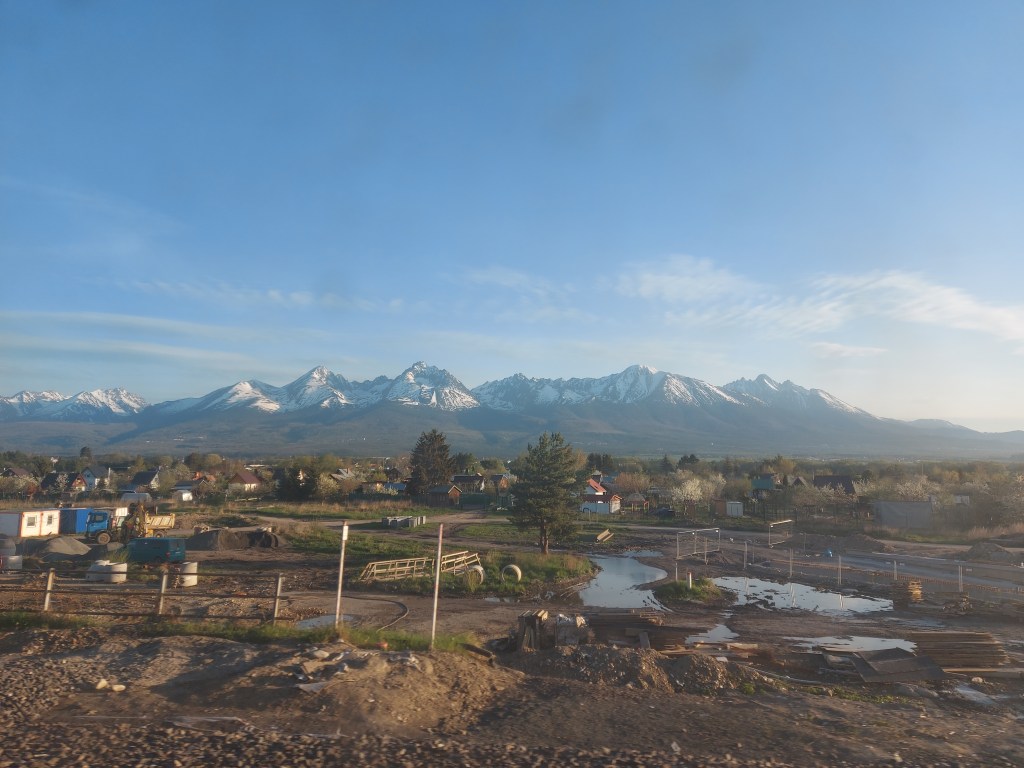
I checked Google Maps to see that we’d just left Liptovský Mikuláš, a station we’d been scheduled to depart from at 4:02am. We were around eighty minutes late! Thankfully I’d allowed for a two-hour delay before my connection to Miskolc, meaning that so long as we didn’t have any further hiccups, everything was in order. Additionally, the views over the Tatras, which I’d have otherwise passed in the dark or while asleep, were absolutely gorgeous:

Sure, we were quite late, but I was sat propped up in a bed under a duvet watching mountains toddle past my window. What’s not to like? The views kept coming for the next hour or so, as I slowly acclimatised myself to being awake, having had roughly four hours or so of slightly interrupted sleep. I wasn’t even particularly tired to be honest. In fact, that felt like pretty good going considering the bumps in the night.

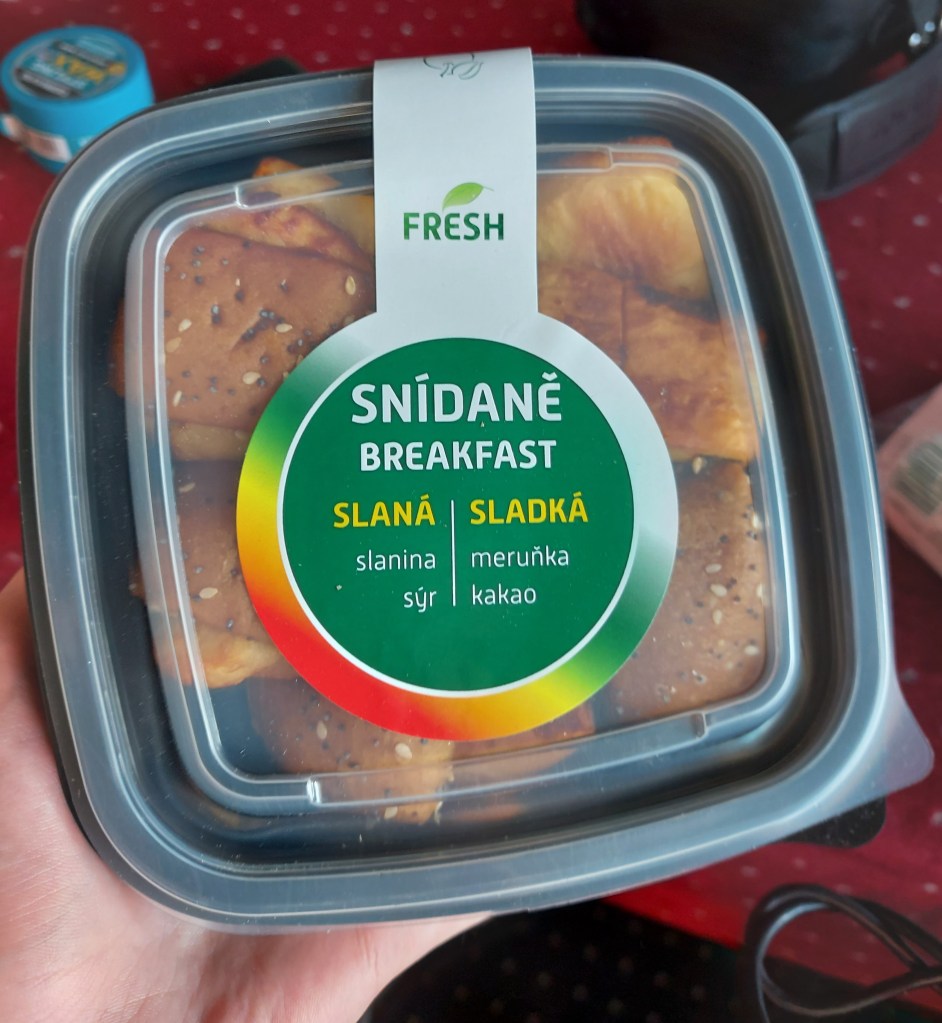
I decided to take a look at the provided breakfast offering. It was a bit strange-looking at first but was actually a pretty fair offering to start the day with:

It was essentially a box of small pastries with various fillings. ‘Various’ in this instance was cheese, apricot jam and chocolate. The latter was a bit much (very little pastry, LOTS of chocolate) and the cheese was somewhat meh, but I loved the apricot ones. You also received a small bottle of orange juice and water to go with these. Notably, these are left on the seat as you board, so you can have them as and when you wish. There are no awards to be won for catering, but the offering was thoughtful and better than the nothing that you’ll get with other operators on sleeper trains.

My snacking was briefly interrupted by catching an older woman lugging two cases behind her as she headed for the doors in Margecany. Knowing that the chasm between the train and platform would be huge, I followed behind and plopped her cases down to her.

My coffee order soon followed as we closed in on Košice, delivered with a good morning and a smile. It wasn’t the biggest cup in the world, but it was a welcome dose of caffeine after a bumpy night. Then, it was just a case of getting my things together and getting ready to leave. We arrived at 07:27, a total delay of 80 minutes.

An already VERY warm morning…

The Verdict

Well, RegioJet isn’t going to win any awards for luxury with their sleeper product. There’s no en-suite, not even a sink, and it’s clearly a lottery as to whether things such as power sockets will actually work (thank the lord for power banks). At the end of the day, it’s a couchette carriage, not a sleeper carriage. That said, you’re paying a hell of a lot less for it if you get the right price. 67EUR for a private compartment on an international journey isn’t to be sniffed at, after all.

It’s a budget price with a budget product. Would I do it again? Probably, if the price was right. The experience and the staff more than made up for it. At the end of the day, I was able to sit and have a complimentary breakfast at the foot of the Tatras. I had plenty of space to myself and clean, working bathroom facilities nearby.

As for the punctuality side of things, it was certainly unfortunate that I was delayed but to be honest, it worked out quite well in that I had more time to enjoy the scenery and still had ample time to make my connection. I was a little irritated that it wasn’t mentioned once by the crew, but I did do some more reading into this.

RegioJet operates with an ‘On Time Arrival Guarantee‘. Little did I know that this meant I was actually entitled to 25% of my fare back in credit for another journey. How does it work? The credit is automatically given to the account that you booked with. As I booked as a guest, I was able to access the 17EUR credit I received simply by logging in with my ticket number and selecting another journey. The efficiency of this, compared to even UK operators, is actually quite astounding and is a massive positive. I commend them highly for this.

Following this experience, while I can say that RegioJet might offer a slightly ‘quirkier’ product to the national operators, it’s certainly worth a try. As for punctuality, well I don’t doubt that the EuroNight service behind us was probably snarled up in delays too. It certainly wasn’t specific to RegioJet.

At a minimum, I can certainly recommend you give RegioJet a try on one of their daytime services. From Prague, other than to destinations previously mentioned, you can also travel to Brno, Wien, Budapest and various points in-between.

(Updated!) Travel Goals for 2022

I produced a blog post a couple of months ago, where I reflected upon my disastrous dating choices and tentatively travelling into mainland Europe once again. Now that the world is opening up at a more rapid pace than ever before, it feels apt to, say, recalibrate what I’m looking for in 2022.

Latvia was fucking brilliant, as I’ve previously written. It’s a country that’s suffered so much in times past and is understandably now so fiercely independent. I travelled there in the midst of a state of emergency yet everyone was so outwardly positive. It’s a country that can be proud of how it’s risen above its past and become the strong nation that it is today.

The only issue was that travelling to Latvia made me realise how much I needed to start doing this again. The spontaneous flights abroad, the last-minute planning and truly squeezing every penny I could out of a trip. I used to be a little more picky about where I’d travel to, with perceptions of whether a country was ‘safe’ or not getting in the way. But now, I don’t particularly care. This is Europe we’re talking about, for the most part. Don’t wander into dodgy estates or back alleys or wander around alone at night and you’ll be fine. Granted, I’m a bloke, things are unfortunately different for the lone woman traveller and I absolutely recognise and accept that. And by accept, I mean that I’m horrified by it too.

A week or so after arriving back from Latvia, I had a little too much to drink and booked a day trip from Manchester to Charleroi for around £25 return. It was incredibly silly, liable to going horribly wrong and gave me only a few hours in Belgium, but man was it bloody good fun. My outbound flight was on time, meaning that I could quickly head outside, head into Charleroi and take a train to Tamines. A bit of a wander later, I headed back and awaited my flight home…which was quite late. Somehow though, on arrival, I managed to bolt through security and make my booked train. Just as well too, as everything else from Manchester to Sheffield that night ended up being cancelled. All things considered, it went quite well.

Two weeks later, I did a re-hash of the aborted Bordeaux and Madrid trip, this time with Barcelona mixed in. It was again, bloody good fun, shall we say. I’m not even talking about how I accidentally had five Aperols in Manchester Airport and ended up doing rather well on Tinder. I now adore Barcelona. Nothing could beat the feeling of sitting with a drink from the rooftop bar of my hotel looking out over the skyline, or looking out over the River Garonne at sunset. What could however beat that feeling, by a long shot, was my 23:50 flight not leaving until 01:30. I reached my Manchester hotel at 4am, needing to leave again at 7am. Not a lot of work was done that day and I paid for such chaos with a broken sleeping pattern for the entire week. Still, it was time to do it all again.

I found myself shivering on the platform at Regent Centre the following Saturday morning, awaiting the first train out towards the Airport. I looked back fondly on the days that I would work at this station, seeing as it’s home to Metro’s storage facility of all-sorts of gubbins, as well as an endless maze of voids behind the platform walls and under the station itself. It was usually home to a bunch of feral arsehole kids who enjoyed pulling the fire alarm a lot or on one fun night, somehow ramming a basketball into an escalator handrail, but I wouldn’t have changed those escapades for the world.

Newcastle Airport is great. Unlike Manchester, the staff are quite chirpy and it isn’t a complete hellhole. My flight out to Palma was nicely on time, and I was through passport control nice and quick. A quick chaotic bus trip up to Port de Soller and some near-fainting in the heat walking around Palma later, it was a hop over to Barcelona and a late-night adventure to my hotel in Molins de Rei. The next day was spent exploring the Costa Brava with occasional snow flurries and causing a grown man to punch a train because I told him it wasn’t going to Girona.

And so, we’re in the present. I told myself no more spontaneous trips this month, and then yesterday I booked a flight to Poznan. Hotel, flights and train to Wroclaw for £50 all in: what’s not to like? When am I going? Saturday, of course. It’s so liberating that you can just do this again.

But, what does the rest of my year look like? In May, I’m Interrailing without the Interrail. I’m truly freestyling a trip from Prague to Split. Who needs an Interrail pass when a day pass in the Czech Republic is £15? When rail fares in Hungary are dirt cheap? When the most expensive rail ticket I’ve purchased was £26 from Graz to Zagreb? I’m also going wild and staying in private apartments in Croatia. It’s a country I’ve wanted to visit so badly for so long, and now the opportunity is finally there. No expensive Interrails, no rigid plans, just good old classic spontaneous exploring. The roots of what made me love European rail travel so much.

In June, I’m taking myself to Bari, Italy. I wasn’t quite sure what to do after that, but eventually settled on a train to Naples, another up to Rome, a flight to Bucharest and more than likely an overnight train into Hungary. I’d never really considered going to Romania before, but why not? July will bring with it more Spanish adventures, as I fly to Jerez de la Frontera, the nearest Airport to Cadiz. What comes after that? Who knows. The world is my oyster.

August is another month where I’ve booked half a trip. I’ll be flying to Riga, again, but this time with bigger things in mind. There’s a couple of museums I didn’t get to, so I’ll be filling my time in with some more dark history geeking out, before taking the train to Valga and then Tallinn, Estonia. After that, I’m eyeing up boats across to Helsinki and possibly taking the long way around to Sweden via the edges of Lapland and a walk across the border. Maybe I’ll keep going north instead and end up on Svalbard? Who knows.

Beyond that? My goal for this year is to just say fuck it, and do things. That doesn’t mean anything totally nutty, like going halfway across the world, or spending ages away from home. It means seeing somewhere I like the look of that I can realistically get to, booking a flight, and spending a couple of days there. Live in the moment, shall we say.

I just want to have fun and embrace the beautiful continent that we have lapping at our shores. I can now guarantee that it’ll be a bloody good ride.

Going Latvian: two

I started the next morning at the fairly early hour of around half six. It was bitterly cold outside as I contemplated my life choices, as with every single time that I’d start an early alarm on holiday, and packed myself up for a short stroll to the tram towards the station.

This morning, I was headed for Sigulda. It was about an hour out of Riga, being famous for its castle and various hiking trails, and I decided that I may as well have a gander, despite being pre-warned that it wasn’t necessarily the place to go in the depths of winter. I purchased my ticket for the train on the insanely easy-to-use Latvian Railways app, paying a pittance for the hour-long journey.

It remained predominantly dark for the winding trip through the mountains, as I was deposited at a rather snowy Sigulda, knowing only the vague direction that I needed to head in, and that I had around two hours to see it all. I trudged my way towards the main road into town, keeping some distance behind the dodgy-looking bloke that had joined my train mid-way through the journey. There was a fairly thick layer of snow on the ground and I was thankful that I’d bothered to wear my boots, even if they were about as comfortable as listing to Piers Morgan speak.

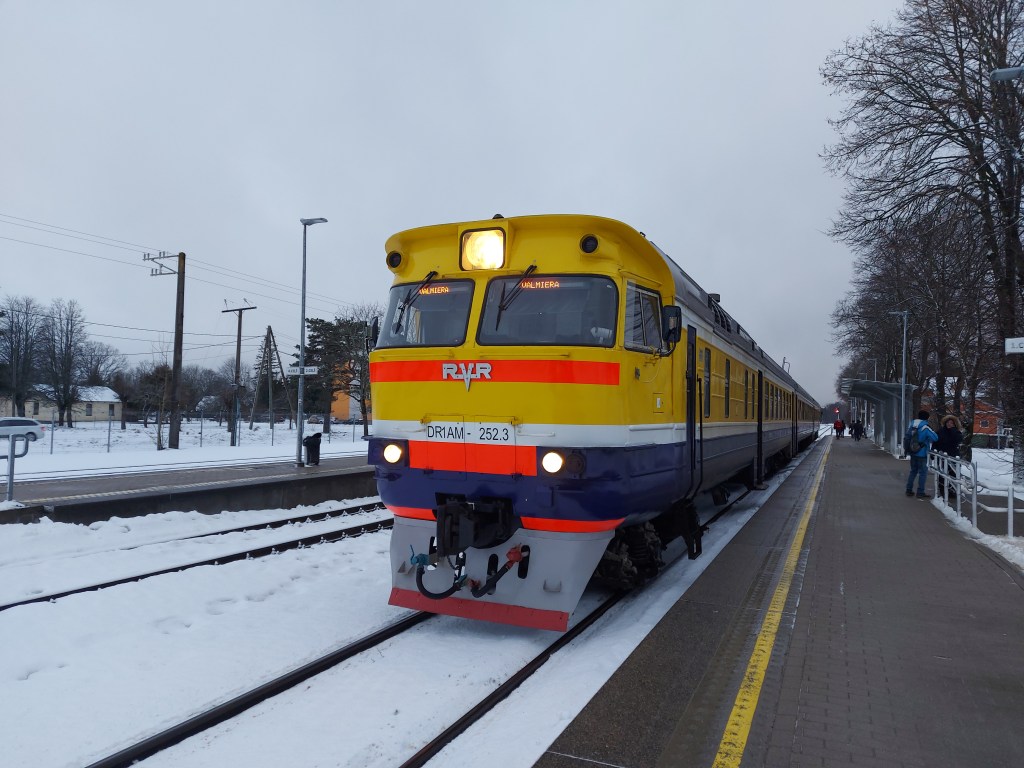
My train to Sigulda, which was bound for Valmiera (a line which then heads towards Valga, Estonia)

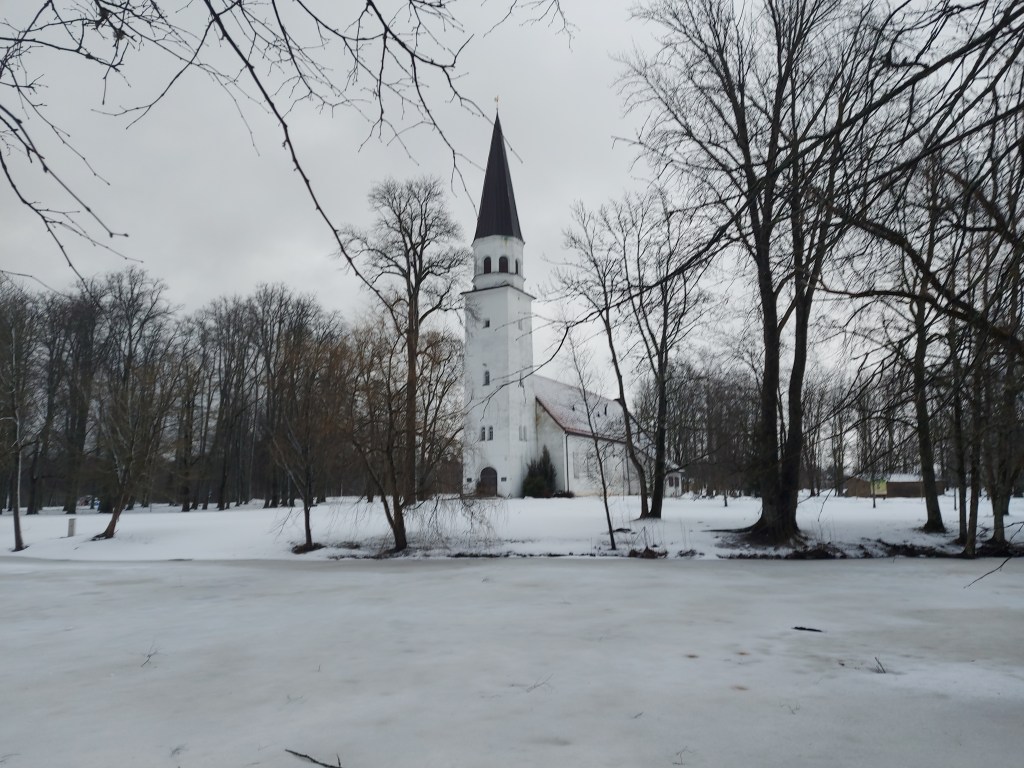
The first sign of civilisation along the long and not-so-winding road was the Evaņģēliski luteriskā baznīca, or Lutheran Evangelical Church, which sat next to a rather frozen-looking lake. A lone dog-walker (seemingly a feature of every deserted landmark in Latvia) made their way past me as I tried to make my way towards the castle.

Ominous church.

I did quite well in following Google Maps, but alas it seemed that I was either too early or plainly lost as it would appear that all of the grounds surrounding the castle were very closed. I tried to make myself look not-totally-insane by making a loop around a frozen pond which apparently played host to various forms of wildlife when it wasn’t resembling a flavourless slushie.

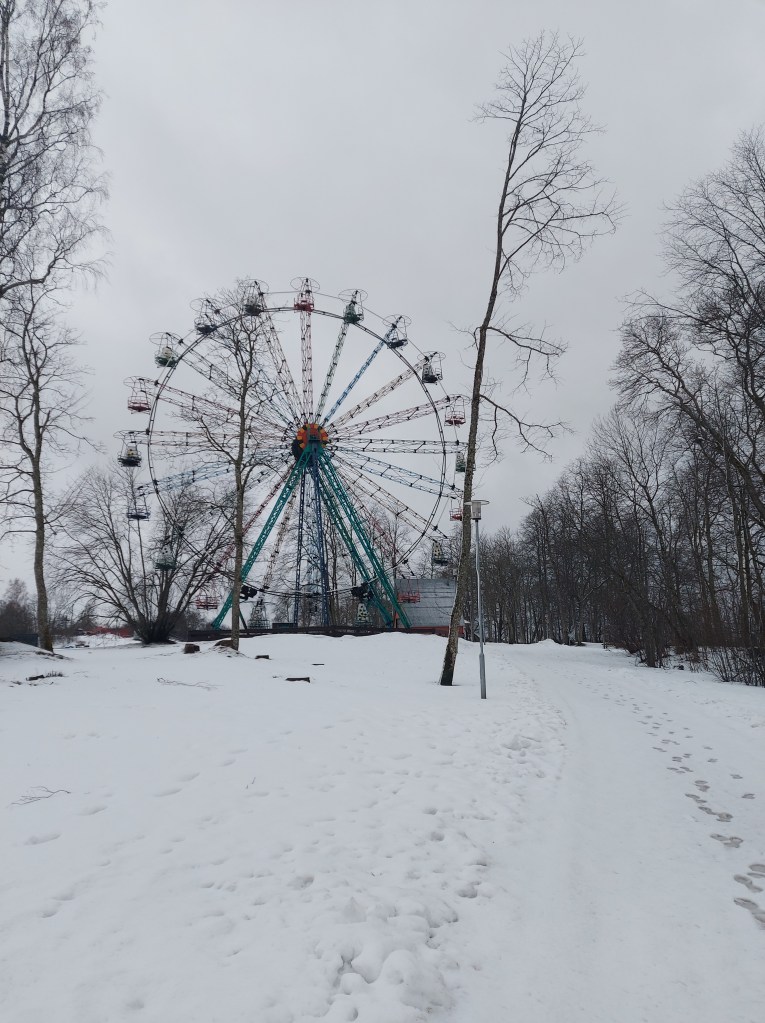
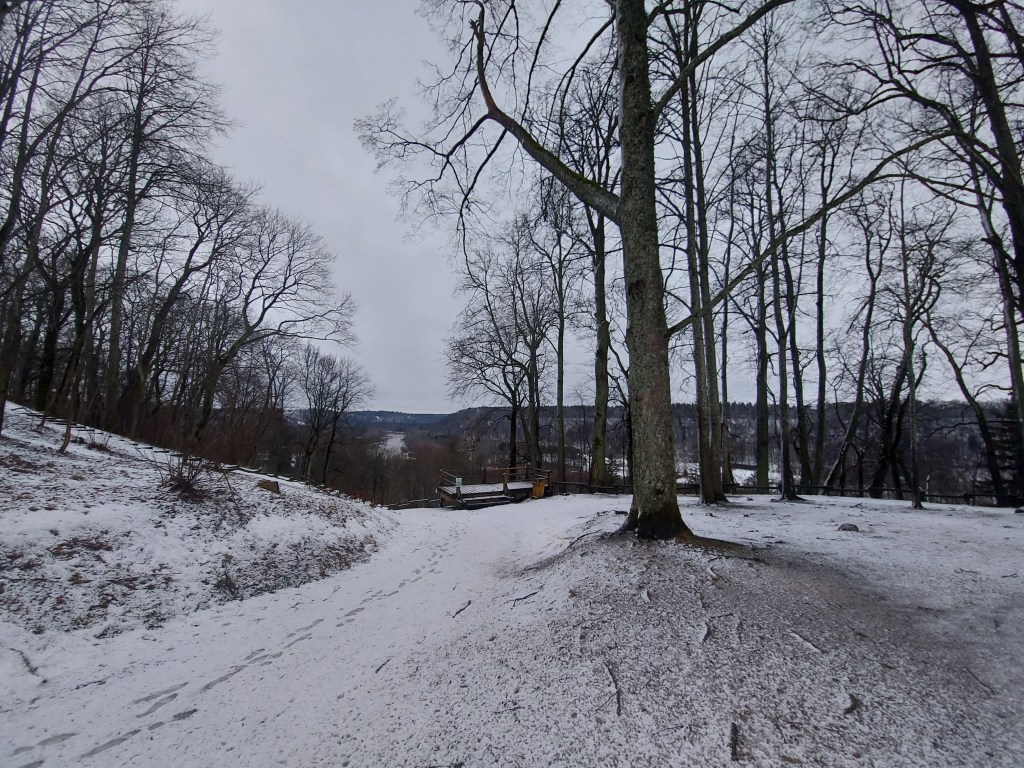
I ended up on a path high above the River Gauja instead, which I’ve no doubt again plays host to various events and a plethora of happy families at warmer times of year. Instead, we had a Soviet-esque Ferris Wheel and a couple of dog-walkers for company as I sized-up the best vantage points for photos without meeting an untimely death several hundred feet below.

Bald and Bankrupt-approved Soviet Ferris Wheel.

No doubt, in warmer weather, Sigulda is an absolutely magical place. That said, I wasn’t entirely annoyed at the wintry mystique that it held as I realised I was absolutely fucking starving and headed for the nearest supermarket. None of what I bought vaguely resembled breakfast, but pistachio eclairs and Kvass sounded healthy enough to me as I clambered my way up onto the train back to Riga.

With the Dark Tourism website as my guide, I headed for the bus after we arrived back at Riga’s main station, with me passing various signs pointing out the departure locations of trains to Minsk, St Petersburg and Moscow. No doubt, COVID-19 had put paid to such services and the subsequent Russian invasion of Ukraine hasn’t done that any favours.

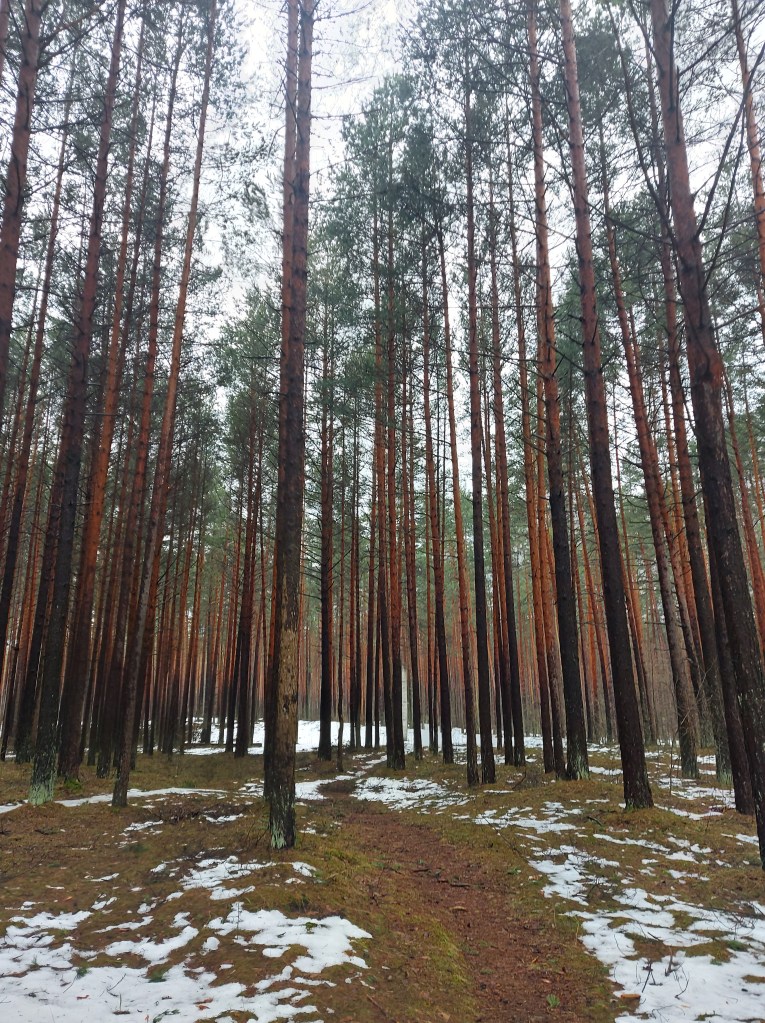
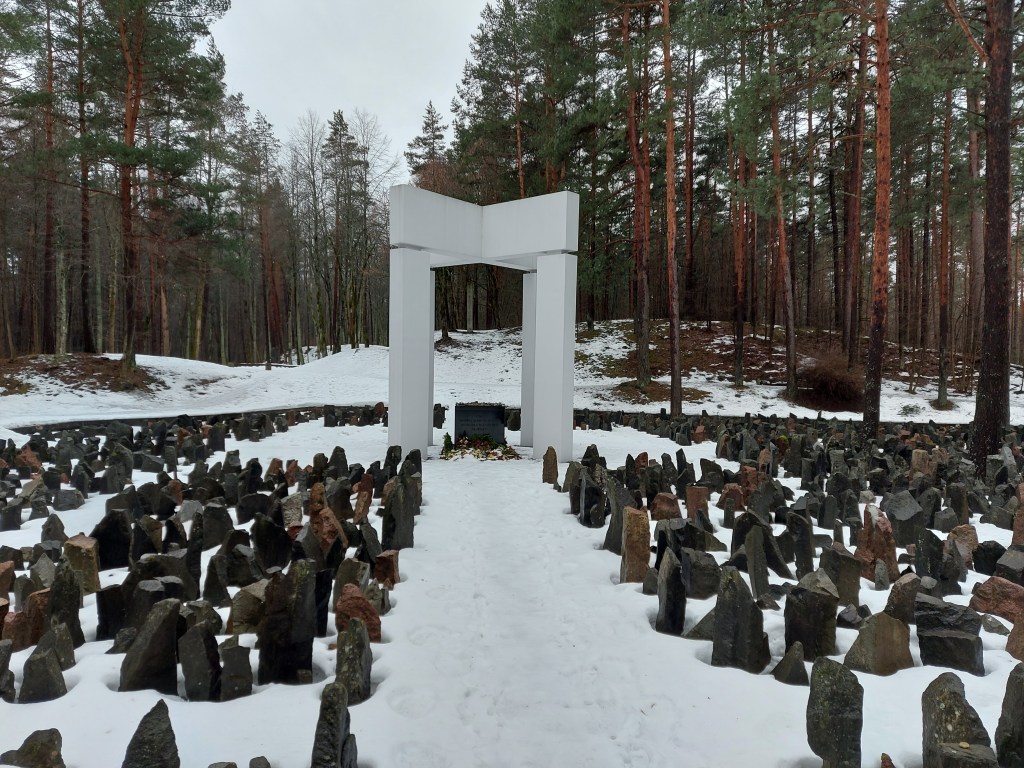
My next stop was the Biķernieki forest, which lay at the side of a road a few miles out of Riga proper. After the bus made its schlep through suburbia, we seemed to enter the middle of nowhere just as my cue came to press the bell and jump off. It went against all normal instincts to head straight into this creepy-looking forest that lay in front of me, but I went for it and started walking. Small markers with the Star of David started to appear between the tall trees, with I was soon confronted with the main memorial, with roughly 5,000 granite stones representing typical Jewish tombs.

Biķernieki was, basically, a killing forest. It was used by the Nazis to slaughter around 46,500 Jews with their bodies being buried in mass graves. I was alone there, no doubt, because it was the middle of February and I was in the middle of a forest, but it was absolutely haunting to know the atrocities that took place exactly where I was standing. It was even worse knowing that unlike in Western Europe, such atrocities were only followed by further oppression and atrocities too.

Having soaked up what lay around and underneath me, I headed back to the main road and took the bus back into the centre. I stopped off at the Elkor Gift Shop for some souvenirs for home, being rather taken aback by the demand for my vaccination pass (indeed, the Latvian state of emergency at the time meant that getting in just about anywhere required this).

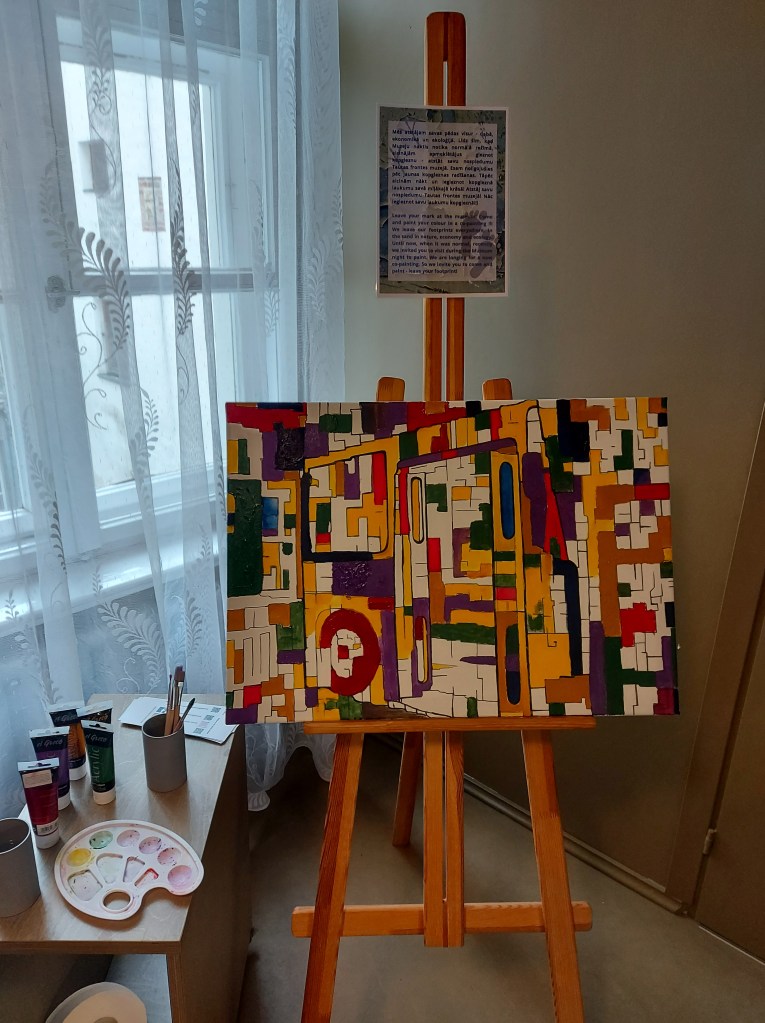
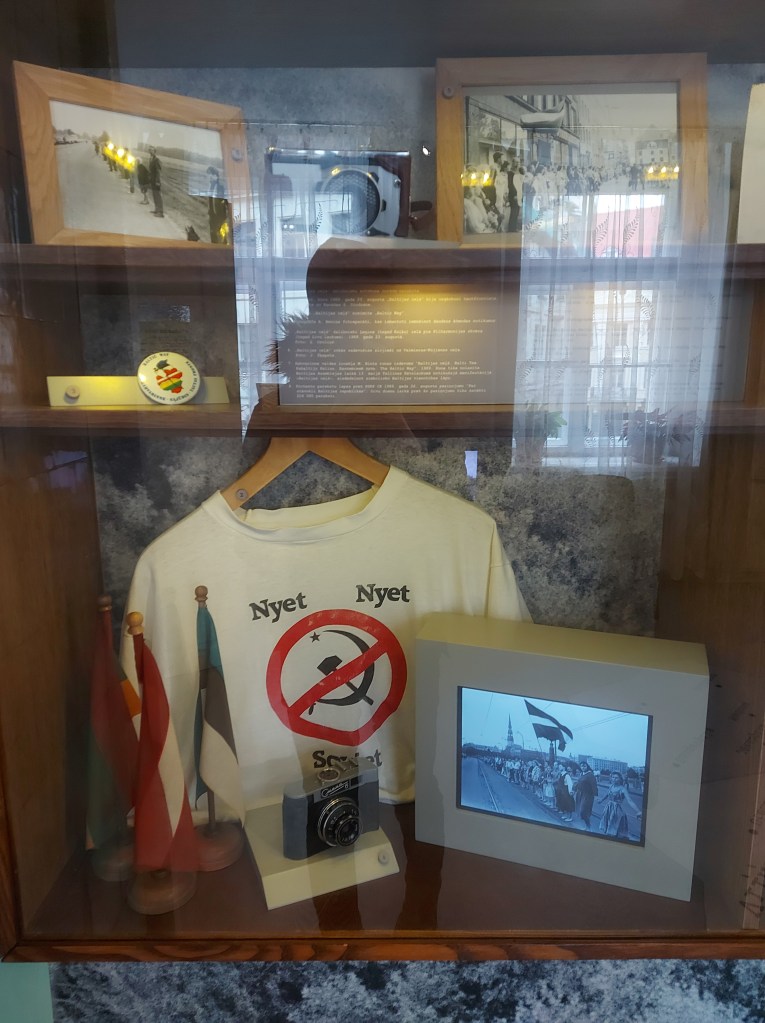
My next stop was the Museum of the Popular Front of Latvia. It was a slightly jollier affair than the museum I’d visited the previous day, telling the story of the road to revolution. Again, it was entirely free to visit, though donations were welcomed. The museum spanned across several floors, beginning with the initial struggles for independence, the revolution and finally the first steps of Latvia as a democracy. There was also the rather adorable opportunity for me to try my hand as an artist:

It was a fascinating hour or so, and I was then left pondering how I would spend the rest of my afternoon.

I ended up in a fancy-ish shopping centre, picking up some more Kvass to quench my thirst. It’s an odd ol’ drink, best described as kombucha, rye bread and malt loaf shagging over a plastic bottle. Alas, I had to show my vaccination pass three times in my twenty minutes or so spent wandering around. It was a bizarre contrast to the UK, where restrictions were nearing non-existent.

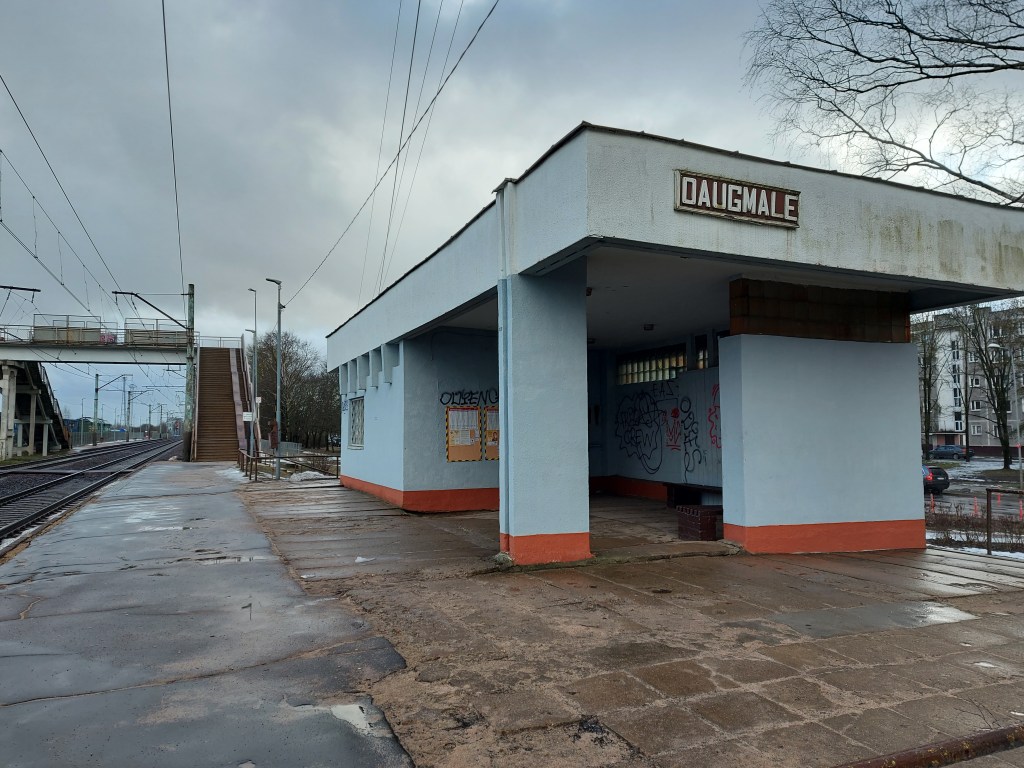
With rain starting to come down, I ended up taking a tram right to the end of the line near Daugmale, in the south-eastern suburbs of the city. It was then about a fifteen minute walk through some slightly dodgy-looking Commieblock estates to Daugmale Station, which lay on the mainline towards Ogre (hello Shrek fans) and Daugavpils. I whiled away my wait for a train back towards Riga Pas. watching the freight yard comings and goings and ignoring the massive ‘no photography’ signs.

With little else to do in the pouring rain, I ended up taking another train towards Jelgava, around an hour south of Riga, when I reached the main station. There’s little to say about the journey there and back, other than that it was decidedly bleak but an interesting (and very very cheap, and warm) insight into provincial Latvian life. All that was left was to head for the nearest branch of Rimi and pick up some sandwiches, weird sliced meat, and beers for the evening, before getting ready to fly back to the delectable London Luton the next morning.

The beers were terrible. I don’t know what it was, but they both tasted exactly the same and were like licking a musty floor. Which is something that, of course, I have extensive experience in.

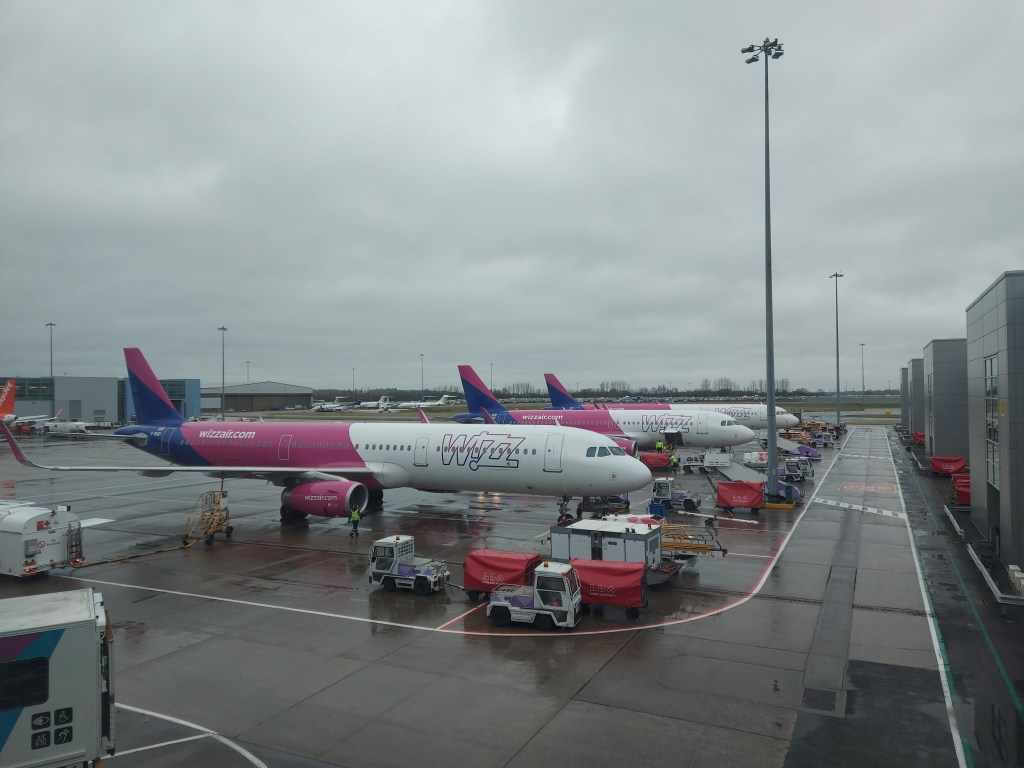
Of course, landing in Luton was ten times worse.

AAAAAAAAAAAAAAAAAAAAAAAAAAAAAAAAAAAAAAAAAAAAAAAA

Going Latvian: 1

Prelude

Being frank, I didn’t exactly book a trip to Latvia because I absolutely wanted to go there and had my heart set on it. I booked it because it was a new country, relatively easy to get into and the flights were cheap. Little did I know that I would end up so invested in a country and its history. Of course, I had few storms and hiccups to dodge in the process.

At the time of writing, Europe is also entering an uncertain period, with Russia having invaded Ukraine. This makes looking back, in hindsight, at a trip to a country which fought to break away from Russia and retain its identity, all the more poignant and at times, chilling.

We start this story at 9pm on February 17th, as I was making my way back towards Central London after having spent the evening with a friend in Chichester. As we were approaching Horsham, the conductor made the bleak announcement that “most services tomorrow are cancelled, including everywhere in Wales and much of the South East. It’s going to be a bit windy.”

The lass across from me grimaced and uttered “I pay too much for this shit“. Feeling sarcastic, I responded with “I used to work for the railway until yesterday, how do you think I feel?” The irony being that she’d short-fared and bought a ticket for half a journey anyway. Her input of “yaaaas, power to the people” suggested that maybe alcohol or drugs were also at play here, but who was I to judge, as I sipped on my M&S Bramble Gin.

I knew for a fact though, that I was trying to outrun a storm. Storm Eunice, to be precise. Weather warnings were gradually seeing the country painted in Yellow, Amber and the deadly Red colours as we were told that chaos was to come. Meanwhile, I had more important things to worry about, such as the fact that I was getting a bit chilly outside of London Bridge Station and really needed the bus to Liverpool Street to hurry up. After all, I had to get to Stansted Airport, sleep, then catch a bastard 6am flight.

For some reason, it took an absolute age for one to actually turn up, in which time I could have not only walked but probably swam across the Thames and had 12 pints in the Queen Vic. Alas, the 388 did eventually grace me with its presence, in the process giving me just enough time to purchase a ticket to Stansted and nab a can of lager from the M&S upstairs. It was just approaching 11 as I left Liverpool Street in relative solitude, with a few hardy souls leaving us at Harlow Town & Bishops Stortford.

For some reason, we had a bizarre influx of suitcase-wielding folk joining us at Stansted Mountfitchet, the Airport’s namesake which is in fact just a sleepy village to the west. One can only assume that they boarded a ‘Cambridge’ train and realised their mistake about 10 stops later, which of course is an easy mistake to make, considering that ‘Cambridge’ and ‘Stansted Airport’ are indeed one and the same.

There were surprisingly quite a few people on the platform at Stansted heading back to London, but unsurprisingly very few of us actually getting off the train and heading towards either the terminal (for the very brave) or nearby hotels. I was staying in the Premier Inn, and so I headed for the shuttle bus, which very conveniently proceeded to fucking leave as I walked up to the stand.

Having concluded that I would rather die than spend half an hour in the cold staring at an empty bus station, I clocked an Arriva bus bound for Harlow in the next stand over getting ready to leave. A quick look at Google Maps suggested that it went near-ish to the hotel, and I’d probably only have to take my life in my hands a few times to get to the hotel. Plus, it likely wouldn’t set me back £4 (unlike Mr Shuttle) so what did I have to lose?

The driver was perplexed that I even wanted to get on, suggesting that I needed to wait for the actual shuttle bus which went directly to the hotel. He didn’t seem to understand that I wasn’t arsed about the walking involved, but I just wanted him to do the bulk of the work and I’d walk across a few fields, dual carriageways or death-traps afterwards. Having pointed at the stop I wanted on Google Maps, he squinted at it, and simply replied “ah yes, that’s only one stop, I’m not charging you for that” and gestured for me to take a seat. What an absolute legend.

I was relieved to be at least getting out of the Terminal area, which did entail a good two minutes or so of my new best friend hot-footing it down a dual carriageway. That is, apart from the brief pause when somebody decided to do a U-turn on a roundabout.

As we approached the stop, he said “you’ve got some walking, yes?” and I laughed this off, merely thanking him for his generosity. We even waved to each other as I headed for a literal field, while he swung off to the right onto another roundabout, into the night, towards the beautiful bastion of Harlow.

No kidding, I was very relieved to have my walking boots on. There was no lighting, no anything, as I squelched my way through a pitch-black field with my phone torch lighting the way. I was somewhat weary of the fact that this ‘field’ seemed to turn into a ditch before turning into a dual carriageway, so ended up cautiously edging my way along the side of it in the direction of the hotel, before sprinting across what felt like about 90 lanes of traffic.

Stansted isn’t designed for you to walk out of the terminal and go anywhere, and it shows. Granted, my hotel was about 35 minutes walk or so from the actual terminal, but I was really attempting the last eight or so minutes of that which was bad enough. Thankfully, once I’d played chicken with what felt like several incarnations of the M25, it was just a case of snaking my way through a service station to stagger into the Premier Inn and realise it was already past midnight when I had a 3:30am alarm.

Day one

The alarm was unwelcome and I certainly wasn’t in the mood to be getting up, but needs must. I judged that there was a bus due at 3:55am and made my way downstairs to the hotel entrance, alongside various other suitcase-pulling half-asleep zombies. When departure time came, I sauntered outside and then back in, when it was evident that the various buses going past weren’t for us.

“Can you come inside please?” was the drone of the receptionist as I was also causing the automatic doors to keep blowing in the increasingly brisk wind outdoors. Eunice was certainly coming.

The bus chose to turn up just past 4, and proceeded to sit and wait for nearly fifteen fucking minutes until it was so full nobody else could board. The first flights leave Stansted just before 6, so this was a great way of ensuring that everyone had to rush that little bit more around the terminal. Thankfully, I was at security for 4:25, having struggled to ram everything inside the always slightly too small liquids bag.

Stansted is essentially the bus station of Airports. There’s nothing pleasurable about it, it’s always impossibly busy, but it’s functional and you get to where you need to be. At least I only had an hour so to contemplate the excessive amount of people sleeping on benches and having 5am £50 pints of Fosters.

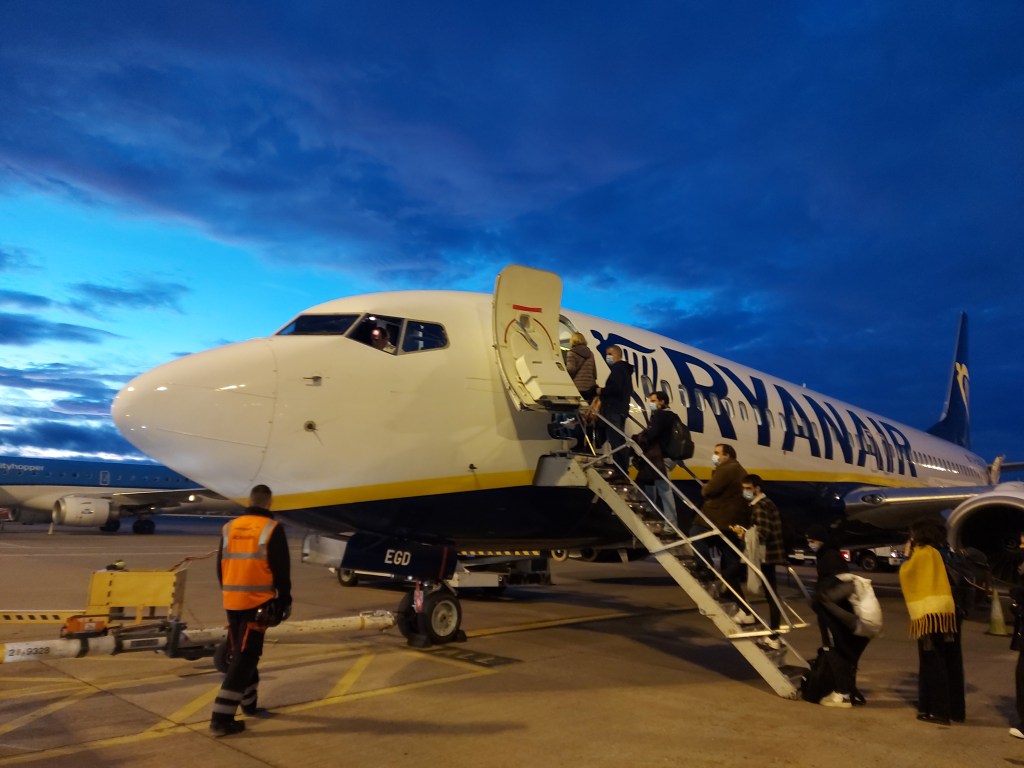
It was just a little bit chaotic when the gate was announced, as just about everyone descended on the shuttle train. Yet, there was a bizarre serenity in the boarding process, with the agent asking me if they’d actually announced it in the main terminal. Boarding was then the typical Ryanair fashion, with an awful lot of queueing halfway down some stairs before being subjected to the wind blowing a hoolie across the tarmac.

It was also a fully booked flight, and I wish I could tell you more about it, but once we took off in somewhat lively fashion and were thrown about a bit, I was out cold until we were on the approach to Riga. One of the flight attendants was wearing a Ryanair Scratchcard lanyard, I can tell you that much.

Riga Airport was modern and fairly uncomplicated, though passport control felt like a throwback to the Soviet Union, with officers in highly elaborate uniforms giving everybody a bit of a grilling. I was asked why I was there, where I was staying, if I had a return flight booked and for all of my health documentation. To be honest, fairly bog standard stuff but when you’ve been used to the heady days of the pre-Covid EU and waving your passport willy nilly, it was a bit of a faff.

It was cold too, really cold. I batted away a taxi driver and made my way to the windswept bus stop across from the terminal building, paying the 10EUR for three days travel on public transport and hoping that the bus would turn up sooner rather than later.

Sooner it indeed was, with it only being a few minutes until I boarded the 22 into the city centre, being taken down various nondescript highways and through uninspiring suburbs to the banks of the Daugava, where I swapped to the tram around the corner to 13. janvara iela, on the edge of the old town. I didn’t really have any idea where I wanted to go, other than that I needed to have a good wander around and appreciate some old buildings.

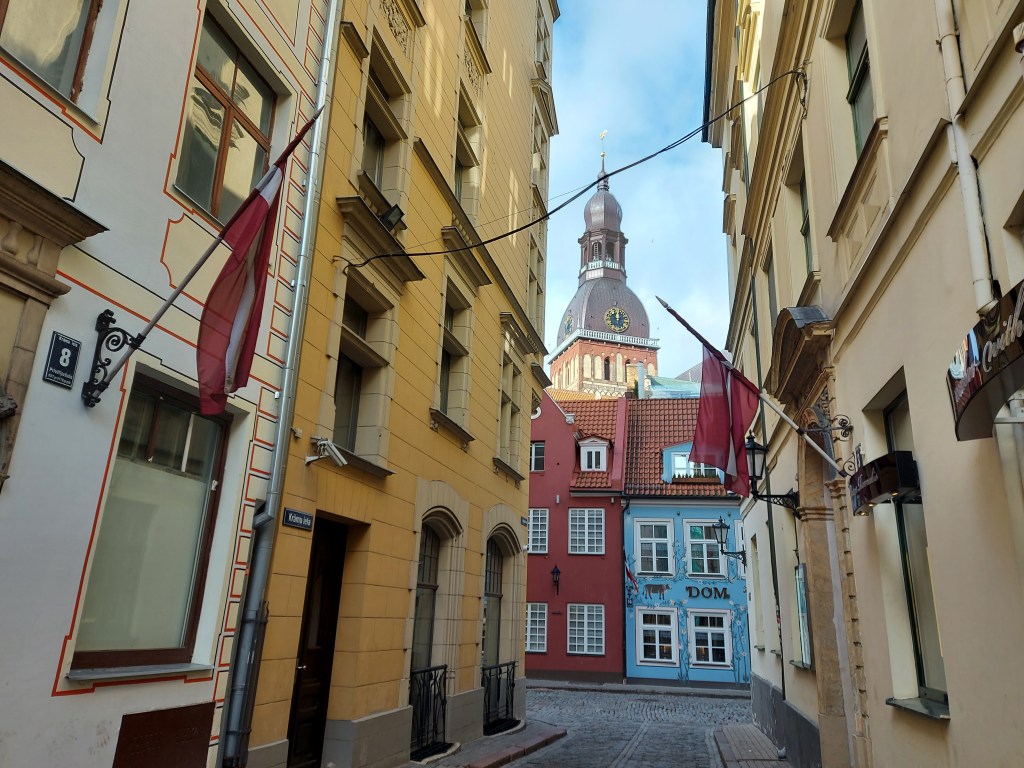
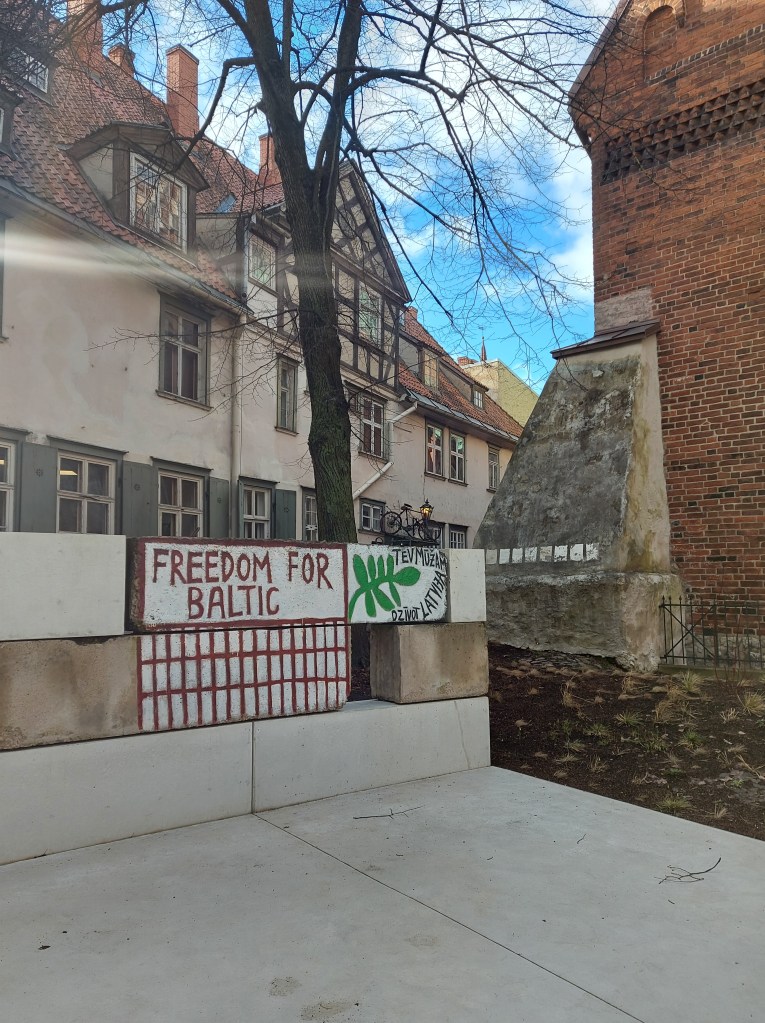
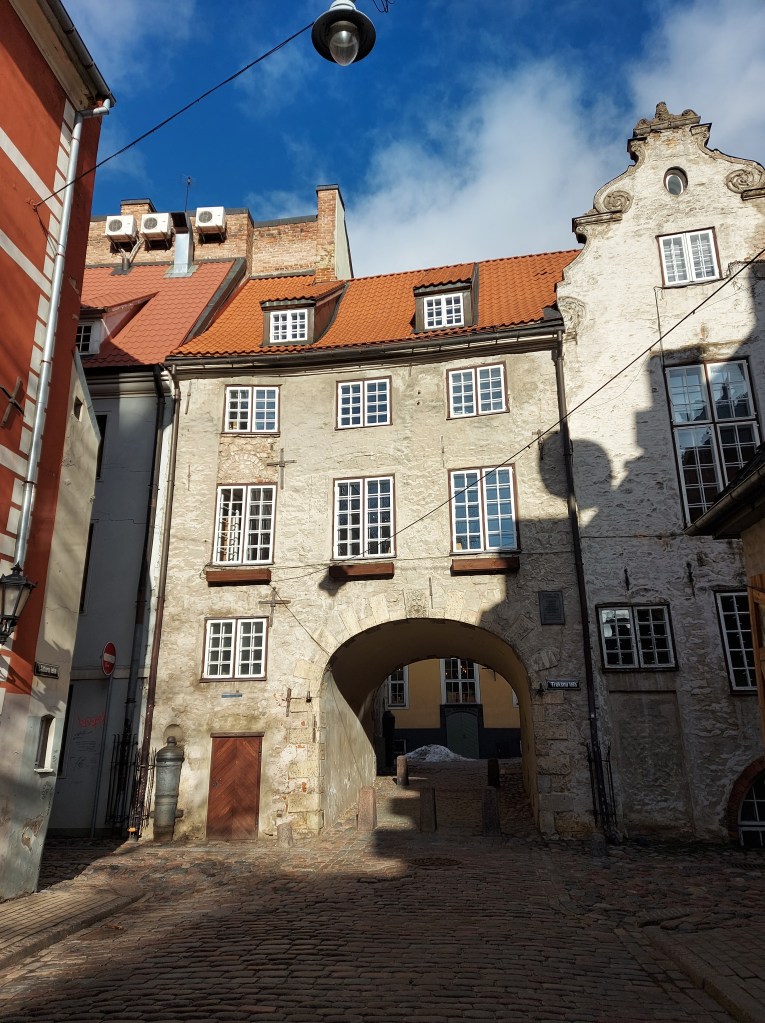
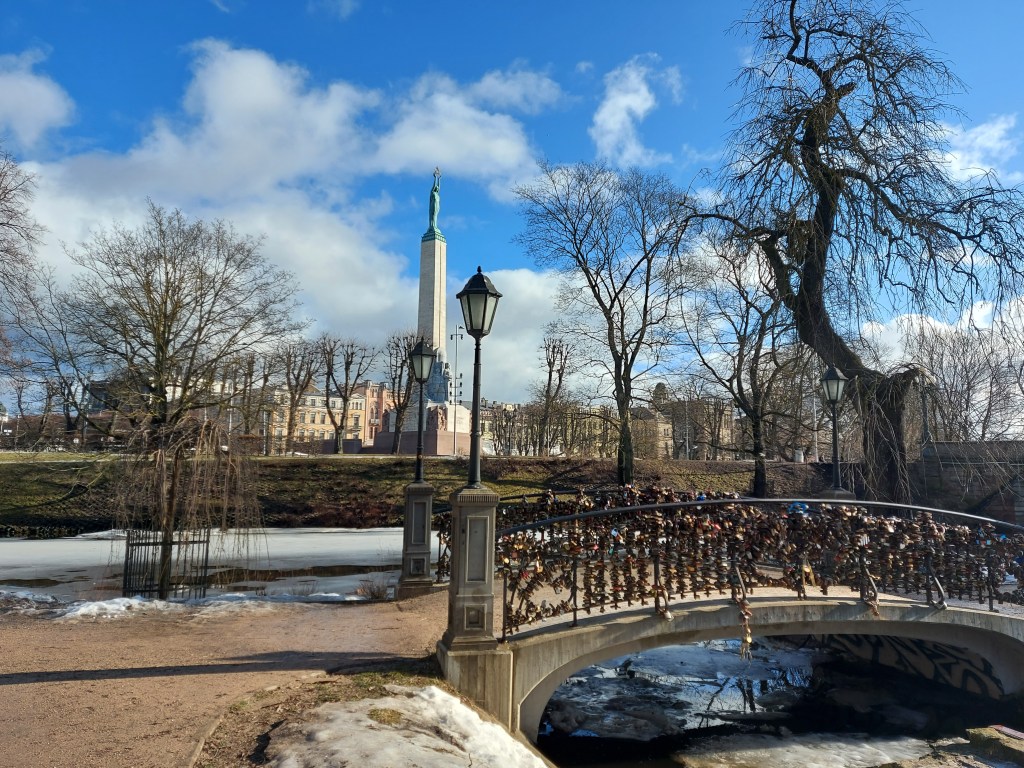
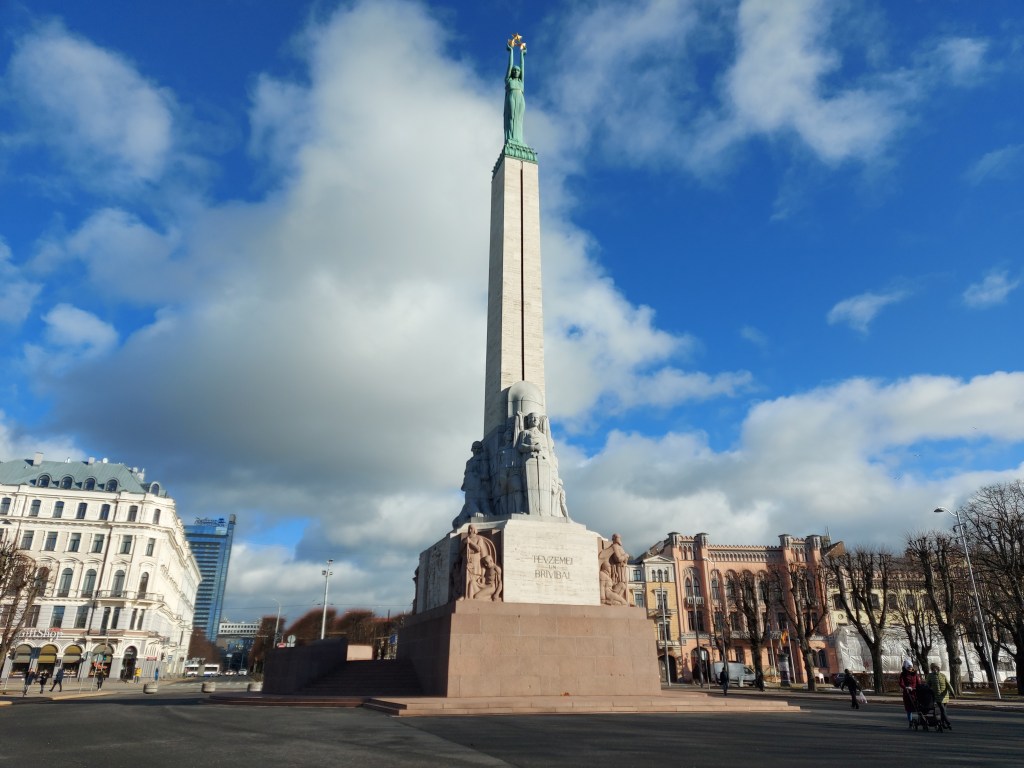
Appreciate some old buildings I did, taking a winding route around the various churches, past the Swedish Gate and to the Brīvības piemineklis (Freedom Monument), which commemorates those who lost their lives in the Latvian War of Independence between 1918 and 1920. Alas, it wouldn’t be the last time that Latvians had to fight for their right to exist as an independent country. So poignant was the moment that I almost missed the fact that my phone had decided to go from 50% to dead in a matter of fucking seconds, such was the pain of the cold.

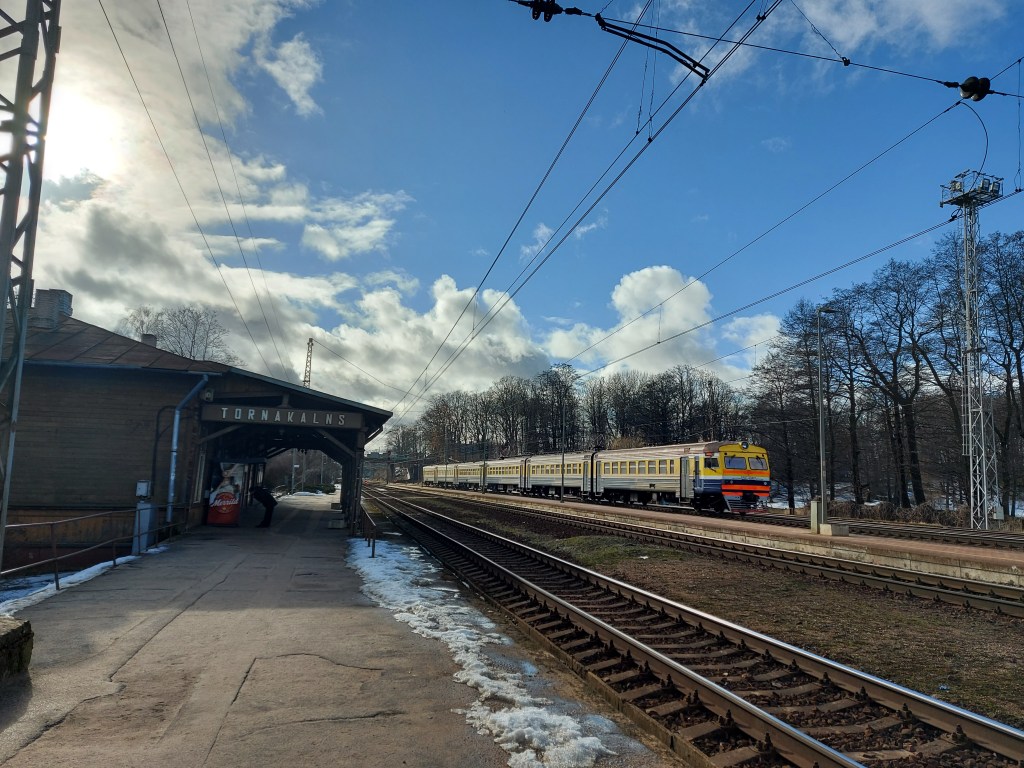
I became a little sick of walking, so took myself to the main railway station and decided to board a random train out to the suburbs. I settled on Tornakalns, being a short hop away across the Daugava. I purchased my ticket for a whole £0.70 on the Latvian Railways app, and psyched myself up for having to physically haul myself onto the classic ER2 unit, which is a mainstay of suburban railways across the entire former USSR.

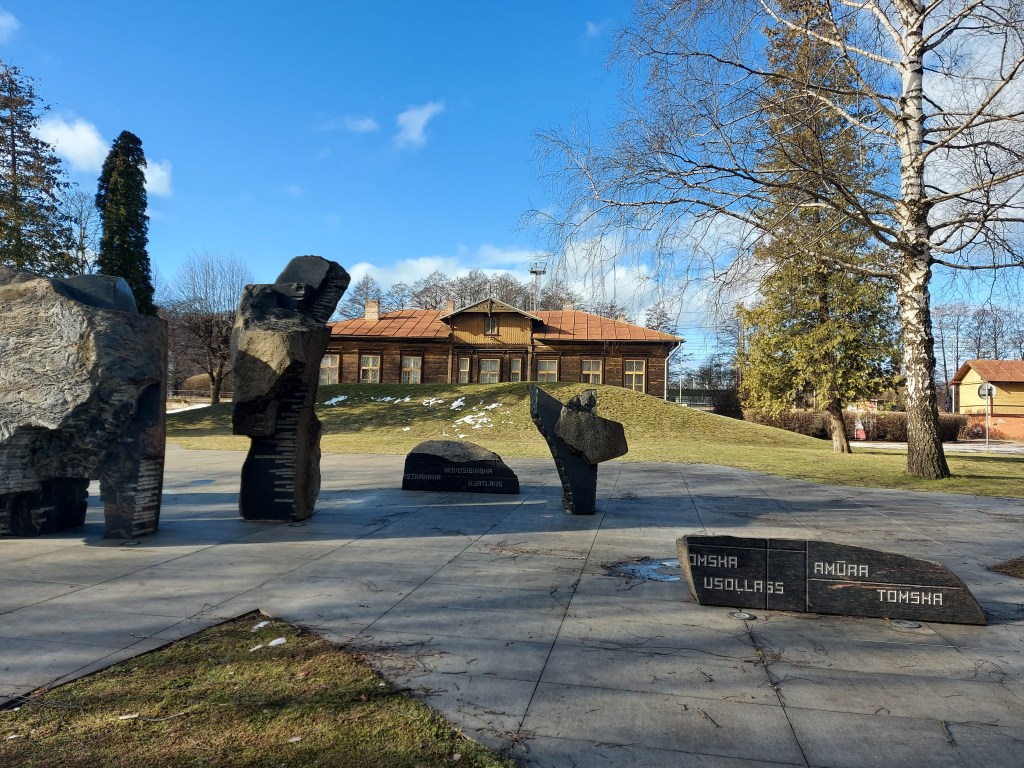
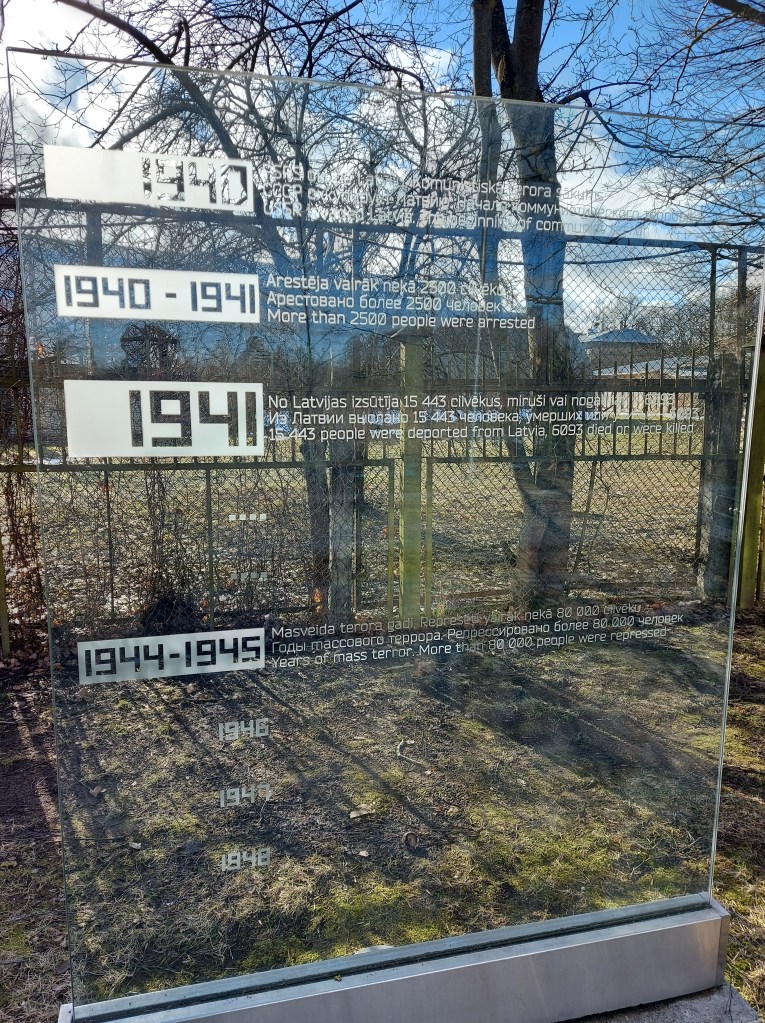
We shuddered our way over the Daugava rather slowly before pulling into Tornakalns, with an old bloke joining me in throwing himself down onto the platform. It seemed like a fairly quaint little suburban station, to be honest. That was, until I trudged my way outside and something didn’t seem quite right. There were various plaques stating place names across Europe along with a freight wagon and information boards. This station serves as a memorial to the deportations of 1941, where over 15,000 Latvians were forcibly sent to remote areas of the USSR. It was somewhat surreal that it was placed in a quiet suburb of Riga, but this is how the history of the Communist terror in Latvia goes. It gently follows you everywhere with subtle reminders. It doesn’t jump out at you but it’s always there.

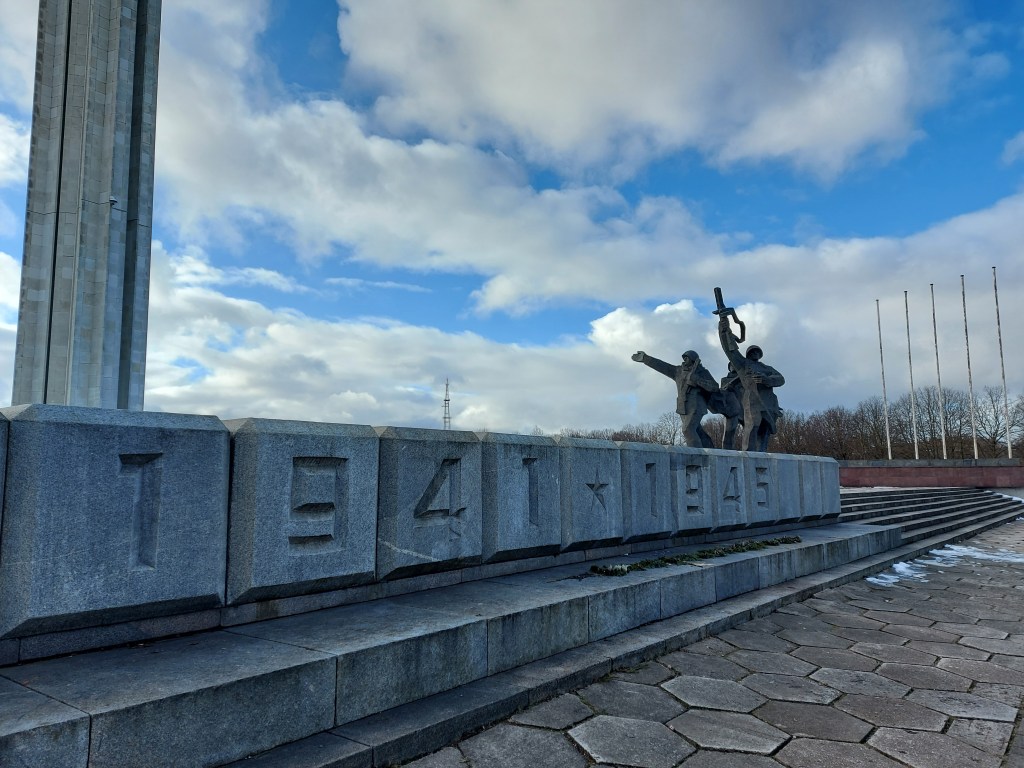
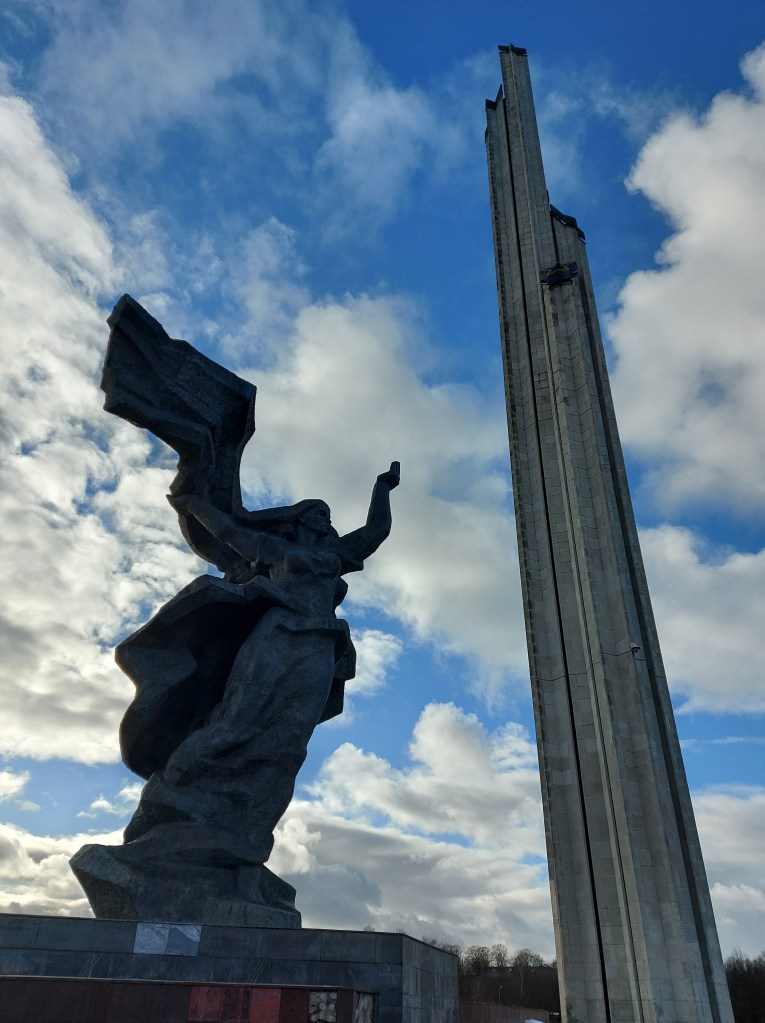
It was a short ride on the tram from here to the rather striking memorial to the Soviet victory in World War II. Suffice to say that despite a large Russian population in Riga, this memorial is not exactly popular and while enormous had certainly been left to rot. In fact, at the time of writing, following Russia’s invasion of Ukraine, discussions are currently underway to demolish it entirely. That’s not to say it hasn’t already been attempted, when members of the far-right Pērkoņkrusts group attempted to bomb the fucker in 1997. It didn’t work, though it did succeed in killing two of them instead.

The whole area felt rather windswept. It was imposing, yet everyone simply pretended that it wasn’t there. It formed part of a park chock-full of benches and other places to sit, yet the only soul in the vicinity was a lone dog walker (with a dog obviously, not just an empty leash). I was glad to have seen the Monument, but agree that the best place for it is either removal (and placement in a museum) or simply being left to rot. It is, after all, a monument to the so-called liberation of Latvia. All it is, is a reminder that one chapter of oppression was ushered in by another. There was no liberation.

I was starting to get bitterly cold as I headed further down the road into the suburbs for a bus back to the city centre. It was also getting quite busy as we approaching school kicking-out time, but thankfully it was also time for me to check into my hotel, the Pullman Riga Old Town, and take half an hour to lie down.

What a beauty the hotel was, too. It plays host to a very fancy restaurant (more on that later) and the whole lot is equestrian themed. I was also thrilled to see a bottle of local black lager waiting for me on the desk of my room, and I happily necked that back while working out what my evening would look like.

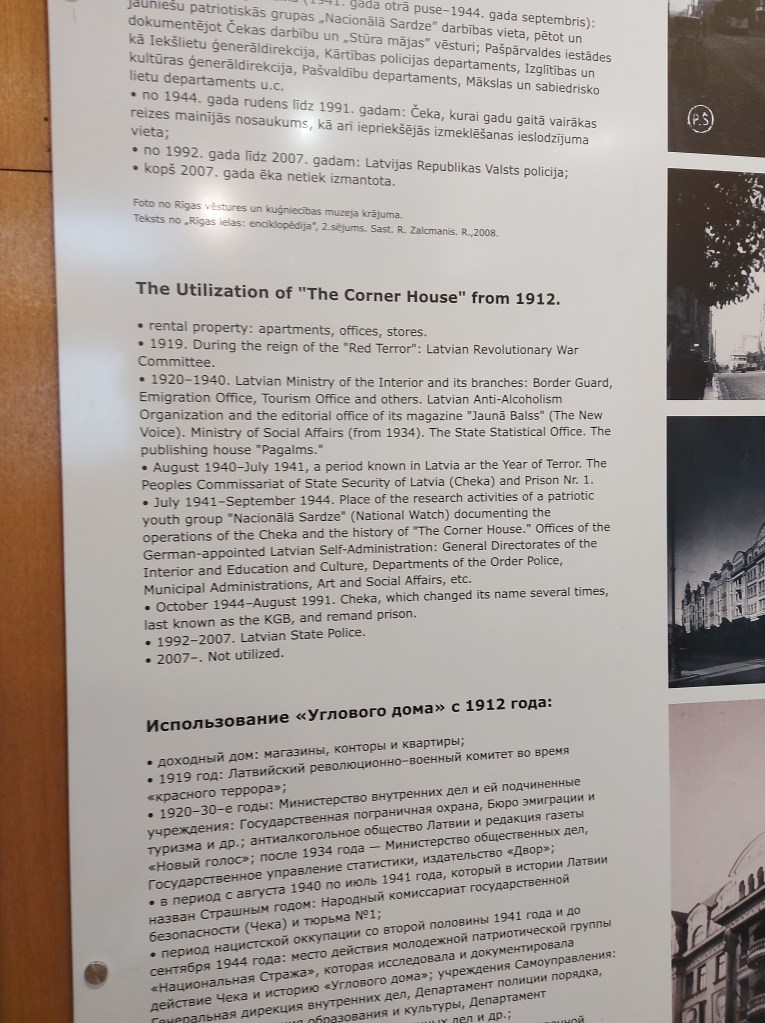
Of course, my first thought was to go to a building where people were previously murdered by the KGB. So, it was a quick hop, skip and a jump onto a tram to the ‘newer’ part of town as freezing rain lazily fell from the grey February sky. The ‘Corner House’ wasn’t exactly a very imposing building, blending into the cityscape like any other building, rather than being the headquarters of the Soviet’s secret police force.

A kind reminder from our friends on Riga’s Tramway that having a fight with the poles and snapping them in half is NOT permitted..

I almost questioned myself as I walked through the very non-descript door and waved my vaccination status at the woman behind the window. All of these museums are free, but donations are welcomed.

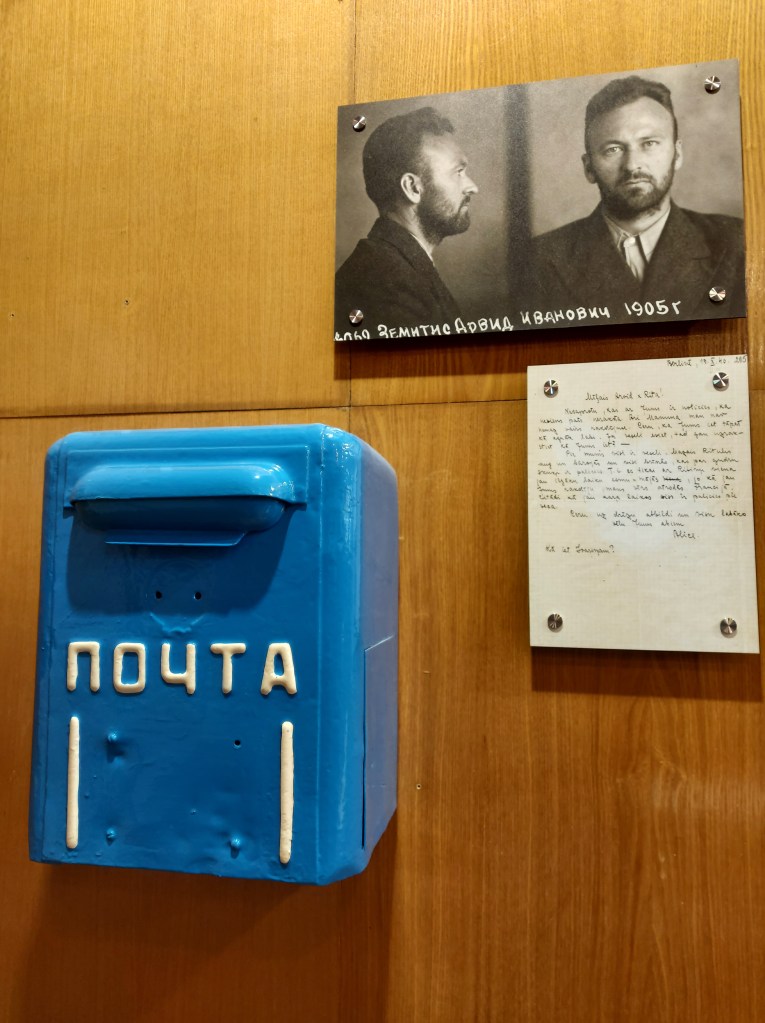
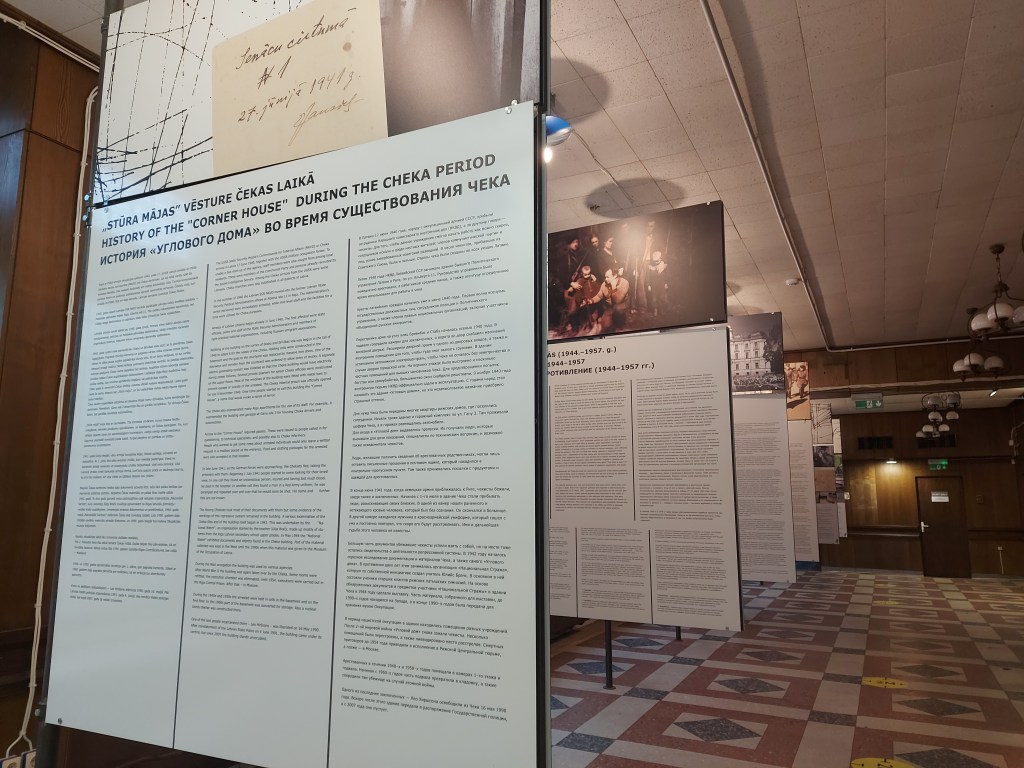
Straight away, I was faced by stories that ended with ‘they were shot in this room’ and ‘they disappeared into this building and were never seen again’. It was fascinating yet sobering. The tours through the different rooms discussed the different methods of control and fear used over the population, and the stories of those who dared to defy the oppressive regime under Soviet rule. In some cases, they weren’t even defying it, they just acted in a way that those in power didn’t like. Paranoia reigned supreme. It ended with a looping video of people telling their own stories of how families had been deported to Siberia for the most minor infractions. How they’d spent time in prison for expressing the fact that they were Latvian. Most of these people were still alive too. A great proportion of Latvia lives with this memory (as do the rest of the Baltics).

There’s a much larger ‘Museum of the Occupation’ which is currently in the final stages of reopening after refurbishment, which no doubt will provide significantly more depth to the information available at the Corner House. Alas, it was still closed when I visited and I had to think about what else there was to do on a rainy evening as darkness slowly fell.

‘Go to the grimmest, Soviet-esque industrial shithole you can find’, was my first thought, so I paid another 70p and took a peak-time train to Mangaļi. It was mostly full of commuters and shoppers, but there was the odd jolly alcoholic joining us too. I chose Mangaļi on the basis that it was only a short walk to the Mīlgrāvis tram terminus, which would then take me straight back to my hotel.

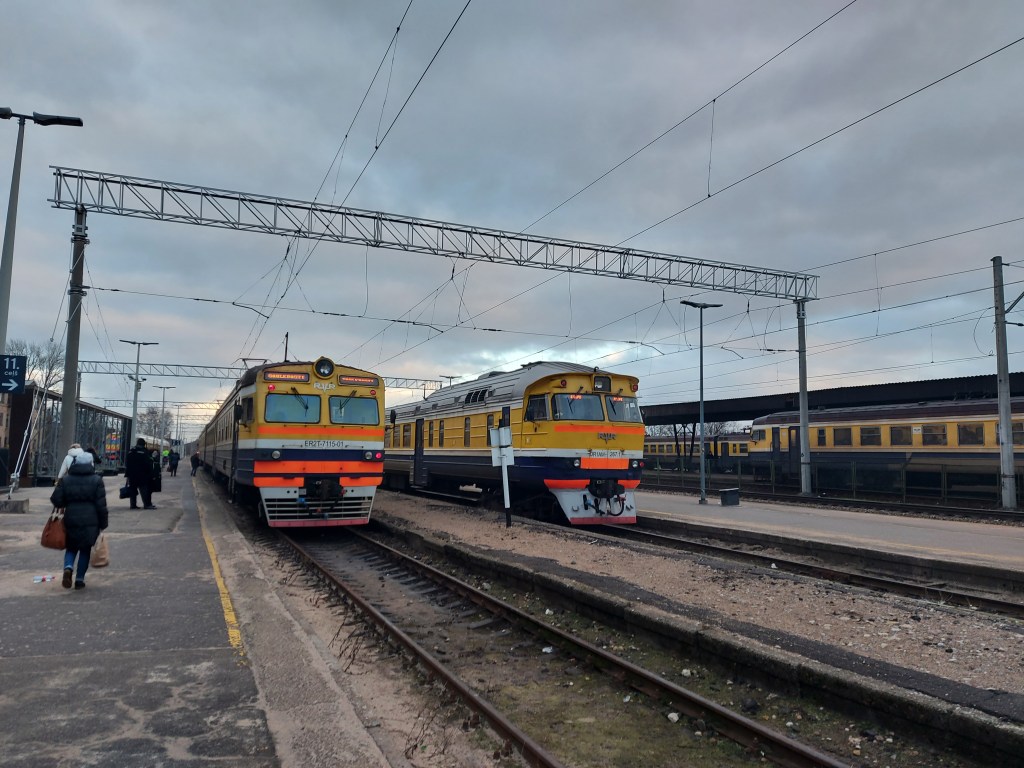
The exclusively Soviet-era fleet of Latvian Railways is…quirky, to say the least..

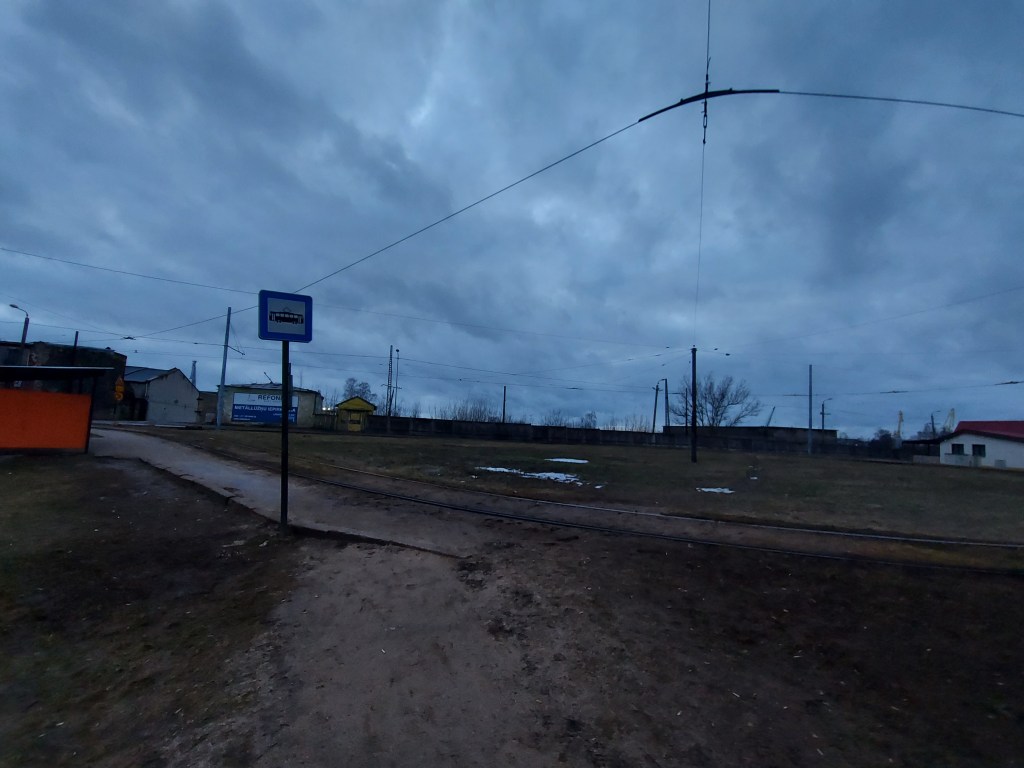
Around 15 minutes later, I was jumping off at my lovely destination and watched as everyone else wandered across the tracks through various holes in fences and across some scrubland. I was the only person walking towards Mīlgrāvis, which didn’t bode too well. I felt like a true Bald & Bankrupt as I trudged down a partially-flooded road and past various abandoned buildings. The entire place was like some sort of setup for a shooting range, with no actual people in sight.

I turned a corner and negotiated various roadworks and stepped over a set of rail tracks leading to a freight terminal. The air didn’t feel too clean and smoke belched out of various factories. It’s a bit crass to find such grimness interesting, but it was a marked contrast to the polished old town of Riga. This was the grey, industrial legacy of the Soviet Union. I’d just missed a tram though, so I had 24 minutes to admire this lovely terminus:

Back at the hotel, after a freshen up, I decided to take the plunge and see what this intimidatingly fancy restaurant was up to. I couldn’t find a menu online, so there was every risk that I’d sit down and scream at the prices.

‘Just you alone?’ asked the waitress as she took my drinks order. I nodded in agreement and wished I hadn’t just been called out on my forever alone status.

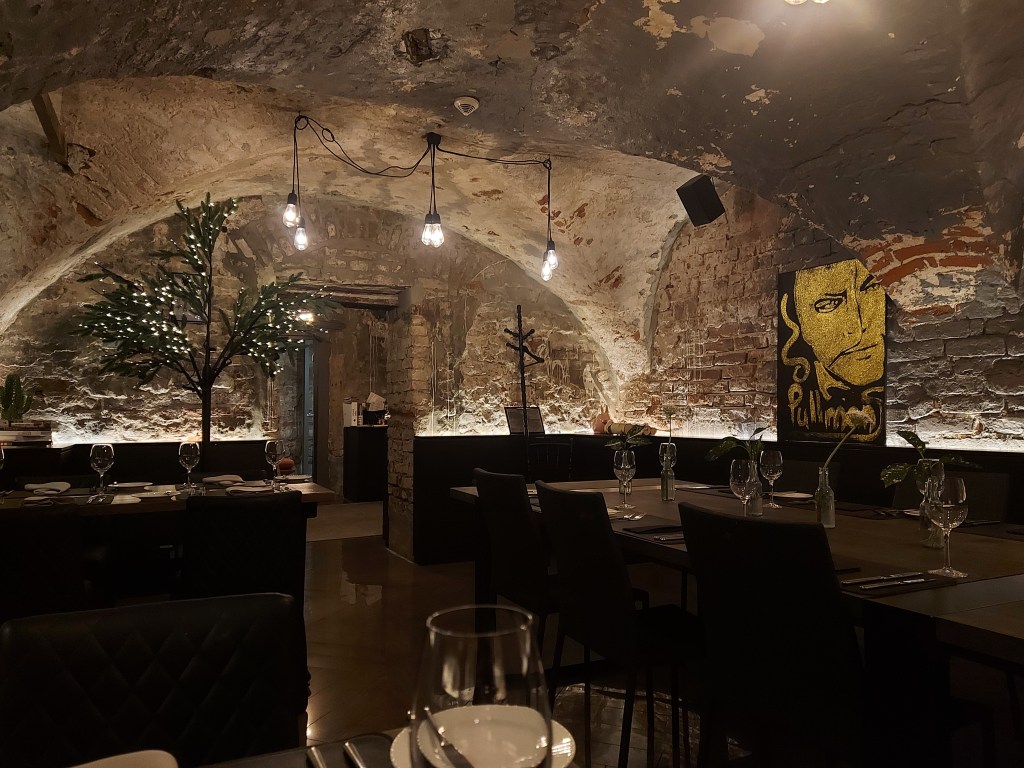
Cute, innit.

Thankfully the menu wasn’t horrifying, with all of the rather opulent sounding main courses being around £15-£20. It wasn’t cheap dining, but I wasn’t exactly feeling rinsed. I ordered the duck followed by a melt-in-the-middle cake served with Balsam (the true liquor of Latvia) ice cream. It was worth every penny. ‘Something else?’ I was asked. Yeah, my bed, I’m fucking exhausted.

To be continued…

To Portugal! #2

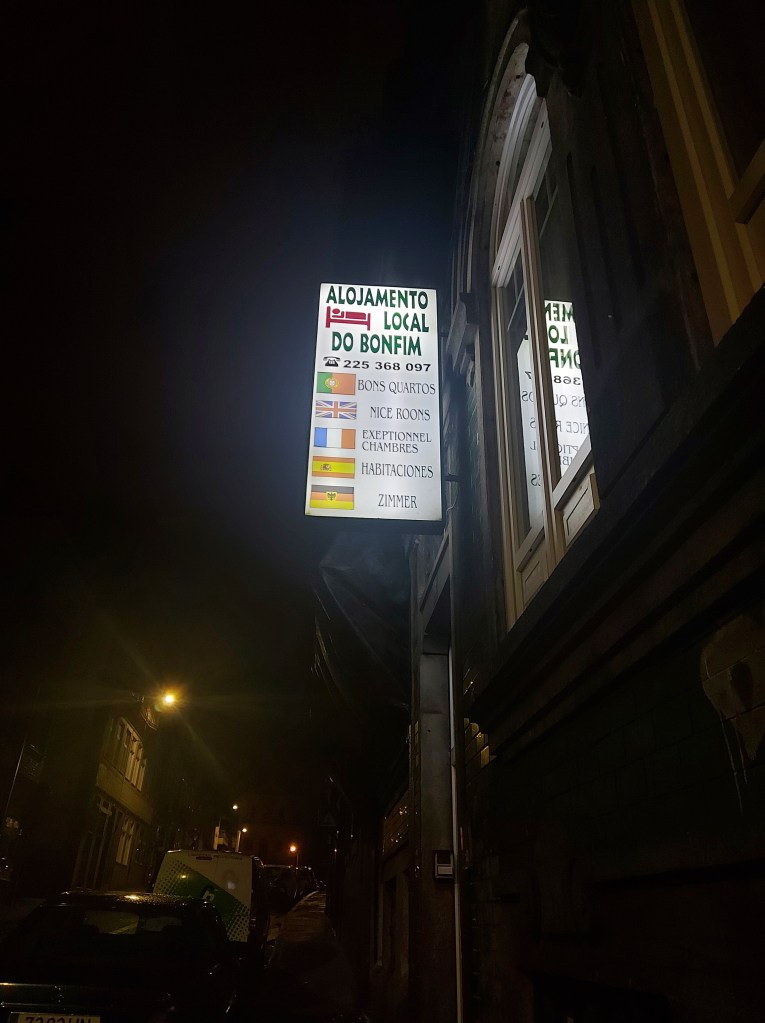
I woke up bleary eyed at around half 4 in the morning, cursing myself as to why the hell I’d insisted upon such a fucking early start, especially when it entailed walking through several dodgy areas of the city. Nonetheless, I was a sucker for punishment and headed out, with the charming streets of the city centre giving way to the gritty suburban edges. My morning was however brightened by this sign:

I mean, where do you start? What the hell is a “Nice Roon”? Why do the Spanish only get “Rooms”? Most of all, why the fuck does the defunct state of West Germany only get a singular room? It was half tempting to pop in and find out, but alas I had a train to catch.

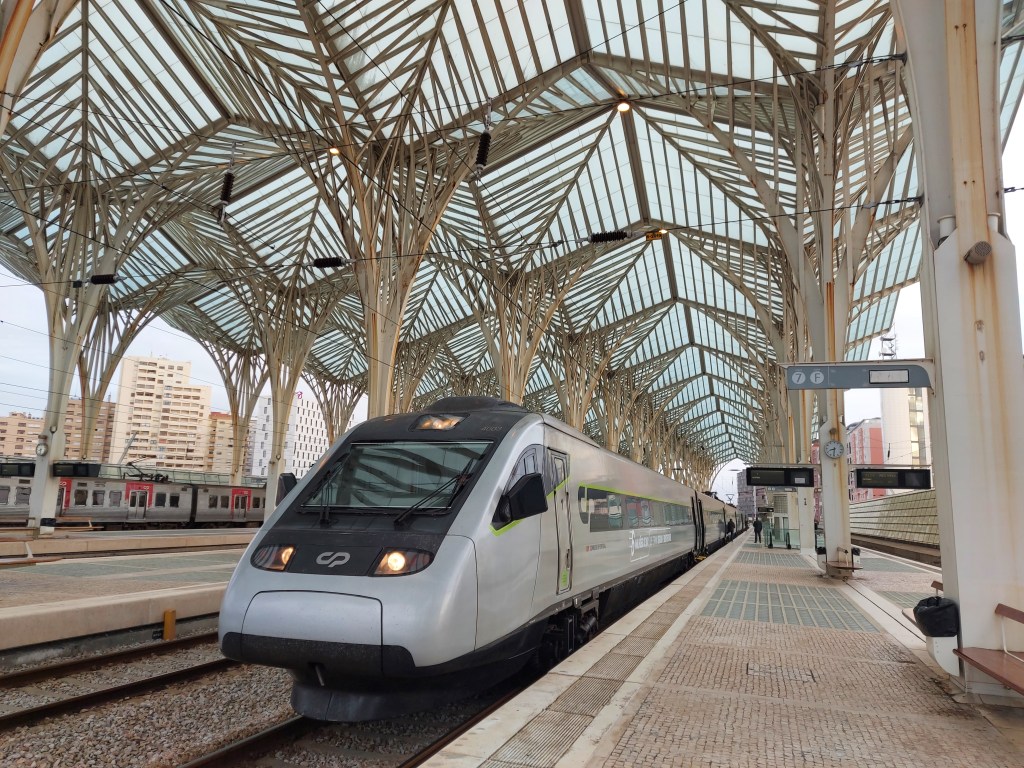
Soon enough, Porto Campanha came into sight, and I made my way along to, conveniently, the furthest platform from the entrance, for the Alfa train to Faro via Lisbon. It decided to arrive in just as it should have been getting ready to depart, so we were on the move sharp as I settled in for the three hours or so trip to the Portuguese capital. It was a rather jolty stop-start affair down to Aveiro, with me being conscious of the fact that we had seemingly lost a lot of the time in the process, but alas I was somewhat more conscious of my own sleep deprivation, and so I drifted off in my rather nice first class seat.

I awoke as we passed the railyards of Entroncamento, putting my phone back on charge that I’d kicked onto the floor in my sleep, and promptly drifted off again when I realised that we still had a reasonable distance to go. It took the sight of the Tagus river appearing to my left as we approached Alverca for me to realise that I really needed to wake up and not end up somewhere on the Algarve.

Lisboa-Oriente station is a rather flamboyant affair, though while eye-catching it is without a doubt absolutely useless for sheltering you from any of the elements, due to the fact that rain and wind are in fact capable of circumventing a roof that is approximately halfway to Mars.

At least it wasn’t raining…

Various snaking escalators and stairs took me down to the Metro station, and it took only mere seconds for me to be accosted by a scammer who appeared to be telling me about his plight in Colombia or something. Unfortunately for him, I was doing a stellar job of ignoring him (in multiple languages) with my headphones on maximum, and I proceeded to purchase my day pass and pass straight through the gates. Unfortunately, I was so focused on ignoring him that I entirely ignored the signage too, proceeding to end up on the wrong platform.

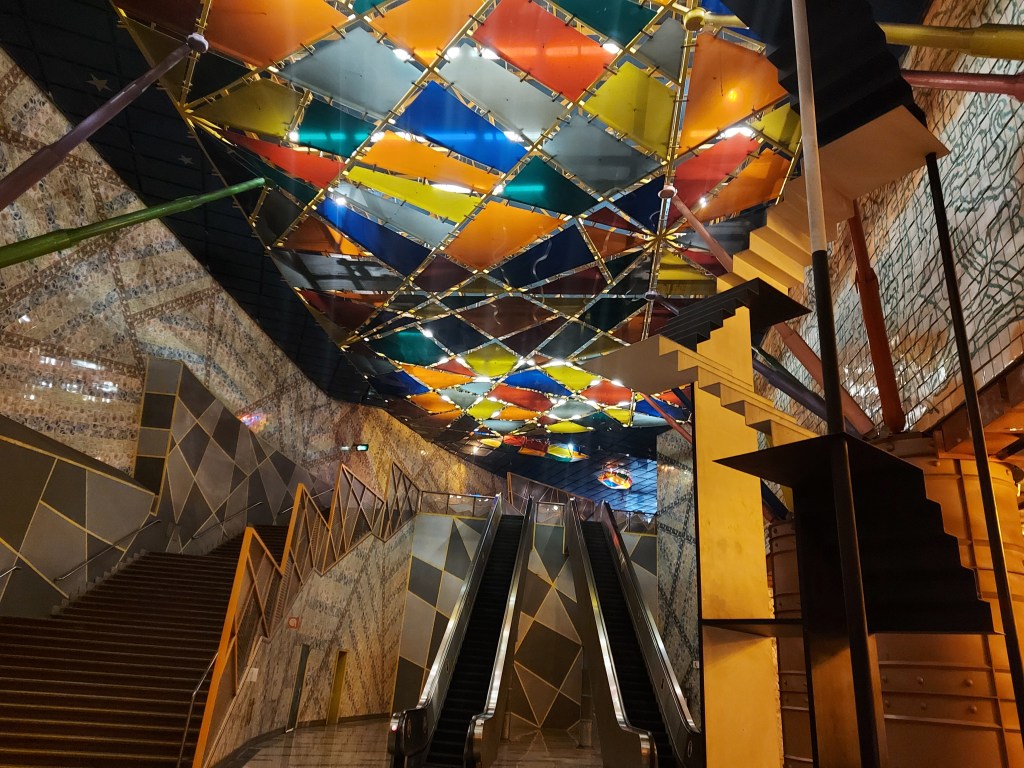
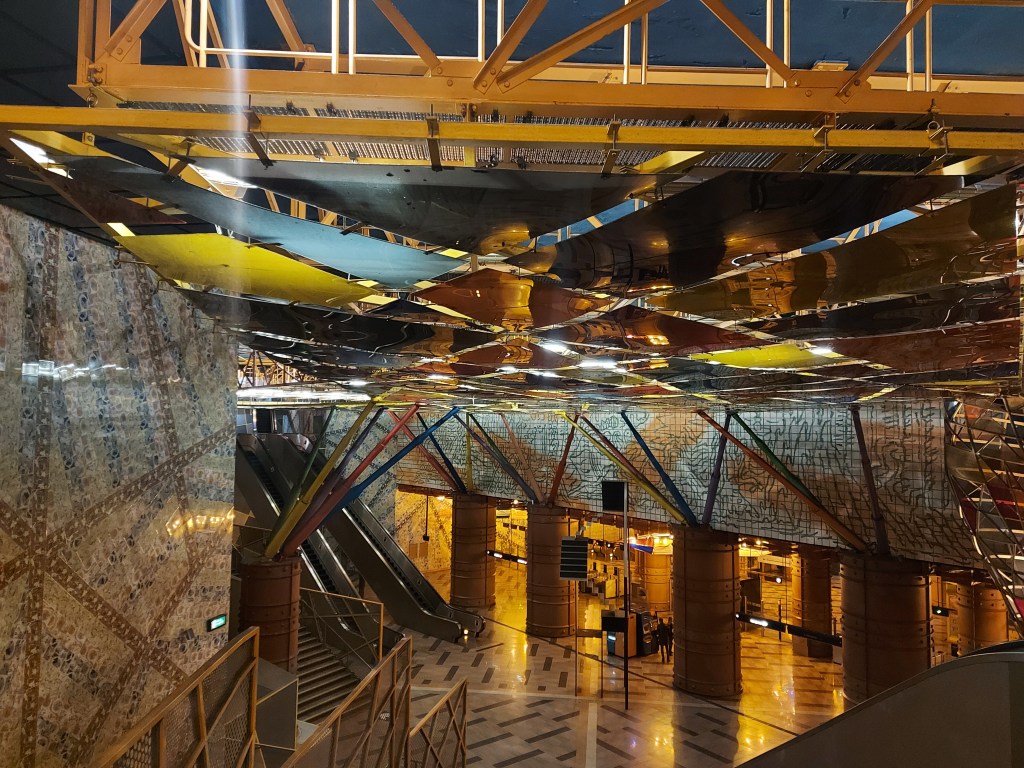
While sat on the train heading towards the city centre proper, I started reading about the architecture on the Lisbon Metro, and how the Linha Vermelha (Red Line) that I was riding on was home to some of the most wacky and impressive architecture out there. It just so happened that I looked up from my phone as we pulled into Olaias station, and I stepped off to have a wander.

Tomás Taveira certainly hadn’t done half a bad job at designing this place, along with the plethora of artists responsible for the various installations. The fact that the security guard didn’t seem to bat an eyelid at the pale-faced Brit wandering around aimlessly and taking pictures, seemed to suggest that I wasn’t the only one who enjoyed wacky Metro station art.

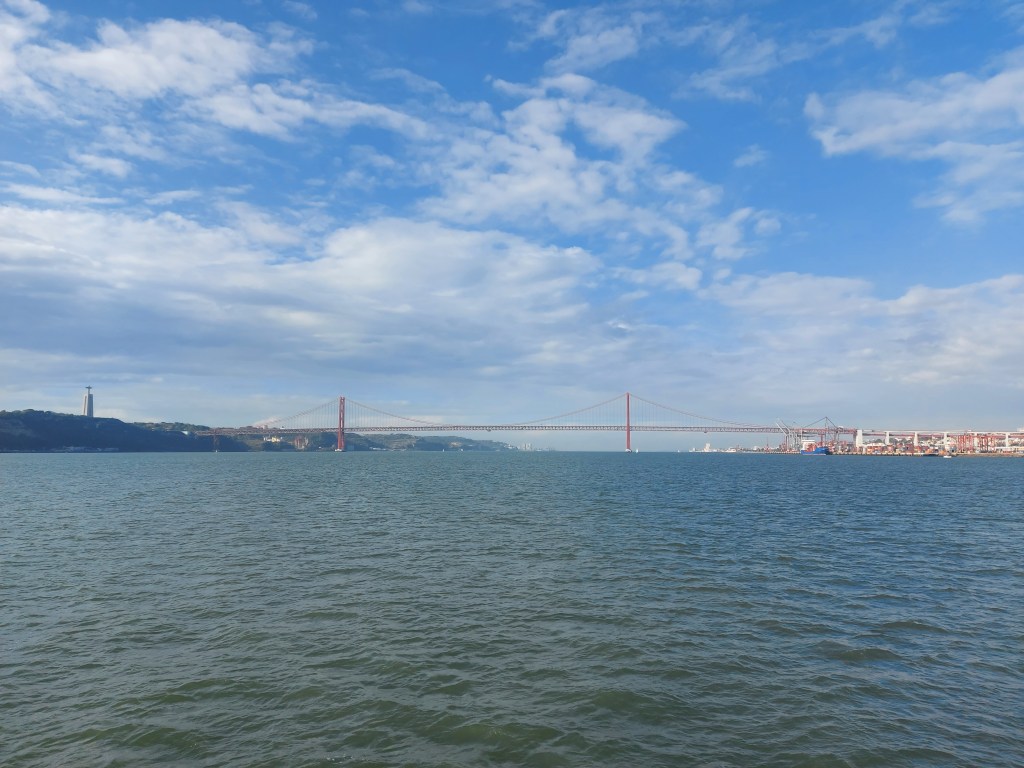
Back on the rails, I took myself to the ferry terminal at Cais do Sodre and hot-footed it (after some furious pressing on a ticket machine) for the boat across the Tagus to Cacilhas. Prior to the opening of the Ponte 25 de Abril (then called the Ponte de Salazar, but renamed following the Carnation Revolution) in 1966, the predominant way of accessing Lisbon from the south was on one of these ferries, albeit to Barrieiro, which was one a vast rail terminus for destinations such as Faro and Evora.

The boat itself was somewhat careworn, but I was able to force the window down and enjoy the views downstream towards the aforementioned bridge and the Atlantic Ocean. Also visible was the Santuário de Cristo Rei, inspired by the statue of Christ the Redeemer in Rio de Janeiro.

Cacilhas itself was a world away from the cosmopolitan Lisbon, being dominated by cafes and market stalls (and some really fucking dusty roadworks), as well as the terminus of the Metro do Sul. This small tram network links the communities on the south banks of the Tagus to the Fertagus railway line, which provides the overland link to Lisbon across the Ponte 25 de Abril. The fare was dirt cheap (85 cents!) and I was taken to Corroios station in good time for my (very very busy!) train to Sete-Rios.

Having successfully completed a loop around the Tagus, I took myself to the centre of Lisbon proper, towards the Praça do Comércio. This beautiful and expansive square, which hosted the assassination of Carlos I in 1908, is somewhat what of a most peaceful affair in current times, aside for the rumbling of trams and the throngs of tourist groups. When I was last here, aged 17, I also had the pleasure of being offered weed by the world’s most obvious drug dealer.

Much wandering later, it was then time for me to embark on the second half of the adventure back towards Porto, albeit along a much slower (and scenic!) route via Caldas da Rainha.

I retraced my steps back to Sete Rios, which conveniently hosted a large branch of Lidl, sufficiently supplying for me for the rest of the day and night. It was at this point that I realised I had misplaced my day pass, so I begrudgingly purchased a single ticket to Mira Sintra-Melecas, which serves as an interchange between the bustling Lisbon suburban network and the…quirky CP Regional trains. My journey necessitated a change along the way, as only trains to (the much more popular and beautiful) Sintra passed through the centre of Lisbon, with the hourly service to Mira Sintra-Melecas coming from the Rossio terminus.

By the time I made it to the end of the line, it was patently obvious just how thin the utilisation is of the railway in rural Portugal, with just four of us crossing over onto the second-hand Spanish train taking us up to Caldas da Rainha. One other quirk of the Portuguese ticketing system is that when you purchase an e-ticket, there’s absolutely no need to show it! One flash of my passport and a rather delighted sounding “Aaah, Richard!” was sufficient on every train, with the conductor merely checking who had purchased a ticket.

The route was single-tracked and rather slow but my lord, it was beautiful, even if my connection onwards to Coimbra was seemingly broken by the train coming the other way being late.

Of course though, this is rural Portugal, and we don’t really play by the rules here. There was an overwhelming feeling that the driver was driving either right on or above the speed limit for much of the rest of the journey, with the train lurching and groaning around the many twists and turns. The conductor, too, was keen to have us away from the many deserted rural halts almost as soon as we were stopped. Suddenly, my connection had gone from zero minutes to nine, and I jumped off at Caldas da Rainha in search of my connection, choked from the stench of diesel that this 40-year-old box of a train was emitting.

Having tried to find some sort of information screen, I began to panic only to realise that the only train taking on any sort of passengers was…the one I’d just alighted. Let the diesel-induced headache resume.

YOU again?

We had now gone from being a regional train to an “InterRegional” train, setting off for the inventively named Coimbra-B under the setting sun and subsequent cloak of dusk. The conductor, who seemed completely unfazed that I had just re-appeared again in a different part of the train, asked my name again before I went for a wander around the train and realised just why Portuguese Railways seem to be having a financial crisis after 26 seconds.

Nobody uses the fucker! Fares are dirt cheap too (this entire trip around half of Portugal was possible for less than 50 euros) but the sporadic nature of services away from the main Faro-Lisbon-Porto corridor and the urban networks means that people aren’t exactly enticed out of their cars. Heck, not to mention the train itself, which was built in 1981 for renfe (Spanish National Railways) and only ended up in Portugal due to a chronic rolling stock shortage. Portugal also has a tendency to remodel old stock as far as they can possibly stretch it, meaning that most of the trains running around date from the fifties, albeit with a facelift.

Even as we closed in on Coimbra-B, I had the run of the carriage, and only half a dozen people left the train with me. 2021 was the European Year of Rail, yet Portugal seemingly has some catching up to do.

Back to the sightseeing, Coimbra-B is named as such because it’s actually half an hour’s walk from the city itself, with “Coimbra” being the main station on a short spur off the mainline. Unfortunately, due to the timetable being somewhat wild, I needed to use my legs if I wanted to do any last-minute wandering. This was easier said than done, because Google Maps started trying to send me down various underpasses and subways to dodgy looking corners. The first 10 minutes of the walk were less than salubrious and subject to the mercy of the throngs of traffic coming at you from all directions. I was wondering why I’d even fucking bothered as the rain started to come down.

Thankfully, it turns out Coimbra is rather pretty at night.

Barbican Gate, Coimbra. The hill was almost as steep as trying to get up Conduit Road in the morning!

I did however only have around 45 minutes, so having picked up some beers for the train back to Porto, I made my way to Coimbra (proper) station for a local train to take me the literal two minutes to Coimbra-B, where I joined my Intercidades train up to Porto-Campanha. These slower, but cheaper trains are formed of classic French carriages and I quite enjoyed sitting back and necking back those beers, reflecting on what an amazing 48 hours this had been. I was even in such good spirits that I even tried to help an old geezer get his luggage off the train!

It was then a short hop to Porto Sao Bento, where I had started this adventure. I pre-loaded my smartcard with a ticket for the bus in the morning, and headed back to the hotel where I mentally faced up to the fact that tomorrow’s alarm was even crueller.

A few hours later, at THREE in the fucking morning, I arose and decided to be cocky by walking ever-so-slightly further to the terminus of the Nightbus in by the City Hall. This worked out absolutely fantastically, as I realised that not only could I not find the bus stop apparently being alluded to by Google Maps, but that if I wanted to reach a stop I was familiar with, I needed to leg it back up the hill to Trindade, weaving my way through the jolly drunks.

The bus turned up, full of said revellers, and the driver wasted no time in getting us to the Airport. I sat up front, mildly in awe, mildly in terror, as he was sending pissing WhatsApp voice notes to the group chat as he did around 40mph through residential streets with one hand on the steering wheel. That said, I can’t lie, he did make pretty good time.

We reached the Airport for around 04:30, and having got myself through security, I settled down for a Pastei de Nata and a coffee, contemplating what sort of Duty Free I fancied buying myself when it opened at 05:30. Heck, it was cheap too, as I picked up various local liqueurs (including some absolutely gorgeous sour cherry Mariquinhas) and a bottle of Douro red wine with change from 30 euros. Word of advice, avoid the “local” shop opposite, which sells exactly the same stuff for even more money.

Having been stamped out of Portugal, I waited for the flight home, which was called for boarding at around 06:30. Sleep certainly wasn’t difficult to come by either.

It had been an incredible weekend, so much so that I booked flights to Madrid and Bordeaux for the following one. And, we all know how fucking dreadful that went, don’t we?

To Portugal! #1

Following my escapade to Canada and the realisation that travelling to another continent wasn’t quite so bad, I embarked upon a slightly less crazy adventure to Portugal in November 2021. This also followed the further relaxation of rules for travellers returning to the UK, meaning that a cheaper Lateral Flow test was only required on your return from the vast majority of countries. The rules differ at the time of writing.

I had actually booked this trip with the realisation that my Ryanair voucher, obtained as a result of COVID-19 causing my travel plans to Slovakia in April 2020 to be nothing more than a mere fever dream on an alternate timeline. I was after somewhere warm, somewhere reasonably cheap and somewhere I knew I would love. So, a return flight from Birmingham to Porto for less than a tenner cash had me sorted, with it being around £120 for three nights in the Ibis Mercado Bolhão.

I set out on the Thursday morning, somewhat half asleep from my late shift the night before, in the direction of Manchester, due to it genuinely being the cheapest option to have somewhat of a jolly around the North West and Midlands before reaching Birmingham. I spent the early part of the afternoon gandering at the Christmas Markets, getting lost in Bullring and ending up tipsy after one pint in a Spoons due to my infallible ability to neck half a pint before the food even rocks up.

Birmingham Airport very much gives off the impression that it was put together gradually by a group of random men all named Gav and Steve on a Wednesday afternoon and gradually extended on subsequent Wednesday afternoons with the potential for some heavy drinking in between. As I made my way through the cramped and narrow security queues, I eventually ended up at another queue for my flight which had managed to completely block off an entire corridor. After making it to the front of the queue, having been asked “got yer vaccination proof innit?”, we were all in a bit of a huddle and sat around in this rather flatpack looking departure lounge.

I do pity anybody who actually paid for priority boarding on this flight, considering that half of the lounge had decided to queue down the stairs to the tarmac without even being told to. The eventual call for boarding was a man stood at the other side of the lounge shouting “Uhhh priority boarding please….ahhh uuhhh everyone else go whatever”, to which there was something resembling a stampede, due to everyone’s undying enthusiasm for standing at the bottom of some stairs outside of a plane in the freezing cold.

Studies show that this is indeed a plane. EI-EGD, to be precise.

I took a more leisurely pace, pausing to take a photo of my first Ryanair plane in nearly three years (I think my last flight was from Stansted to Basel-Mulhouse-Freiburg-Istanbul-to-Constantinople in January 2019) before being delighted to see that I had an entire row to myself, which meant that I could have a perfect groggy eyes nap. We were quickly away on time, meaning that I could eye up the last of the sunset over the delightful Brum before that aforementioned very refreshing and not at all disorienting nap.

We landed in Porto slightly early, with the mandatory klaxon and slightly pissed-off sounding Irish woman informing us that over 90% of Ryanair planes landed on time, which in general is the entire purpose of an airline making a schedule in the first place. Passport control was next, with my passport being pushed back at the officer followed by a curt reminder that he needed to stamp it now (glory to Brexit, or something like that).

All that was left for me to reach Porto proper was to have a fight with the ticket machine (which wouldn’t accept my 20 euro note) and dash onto the incredibly busy line E Metro, which was headed for Trindade, one stop short of where I actually wanted to be at Bolhao. How convenient. The Metro itself is more of a heavy-duty tram of sorts, being not the most frequent rapid transit system I’ve ever used but most certainly clean, safe and punctual. Do note though, that tickets are somewhat complicated at first glance, with the price you pay for a day pass being based upon the various zonal rings that surround your starting point and the number of zones you’ll need to pass through to get from your origin. Hence, a two zone ticket covers two zonal rings from the Airport, and so forth.

A thankfully painless change at Trindade later, I was out of the station at Bolhao and face-to-face with the rather majestic Capela das Almas (Chapel of Souls).

The 15,947 tiles of this building were actually only affixed to the Chapel in 1929, there being mere whitewashed cladding beforehand..!

It was only a few minutes to my hotel, where I checked in and settled in for the night, planning my moves for the morning, being keen to get myself up to the city of Braga under the cover of darkness in time for sunrise. On that note, it was also time for some well needed bloody sleep.

The morning actually had me feeling rather refreshed, as I took a short stroll down to Porto Sao Bento station, which sees regular “Urbano” trains to the likes of Braga, Guiamares, Aveiro and Marco de Canvases. There’s also a handful of InterRegional trains that’ll take you beyond Marco de Canvases right through to Pocinho, through the beautiful Douro Valley. I was of course heading for Braga this morning, having picked up one of the limited-stop peak services, which provided a…not very thrilling trip north. It was dark, what else can I say?

Braga station is situated a few minutes from the Arco da Porta Nova, which lies at the western entrance of the Medieval city walls. The arch was opened in 1512, though its current design is significantly more recent, being the brainchild of André Soares in the late 18th century. This was certainly a fitting start to my wander around the somewhat chilly and very deserted streets of the old town.

The Eastern façade of the Arch

I proceeded to spend a good hour both shivering (which would soon turn into sweating after the sun broke through) and enjoying getting myself lost in the endless alleys and narrow streets of Braga, all the while doing this in almost complete solitude.

Chafariz da Praça da República

In case there was any doubt as to where you were…

As the sun truly began to break through, I made my way back towards Porto, being hemmed in on the train by throngs of schoolkids and deciding to jump off the train at Nine (that is, Neeenyeh, not NEIN) for an InterRegional service that was soon to join us from Valenca.

Well, I say it was “soon” to join us because come departure time, it was decided that the train was suddenly five then 25 minutes late, then the platform was changed, then the locals started booting off with the Stationmaster, and I was quite frankly wishing I’d just stayed on the Kiddiewinkle Jamboree. Eventually, my luxurious train, consisting of two French-built Corail carriages hauled by a similarly French-esque “broken nose” locomotive screeched into the platform, with there being only a few seconds for me to jump on before we were off again. At least I had two seats to myself.

Still, I guess it was only 2 euros…

I jumped off at Porto-Campanha, it now being time for me to get my teeth stuck into both Porto and some fucking food, due to me apparently having an aversion to every shop in existence and progressively starving myself as the morning went on.

I took the Metro to Jardim do Morro, being situated high above the Douro and requiring a trip over the upper level of the Luis I Bridge, there also being a lower deck for cars and other such automobile-esque contraptions. The bridge was inaugurated in 1886, with an earlier single-deck design by Gustave Eiffel in 1879 having been rejected due to the rapidly growing urban population at the time.

It was here that I eventually managed to sit and eat something resembling food, and decided that the cable car down to the banks of the river sounded like a bloody good laugh. In fairness, I was entirely right, as I proceeded to get lost not only within the gift shop but managed to annoy the bloke at the bottom after telling him “eee hey I look like a rabbit in headlights, nee thanks” in reference to the souvenir photo of myself I was offered.

The south bank of the Douro is dominated by throngs of restaurants and winemakers, the city of course being the home of Port wine. I did originally toy with the idea of doing some wine tasting, before deciding that I didn’t fancy falling down the many hills of the city and gravely injuring myself. I did however take great pleasure in accidentally bumping into a tour group and enjoying the sight of Bordalo II’s Half Rabbit.

Contrary to many scientific beliefs, the average rabbit is not 30ft tall and made of twisted metal and plastic. Your experiences may vary.

I took myself back up to some dizzy heights on the cable car, taking a stroll over the bridge and winding my way around the edge of the north bank of the Douro, eventually ending up at the terminus of the old-school tram line.

This was without a doubt very popular indeed, quite the ask for a tiny tramcar. I managed to get myself jammed in at the front, watching behind the driver as the traffic would dodge and weave around us, greeted only by the passive-aggressive bell and some sudden braking. A trip on the tram will set you back 3,50EUR, and it isn’t included with the usual day tickets for the bus and Metro. It’ll drop you at Passeio Allegre, just a short stroll from the beachfront.

Yes, this photo was taken in fucking November.

Having made my way along the promenade to the Praia do Carneiro, I decided it was time to head back into the city and get myself some more food, though I was begrudged to pay extra for the privilege of the tram. I ended up waiting at the world’s worst bus stop, located just outside of a Newsagent down a narrow alley, whereupon various old men would take pleasure in stopping right in the bus stop to retrieve their Portuguese takes on The Sun or Bild or whatever it is they so fancied. As such, my bus just stopped in the middle of the road and the driver let me do the legwork. This took me to Matosinhos, for a connection to Line A of the Metro.

Of course, the best thing about McDonald’s abroad is the ability to swig back a beer with your food, and that’s exactly what I did next, because hey, when in Rome. Or Porto, as it happens.

Câmara Municipal do Porto. Complete with one of those weird cone-shaped Christmas trees

Having made the most of the food and charging sockets, I took a stroll back out and onto the Metro towards the town hall (Câmara Municipal) before taking an about turn towards the Douro. There was one thing I’d been told prior to my visit, and that was that sunsets on the Douro are some of the most beautiful in the world.

And how fucking right they were. In the knowledge that not only were temperatures were set to drop, but Covid restrictions would likely soon be creeping back in, throngs of people descended on the Ponte Luis I and Jardim do Morro to watch the sunset.

As a band started playing, I sat myself down to witness the last flames of the November sun extinguish beneath the dusk to the chorus of a bit of what was probably rather romantic-sounding Latin tunes. Unfortunately at this point, I realised that I was evidently the only single person in the vicinity, and took myself to my local branch of Pingo Doce for some wine and supplies.

The next task was planning how the hell I was going to get to Campanha Station for 5:20 in the morning, considering that there was no public transport that early and that the walk was long, a bit dodgy looking and likely rather chilly too.

Still, that was a tomorrow problem. Tonight’s problem was finishing this delicious *hic* Vinho verde.

The Trip That Never Was

I arrived back from Porto last weekend deciding that it had been so successful, that I needed another trip this weekend. Oh what a fucking mistake that was.

This is the tale of everything going wrong all at once.

I booked myself on the cheapest route possible, which involved a Manchester-Madrid-Bordeaux-Manchester route, with a total cost of the flights being around £43. It was dirt cheap and while the hotel in Madrid wasn’t very cheap, I knew this was going to be good ol’ chaotic fun. It did however mean travelling there straight from work at 11pm.

Hence, when I finished my shift at 11pm on Friday night, my colleague gave me a lift to the station and I stood freezing my tits off awaiting the 23:27 service to Manchester Piccadilly, the last train west of the night. It was a few minutes late as it came straight from Nottingham and immediately went onto Manchester, but I was in good spirits as I cracked open a bottle of beer and watched us make up a couple of those minutes.

We then proceeded to lose all of them again for…seemingly no reason. We sat at a red signal for a while before wheezing into Piccadilly in time for me to watch the Airport train sail out shortly before 1am. Still, I could just powerwalk it for the 43 which was going to leave at approx. 01:01 from Piccadilly Gardens. I look into Slug and Lettuce, envious of those in the warmth sipping cocktails as I crossed over and stood in the shelter that provided absolutely no shelter.

FOUR buses going to Didsbury came and went before my bus sauntered in 20 minutes late, being covered in vomit and taking absolutely forever to get out of town due to apparently everyone needing to run for a bus right about the second that mine wanted to leave every single stop. My eyes were heavy by this point, as I’d been awake since 8am and was thinking about the wonderful nap that I was going to have on that plane.

I was dumped at the Airport for 2am and made my way to Terminal 1, only to find that security was closed and so I ended up using my backpack as a pillow and napping by the check-in desks until 3:45. For the next 90 minutes or so, everything actually seemed rather normal as boarding was called nice and early and I was on board my rather battered Boeing 737-800 to Madrid. It was a nice lightly loaded flight and I thought to myself how nice this would be for getting some sleep.

We absolutely pelted it down the runway but something felt amiss as I was violently jolted up and down as we gained speed, only to be flung forwards as the brakes came in and smoke appeared outside, with there being an apparent peasouper descending on Manchester. Either that or we were on fire.

It was established that we had “technical issue” and eventually we had to deplane and get on a bus to switch to another one. I was, shall we say, a bit pissed, but these things happen and I figured out that if we got underway quickly enough I’d be in Madrid before Midday. I ended up falling asleep as we started the taxi, only to be rudely awoken by “we need to return to the gate again, I’m not happy with this plane either”. I was now, really pissed.

I considered my options, as we were by now three hours behind schedule and the daylight I’d have in Madrid was ever-dwindling. The captain announced that “some of you want to be offloaded and that’s okay” which prompted me to look at my hotel booking. I could cancel it without penalty, so that was my decision made.

Other passengers started yelling at the crew in Spanish, which was really just uncalled for considering that Ryanair crew are not paid a penny while they’re on the tarmac, so they were dealing with people’s shit for no money at all. When Matteo, one of the cabin crew, had stopped being screamed at, I flagged him down and told him “I’ve had enough”.

He started off on his speech about how safety was paramount but I stopped him and said “no it’s fine, I just want to get off now and go home. It isn’t worth it anymore.”

Some discussions later, he took my details and was practically hugging me as he couldn’t apologise enough for the delay, which by now was getting on for four hours. It wasn’t his fault that we’d been given dud planes.

I was asked to go and sit up front before being escorted onto a bus with four other passengers. One of them took a particular liking to me and we had a good chat while he told me I had a “comedic voice” (tired me reverted to sarcastic Geordie). Turns out that we both like to travel though while he spends his time in the Ritz, I spend mine in the Ibis drinking 2,99eur Vinho Verde.

Once I was back into arrivals, I looked at the wall of cancellations on the trains, thought deeply about how many complaints we were going to have on Monday morning, then legged it for the 43 and retraced my steps. Instead of walking around Madrid, I was looking at the arse-end of Wythenshawe next to a man with several missing teeth who smelled vaguely of weed.

Where did it all go so wrong?

Obituary to Lockdown #3

I remember banging in March 29th and 30th as rest days at work, giving myself a nice long stint off as mere speculation that the world would look slightly more normal. So, when I found out that the stars had aligned and that my first day off would be the first day that non-essential travel was technically permitted, I suppose you could just call me Mystic Meg.

That all considered, I’d be lying if I said I was up fresh as a daisy come that promising Monday morning. Having finished the late shift the previous night, I had decided to indulge in some rather strong stouts (Vocation’s Imperial Kirsch is to DIE for) and so I opted for a wee dram of lying in before heading for the door at around half 10.

The bus into Newcastle was didn’t feel too different to the usual commutes throughout the now dead-and-buried lockdown. Granted, the shops still aren’t open in the same way. You don’t have the hoards running for £2 off in Primark (I say, as if I wouldn’t find myself wandering into TKMaxx after every early shift because that shirt definitely cost £85 RRP) nor do you have people descending on the pubs (as if I wasn’t sat in Revs in Cambridge the day before the November lockdown ordering two cocktails at a time a la Tier One) so three fellow passengers wasn’t much of a surprise. Newcastle itself however is slowly regaining some of its energy. The student population has been returning in dribs and drabs, finding solace in the restrictions in maybe-legal forays to Tynemouth Longsands, while others visit Boots and M&S, selling so-called non-essential items among the essentials.

I found myself in Poundland for some pens (to make notes on this, because I’m a tit who leaves the house with a notebook and no pen) which turned out to be absolutely naff and a little bit explosive, before making my way along to the rather windswept Newgate Street stop for the X10. The advent of extra-long coaches on this route necessitated the relocation of this service away from Eldon Square, though I was sadly cursed with a bog-standard bus for the trip to Middlesbrough this time. To my surprise too, even a wee while before departure, the bus was actually quite busy. Though, in actuality, busy refers to about 15 people. We picked up a singular soul at Gateshead before hitting the A19, or rather, a pile of roadworks at Testo’s Roundabout before wheezing our way to Dalton Park. God, I missed between lockdowns when someone decided to hoy National Express coaches on this route.

An entire Morrisons’ had apparently manifested itself there since my last visit as well as a British Gas protest, with someone getting off at the otherwise closed outlet centre for some reason before we proceeded to the apparently covid-infested Peterlee, where another hardly soul jumped off. In fact, the main in-demand destinations seemed to be Norton and Billingham, with Middlesbrough only being braved by the hardy few of us sticking around. My first impression though was at least some people appeared to be travelling too.

For reasons I can’t quite remember, I decided to order food on the McDonald’s App while on the bus, assuming that the 40 minutes I had between that and the train would be more than enough. Unfortunately I’d managed to make my desire for a 99p Big Mac (this blog not sponsored by Ronald McDonald) coincide with various local college students’ bizarre desire for a coke and nothing else. I ended up queuing still for 25 of those 40 minutes before sprinting down Linthorpe Road ramming fries down my throat and sitting on a bench at Middlesbrough station trying to inhale a Big Mac followed by a wrap, because fuck being healthy and/or not getting indigestion, right? I don’t think I’d actually been down here since 2014 when I recall leading an Australian woman out of the station for a bus to Nunthorpe and her giving me £5 “for a cuppa” afterwards. In hindsight, why the hell was a 15yr old the only person with knowledge of a town miles from where he actually lived?

One of the main things I was actually out to investigate today was whether the rail network had quashed the “essential travel only” message. As we found after the first lockdown (the strict boi, the OG), TOCs weren’t exactly in a rush to welcome us back, with Transport for Wales screaming about key workers only being allowed on board well into July. So, I was pleasantly surprised not to have this messaging blaring over the PA at Middlesbrough. I was even more pleasantly surprised to see a whole four carriages on the 1323 to Saltburn, with my memories of this line being the screeching of an old Pacer train bouncing around the corner and braking with such force and noise so as to leave the entire platform with a ringing in their ears, followed by an announcement from the worst automated PA on the planet declaring that the train was for “RedcarCentralRedcar, EastLongbeckMarske…and Saltburn”.

There wasn’t exactly a lot of folk waiting on the platform, with there being around half a dozen per carriage, but it was better than a few weeks prior when I seemingly had the run of a service across the Tyne Valley. The guard was pacing up and down checking that everyone was in the right coach (a couple of stations were a bit wee for a four carriage train) as we left, then it was time to be reminded of how almost Soviet this line felt.

You suddenly find yourself surrounded by a mixture of disused, mothballed and somewhat operational factories, complete with the overgrown platforms of the disused Grangetown Station, thus resembling the likes of Magnitogorsk or Norilsk. Yet, they’re juxtaposed by the distant sight of the Moors on your right, home to the either adorable sounding Newton-under-Roseberry or vulgar sounding Hole of Horcum, providing a slither of green behind the disused Tata Steel (ex-Corus) steel plant with its own dedicated British Steel Redcar station, which until being mothballed in 2020 saw four trains per day, despite access out of the site itself being at best difficult and otherwise impossible. Teesside Airport station, at one time the least used station in Great Britain, located on the same line at the Darlington end shared a similar fate, though at least I’d managed to visit that one in 2015, being baffled at the fact that there was a literal dogwalker in the terminal building.

British Steel Redcar also acts as some sort of border between industrial Teesside and the leafier side of Cleveland Suburbia, as we approached Redcar Central with a good dozen or so passengers being exchanged. Redcar brought back memories of going out with my Dad back in his courier days 15 years ago, his patch being Eston down to Staithes, as we would deliver to the GAME store there. It’s also got a very pretty stretch of seafront, despite the appearances as you trundle over the level crossing and look towards the Morrisons on one side and the bleak-ish town square on the seafront.

The train had barely even pulled away from Redcar Central before we stopped at East and Longbeck, with suburbia breaking off and your view on the left turning into industrial units while the right side was actually rather pleasant with the Moors reappearing once again, interrupted only by the sight of the “Long Beck” signalbox controlling the crossing there.

Saltburn was eerily quiet. Of course though, the area in front of the old station was mostly occupied by independent shops, forced to stay shut for another fortnight. In fact, the various “Wear a mask, don’t make me ask” affixed to the lampposts in the vicinity felt a wee bit hostile, considering that wearing a mask as you bumble down the street has never been a thing in the UK. From here, I was hopping on the bus to Whitby, which was successfully done after an argument with the driver about whether or not my pass was valid.

The trip out of Saltburn is rather scenic from the off, with the dramatic descent of Saltburn Bank towards the beach being followed by an uninterrupted run all the way to Staithes where we hit the Moors proper. I left the X4 by the West Cliff, deciding to brave the winds along the seafront before settling on a bench on the corner overlooking the Abbey away from the blasts of a strong westerly. For the first time in months, I felt quite content in myself, with Casper’s “Aschregen” singing of Dreh’ das Radio laut, fahr’ zum Hügel hinauf (Turn the radio loud, drive up that hill) in my ears. I felt a little bit more free, despite Whitby once feeling like a mere trip around the corner, even once popping to Prague as a “self-care” interlude not really being anything ground-breaking. Even the fact that I’d been able to go to Norway in Summer 2020 and hang out in a strangers’ home was a fever dream.

January & February were particularly dark months, both figuratively and literally. I existed to work and to be asleep and/or drunk. To be able to sit in the sunshine on a bench 70 miles from home somehow felt like more of an expedition than being rocked to fuck in turbulence on a 13hr flight to Singapore, all the while with a toddler shaking my seat and screaming.

Following this minor realisation of contentment, I descended into Whitby itself, which would have ordinarily been absolutely heaving in such weather. It was actually still reasonably busy though, with Magpie’s doing a decent trade and a fair throng of folk heading towards the Abbey of Dracula fame. I myself couldn’t face the hike up the hill however and instead headed for a couple of alcoholic drinks and dinner from Co-Op, taking the time to even mention this fact to a colleague who was beginning a nine-hour shift as I cracked open a Lone Wolf & Tonic (this is a great gin by the way).

For some stupid reason I was dreading the 16:00 train to Newcastle which was usually the school train, despite the fact that it was the Easter Holidays and Whitby station lay silent, in much contrast to June 2015 when I braved this train and witnessed the conductor practically whip the kids into shutting up. Instead, I found myself sitting at a table, cracking open a drink and watching a kid wave us off (after a seven minute delay due to the train deciding it couldn’t be bothered to gain power).

The Esk River meandered to our left as we similarly wound our way out of Whitby into Ruswarp and Sleights, the conductor sticking her head out and trying to get us quickly away in an attempt to make up time. For some reason, I have scant memories of this line, having only been down it twice (and somehow having been up some railway lines in Japan more times), but it is genuinely very pretty for much of the way to Middlesbrough and usually very busy in the summer season. Instead, for today, there was just three of us on the whole train. But, with the sun shining, a nice tipple flowing and the scenery rolling by, there was little reason to complain. Even when the delays mounted due to a steam train (yes really) getting in our way, everything was just okay.

Middlesbrough soon came with a few dozen passengers more, followed by Newcastle and a good few miles of the Durham Coast in between, followed by bed as I was to be heading for Sheffield the next day. Certainly, people weren’t flocking in their droves back to public transport and to travelling around the region, never mind the country as a whole, but there was something rather liberating about making that first journey. I personally want to see the industry bounce back sooner rather than later, getting us back on that trend of passenger journeys heading ever upwards. Though, the reality may be somewhat different, with the daily commute in particular from the Home Counties into London being dead as a doornail. That said, I don’t really miss being stood on an short-formed Thameslink train and having to shove someone back onto the platform at Farringdon after they ended up kneeing me in the balls in the process of attempting to somehow board.

I spent the following two nights stuck waiting for, or aboard, delayed trains down the East Coast Mainline, at Doncaster and Durham respectively, but somehow it wasn’t as much of a stress as before. The ability to go somewhere is enough even if you’re stood by the door looking pensively into the March evening and wondering when you’ll actually be able to get to bed, not caring because you’ve just been able to drunkenly lie in a park with your two best friends.

Here’s to things getting better x

Europe, Round One. (Part Two)

Having woken up the next morning, I decided to embark on a wee walking tour of Prague before things got busy. I was based not far from the old town, by the Nový Smíchov shopping centre, and so it was a short ride there on the Metro from Andel station. The Prague Metro is very much an ode to the 1970s and 80s, with refurbished Russian-built trains operating on two of the lines, and the stations often being very deep underground. That said, it’s cheap (around £0.80 single for a 30 minute journey, £1.05 for 90 minutes) and trains are clean and frequent.

It was already getting warm as I did the usual thing of wandering over the Charles Bridge and around Wenceslas Square, though there were few folk around at 7am on a Sunday, apart from a police officer who wanted a cigarette lighter. He didn’t take too kindly to being told no! After my legs had said enough is enough circa 8am, I took myself through the infamously rough park outside of the main station and boarded a service to Hradec Králové, which was formed of a rather long rake of carriages with old-school compartments.

This was where I started to trip up, as I marched along to the first class carriage to find little slips in all of the reservation holders that declared “Express Reservation” which I thought meant that the entire carriage was reserved rather than that reservations were possible, and I ended up slumming it in second class for the journey. It was an awfully social affair as around six of us squeezed into a compartment and conversation was certainly flowing. Well, not with me, as I spoke absolutely no Czech at the time (and even now, it’s still pretty limited!)

Having no real plan for the day, I then hopped aboard a local service to Pardubice, which was situated on the mainline towards Ostrava/Katowice/Warsaw and Brno/Bratislava/Budapest. The first service out of there on my arrival was the EuroCity “Metropolitan” to Budapest, first stop Brno, so that was my natural destination. I managed to get myself a seat in first class this time, and this was to be my first taste of proper European dining on a train. Flagging down the host, I paid around £3.50 for a bowl of goulash and a pint of beer, as the train did no more than 50mph, hugging the Svitava River for most of its journey.

When I arrived in Brno, it was a bit of a hike into the city proper, though I can’t exactly recall why as Maps would have you believe that you spill straight out into the centre. It’s certainly a pretty place, like a Prague in miniature, with a Chronometer marking the resistance of the city against Swedish invasion in 1645. I ended up being lazy on the return and catching the tram back to the station, where I was intending to travel down to Břeclav, right on the southern tip of the country, bordering Slovakia and Austria.

However, when I boarded the railJet service bound for Graz, it was absolutely rammed, so I gave up on that idea and crossed over onto an imminent departure for Plzeň. Not a bad plan I thought, until I brought up the timetable and saw that it was a six hour journey with two locomotive changes en route. It would be 8pm by the time we wheezed and spluttered in. The first stop was 45 minutes away in Náměšť nad Oslavou, so I unceremoniously hauled myself off there, relieved to see a stopping train ready to go back in the other direction.

It wasn’t all bad though, as the scenery was pleasant enough and the trains were peaceful enough. After about 40 minutes or so, I left the train at Brno Horni Herspice station, to the south of the city, for a connection to Břeclav once and for all. The issue with this station though was, well, the lack of it. There was a rather abandoned looking station building and an assortment of narrow slipways that were the only thing protecting me from the crack Berlin-Budapest expresses, and no real information on which one of the 10 or so tracks my train would stop at.

Thankfully, the train did at least arrive, and it was just a case of looking both ways and running across the tracks before climbing up onto the train. I spent most of the journey stood at the back, watching the tracks and scenery disappear behind us, before realising that it was getting on for 4pm and that I needed to be back in Prague at some point today. Hence, it was straight across the platform at Břeclav onto a train for Staré Město u Uherského Hradiště, and onwards to Olomouc, completing a sort of loop around the country. The first train’s conductor was the most miserable man in existence, pushing my Interrail pass back into my hands as I tried to show it. A jolly young lass covered in tattoos with neon pink hair brightened things up later on. There is still very much a divide between staff who’ve joined in the past few days and old hands from the communist “Statni Drahy” era.

The final train of the evening was to be a service from Warsaw, with its’ only First Class carriage being absolutely rammed full, so I headed all the way to the back of the train for a rather beaten-up open carriage that was completely empty at least, giving some lovely views of the sun dropping as we ate up the miles back towards Prague. I ended the day in Tesco once again, sipping a couple of beers in my hotel room as I planned out the next adventure.

I was up early the next morning and in a rather foul mood as the long days were making hangovers worse than ever. This morning I was travelling on the SuperCity train back towards Olomouc, the intention being to sample what was the “premium” service in the Czech Republic. One feature of this service is the fact that everyone is served a sparkling glass of Bohemia Sekt, no matter what the hour of the day is. So, being incredibly clever, I necked some of that wine at 7am before I’d even eaten anything. Thankfully, something resembling breakfast followed shortly afterwards.

It wasn’t a smooth journey at all. We ended up slowing down and stopping for around an hour en route, due to a person being hit by a train, made incredibly obvious by the literal body bag slumped by the tracks. That wasn’t exactly a good start to the day and my stomach wasn’t appreciating the Sekt breakfast. On arrival in Olomouc, I saw that my connection to Puchov (SK) was also delayed by about 45 minutes so I’d be down an hour later on. While I was pondering this, an old man decided to fall down the station escalator so I found myself vaulting over a wall to kick the emergency stop while other folk made sure he wasn’t too injured. As you can tell by my slightly sarcastic description of him, he was unhurt.

Eventually the EuroCity bound for Žilina arrived and I was screamed at for daring to sit in First Class by the bloke on the buffet counter. While it was a pretty journey across the border, all of the staff on board had attitudes like they were trying to start an argument with somebody and I was glad to be off in Slovakia to the echos of “STANICE- PUCHOV!” as I awaited my connection to Bratislava hl.st. It was a fairly calm trip and pretty easy to forget, as the rain fizzled out in time for arrival in the Slovak capital. However, it would be another year before I would visit the city itself, as I had a brisk walk over for a train to Devinska Nova Ves, purely to kill an extra 10 minutes as the Vienna train would be following behind afterwards.

I made a slight error leaving the train here, as I blindly opened the door on the left hand side and ended up stepping straight into the middle of a busy, active freight yard rather than onto a platform. Thankfully, this being Central Europe, I just stood back from the train and gave the driver a thumbs up to depart, the stationmaster being completely unfazed by me appearing from behind a moving train. The train to Vienna pootled in behind, and I had soon dumped my bags before catching a local train to Wien Mitte station for a spot of dinner (ie McDonald’s) and went for a wander.

All I can say is wow. I suddenly felt very at home in the warm summer sunshine roaming the pristine streets and milling around the likes of the Volksgarten, with different rosebushes being named after nominated people. There was even a film festival going on across the road, so I had myself a beer and soaked up the atmosphere. I was especially pleased that after a couple of days, I’d be back here for a second time.

The next morning, it was an early start as I caught the train back to Bratislava followed by a Rychlik (fast) train across to Leopoldov, essentially retracing my steps partway from the previous afternoon (the line to Leopoldov then continuing towards Puchov and Žilina). The connection to Nove Zamky was awaiting across the tracks, and so naturally we all jumped down and climbed back up onto the other platform. This was a faff and a half of a journey, with it being advertised as terminating at Lužianky where there would be a connection. In fact, when I jumped off at Lužianky, I found that the train merely connected to another portion and continued onwards, so I sheepishly jumped back on board.

That wasn’t the end of it though, as we in fact terminated at a station called Ivanka Pri Nitre, for a replacement bus to Komjatice, a couple of stations down the line. Usually, a replacement bus service is a farcical affair, but the Central European approach is quite efficient. All of the train-crew abandoned the service and caught the bus with us, which raced down the road to try and keep time with the train timetable. The same had been done in reverse with passengers going the other way, meaning that an abandoned train was awaiting us at the other end, which we all jumped aboard, having lost two minutes on the usual schedule.

We then arrived in Nove Zamky where I could have joined the EuroCity train to Budapest but instead caught the Osobni Vlak (stopping train) to Komárno for a rather unconventional way of crossing the border. It was a short trip to the end of the line behind a rather antiquated Czechoslovak locomotive, with the presence of the border being rather obvious as indicated by the bilingual station signage at Bajč/Bajcs and Hurbanovo/Ogyalla.

I now had around an hour or so to stroll over the border, on foot. I stopped en route at a Spar for a couple of drinks, and took in the rather charming little town. Once, this had formed a hard border between two Communist bloc countries that weren’t exactly enamoured with the Soviet Union, lying at the confluence of the Danube and Váh rivers. It would be the Danube that I crossed, having attained a few suspicious looks for photographing the Slovak side of the town. It was a rather eerie crossing, with the abandoned border infrastructure lying silent, and me being the only pedestrian walking over into Komarom, a rather less aesthetically pleasing place as I walked down a side street into Komarom Station, over a rickety bridge and onto a platform awaiting the twice-daily train to Esztergom.

This was an odd one as it stopped at many stations, all of them deserted, yet still complete with stationmasters giving the driver the right away, though it seemed to be the case that most were jumping in their cars and going elsewhere, just popping in to wave their batons. The names were also rather uninspiring. After all, who decides they’re going to pay a visit to Tat? Hungary has gone through a phase of closing lines like these, but some are reopening again after only a couple of years after a great deal of backlash. Hence, it was me, myself and I hugging the south bank of the Danube and arriving into Esztergom.

You can actually cross the river here into Sturovo, the border station between Slovakia and Hungary on the crack expresses between Prague and Budapest, but the station itself is a far kilter out of town, being on the line that instead crosses into the town on Szob (pronounced Shob) on the north bank of Danube. Thankfully Esztergom has plentiful trains to Budapest, and it took around an hour to reach Budapest-Nyugati.

I spent the evening on the banks of the Danube, taking in the absolutely gorgeous architecture of the city. Budapest surprised me as it was actually not dissimilar to Vienna, rather than the down-at-heel Central European capital you’d expect. It was clean, cheap and had an excellent public transport system, being around £3.63 for a day pass that would get you on anything. I ended the day by catching the Metro to Kobanya-Kispest, complete with giant Tesco, for some supplies.

The next day, I actually wasn’t really using my pass at all, instead heading up to the Budapest Childrens’ Railway. This was a legacy of the communist era that’s continued into the present, with it being equal parts impressive and a little bit weird. No doubt, back in the day, it was a good way of getting yourself in good kilter for a job on the big railway. It wasn’t terribly difficult to reach, being on the hilly Buda side of the city but linked by regular tram services. I rocked up in time for the first service of the day, and was served in perfect English by the only adult in the ticket office, before boarding the train.

Before the service departed, the children all lined up on the platform and seemed to say some sort of pledge of allegiance to working hard for the railway and doing their best that day (I’d imagine that back in the day it was to the Communist Party of Hungary!) We then departed, and my conductor can’t have been more than about seven years old. It was slightly adorable having this wee kid, fully adorned in a smarter uniform than his adult counterparts at MAV-START, turning around to me and barking “Következő megálló…!” everytime we pulled into a station. All other things aside though, it was a gorgeous little run along the hillside with views of Budapest through the trees.

A connection was then made down the hill by using the Cogwheel Railway, which is every bit as bumpy as it sounds. Just imagine an ancient clunky Metro-type train bouncing you down a hill a little faster than it probably should, and that’s the Coggy. I spent the rest of the morning exploring the city some more before having a spot of lunch and then catching the Szemelyvonat (stopping train) out to Vac. This is a pretty little town not too far out of Budapest, lying on the banks of the Danube, and it was a nice little break from the hustle and bustle.

Having taken in the scenery, I boarded another stopper back into Budapest, the conductor trying to tear my pass in half in the process. There was only one thing left to do really, and that was to climb the Citadella. This is an old fortification lying at the top of Gellért Hill, which these days provides a gorgeous viewpoint over the city. In 1956 though, it was used by Soviet-led troops to overthrow the Nagy-led government of the time. I of course wasn’t going to walk up the hill, and caught the adorably tiny bus around the winding streets up to the top, taking in the marvellous views and ignoring the people selling ludicrously expensive bottles of beer.

The next morning soon beckoned, and I was off to Nyugati Station to catch the 06:28 fast train to Debrecen. The train was actually continuing to Zahony, on the Ukrainian border, but several hours at what felt like jogging pace was enough for me in one go. I had a rather battered compartment to myself for the first hour or so to Szolnok, with the conductor being completely befuddled by my Interrail pass. An old man then joined me up to Debrecen, and this is where my faith in humanity went up a little. He clearly wasn’t well off, but having watched me neck the last of my water, he pulled out a 2L bottle and handed it over. He knew I didn’t know the words in Hungarian to thank him, but he seemed unbothered. It was just the done thing to share with others.

Debrecen was a beautiful wee city, with the centre-point being the vast “Debrecen-Nagytemplomi Református Egyházközség” or Reformed Great Church, fronted by a statue of Lajos Kossuth, the Statesman and revered orator who spent his life at the forefront of the fight for Hungarian Independence. It was however rather quiet, as the trams seemed to be off, with a few being parked, rather trustingly, not far from the church. Aldi and SPAR were a little further on, so I stocked up on supplies before the rather long walk back to the station and embarking on a wee loop around the rest of Eastern Hungary.

I joined the 11:53 fast train to Zahony as far as Nyíregyháza, where I’d just missed the train bound for Miskolc. I’ve no doubt that the town itself is very pretty, but due to the immense heat and the fact that it was at least 20 minutes into the centre, I spent my 59 minute waiting time in the air-conditioned station hall. The train was only going as far as Szerencs, and my god it was even more ramshackle than the last. I climbed up from the platform and slumped into the brown leather seats that would have passed for a British Railway carriage circa 1960, and hung out of the window at waist height for most of the journey, taking in the breeze as we didn’t seem to get much above 40mph.

The train from Szerencs to Miskolc was much the same, except there was a belching old Diesel Loco at the head. That said, I encountered much the same issue with Miskolc-Tiszai Station, in that it was absolutely miles from the much-renowned city itself, and with time getting on, it was then time to head back to Budapest and take in one last view of the Danube before it was time to move on the next morning.

I didn’t have a particularly good start though, as my 06:40 RailJet to Vienna didn’t manage to get anywhere, having broken down before departure. Much to the bemusement of the passengers, the conductor insisted on only explaining the issues in Hungarian, with the message gradually filtering through in German from my fellow travellers that the locomotive was zonked. Thankfully, the 07:40 service did bother to work, and we departed an hour behind schedule.

I’d booked a Business Class upgrade for this leg all the way through to Graz, which was only an extra 10EUR for a private compartment with a massive seat that was essentially a lie-flat bed. The scrambled eggs and mushrooms on toast (extra cost) were alright, though a wee bit sloppy for my liking. That said, Budapest-Keleti doesn’t exactly have many other food options, so you’re better off just having whatever’s on offer on the train. It was then an easy enough transfer onto another train in Vienna, this being a Czech RailJet that was the 04:40 from Prague, complete with a different Business Class that had me sat opposite (albeit a fair distance away) a bloke who promptly moved himself elsewhere.

It was a beautiful journey over the Semmering Pass, though the weather was starting to close in as we descended into Graz, and I realised that I had about an hour and a half to give the entire city a fleeting visit. Such was the rain, all I can remember is that it was rather pretty but I was becoming evermore frustrated with lugging my bags everywhere and getting soaked! Hence, jumping on the train to Spielfeld-Straß was somewhat of a relief. Less of a relief was the fact that my train over the border into Slovenia was now a bus!

It didn’t take any longer, certainly, but it was rather strange being dumped in a new country without using my legs or the train. What would Maribor have to offer?

To be continued.

Design a site like this with WordPress.com
Get started